

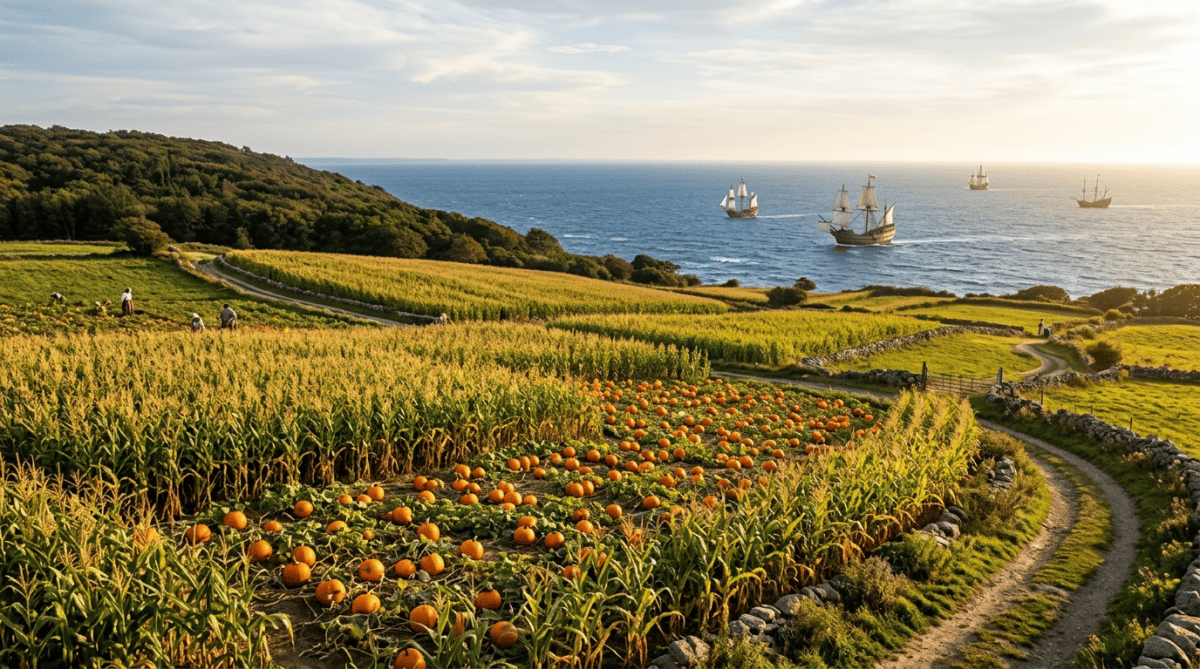
Reasons to Be Thankful
My mother was Cherokee.
Because of that, Thanksgiving has always felt a little different to me than it seems to for some people.
Like most Americans, I grew up hearing the familiar story. The Pilgrims landed at Plymouth. They barely survived their first winter. Native Americans helped them, and everybody sat down together for a harvest feast. There’s truth in that story. What took me years to understand was that it wasn’t the whole story.
As I got older, I found myself wondering about the people on the other side of the table. We spent plenty of time talking about the Pilgrims, but not much time talking about the people who helped them survive. What happened to them? Where did their story go?
One of those people was Squanto.
The version I learned in school made him sound like a friendly Indian who appeared at exactly the right moment to help the Pilgrims. The real story was a lot harder than that. Years before the Pilgrims arrived, Squanto had been kidnapped by English traders and sold into slavery. He was carried across the ocean and spent years far from home. Along the way he learned English and became familiar with the customs of the very people who would later settle New England. When he finally made it back home, he discovered that disease had devastated his people. Much of the world he remembered was gone.
Yet somehow, after everything he had been through, he chose to help strangers survive.
That has always struck me as remarkable.
The Wampanoag people shared far more than a meal. They shared knowledge, skills, food, and experience. They helped newcomers survive in a land the newcomers barely understood. Without that help, there is a good chance Plymouth Colony would not have survived. Four hundred years later, we’re still talking about that meal, and I think we should. There is something worth remembering about people who look at strangers in need and decide to help.
Unfortunately, the story didn’t end there.
More settlers arrived. More land was needed. More promises were made than could be kept. The people who had helped the newcomers gradually found themselves losing control of their land, their future, and their way of life. What began as cooperation slowly became something else. The balance of power shifted, and it never shifted back.
That’s the part of the Thanksgiving story many of us never learned.
Maybe it stayed with me because of my mother’s Cherokee heritage. Maybe it stayed with me because of my grandfather. Probably both.
Some of the most important lessons I ever learned came from him on a farm. He wasn’t a man who sat people down and announced he was about to teach them something. He just lived his life, and if you were paying attention, you learned. He taught me to respect hard work. He taught me to respect the land. Most of all, he taught me that everything is connected.
On a farm, you figure that out pretty quickly. The weather matters. The soil matters. The seasons matter. If you take from the land year after year without giving anything back, sooner or later the bill comes due. Those lessons stayed with me long after I left the farm.
Years later, living in the mountains of West Virginia, I found myself thinking about those lessons again. Funny how that happens. You spend half your life thinking your grandparents were talking about one thing, then discover they were talking about almost everything.
I remember having a wart on my hand when I was a kid. My grandfather looked at it, took my hand in his, held it there for a minute or two, and told me it would be gone in a day or so.
Damned if it wasn’t.
To this day, I don’t know whether that was mountain wisdom, luck, or something else entirely. What I do know is that he left an imprint on me that lasted a lot longer than any wart.
My mother’s people had their own chapter in this country’s history. The Trail of Tears wasn’t something that happened to strangers. It happened to Cherokee families, including mine. Generations have passed, but history leaves marks. Some of them never completely disappear.
Maybe that’s why I’ve never been able to see Thanksgiving as just a holiday about turkey, football, and pumpkin pie.
When I think about Thanksgiving, I think about generosity. I think about courage. I think about people helping other people through hard times. But I also think about memory. I think it’s possible to be grateful without pretending the painful parts of history never happened. In fact, I think gratitude means more when it’s honest.
The older I get, the less interested I am in simple stories. Life isn’t simple. History isn’t simple. Most things worth remembering aren’t simple.
The Pilgrims deserve to be remembered for their courage. The Wampanoag deserve to be remembered for their generosity. The hardships Native people endured afterward deserve to be remembered too.
Those truths belong together.
As I’ve gotten older, I’ve found myself returning again and again to something Henry David Thoreau wrote:
“I am grateful for what I am and have. My thanksgiving is perpetual. It is surprising how contented one can be with nothing definite, only a sense of existence.”
That speaks to me.
These days, I’m grateful for my family. I’m grateful for my friends. I’m grateful for the lessons my grandfather left behind and for the Cherokee heritage that came to me through my mother. I’m grateful for the people I’ve loved, the mistakes I’ve survived, and the fact that I’m still here to appreciate any of it.
A lot of good people I knew never got this far. Some died young. Some died suddenly. Some just ran out of road before I did. The older I get, the more aware I am that every Thanksgiving is a gift I wasn’t guaranteed.
Most of all, I’m grateful enough to remember the whole story, not just the comfortable parts.
To me, that’s what Thanksgiving is all about.
Read more of my stories here:https://danielbrookssanders.substack.com/


Leave a Reply