Wavy Gravy Was Born Today

Some people arrive in this world like a whisper. Wavy Gravy showed up like a marching band that took a wrong turn and decided to stay.

Born on this day in 1936, back when the world was still in black‑and‑white, he somehow grew into one of the most colorful human beings to ever wander through the American story. Hugh Romney was the name on the paperwork, but the universe had other plans. It needed a jester. A peacekeeper. A clown with a conscience. A man who could talk down a crowd of 400,000 hungry, muddy, half‑mad festival‑goers at Woodstock with nothing but a microphone and a grin.

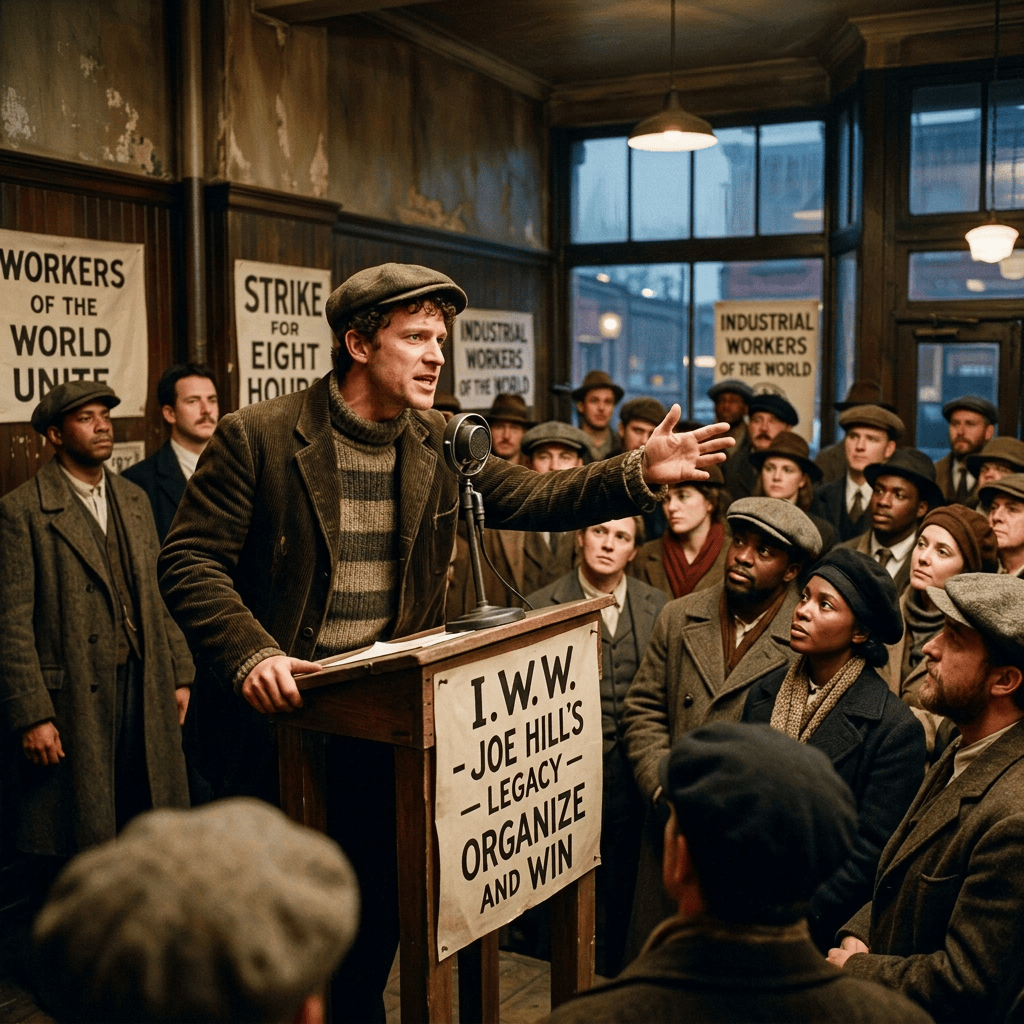
He fed people. He calmed people. He made them laugh when they were ready to break. He turned compassion into a kind of performance art, and he never stopped believing that humor could be a tool for survival. The Hog Farm, the Seva Foundation, the endless parade of red noses and tie‑dye — it was all part of the same mission: make the world a little lighter, a little kinder, a little more human.

Wavy Gravy reminds us that you can take the work seriously without taking yourself seriously. That mischief can be mercy. That joy can be a form of resistance. And that sometimes the best way to keep the peace is to show up dressed like a psychedelic Santa Claus and tell everyone it’s going to be okay.

On the day he was born, the universe clearly decided it needed more color. And all these years later, we’re still living in the glow.

From Rambling Harbor, where the tide rolls in with its own kind of cosmic joke, I tip my hat to the man who proved you can change the world with a laugh and a ladle.

Leave a comment

This site uses Akismet to reduce spam. Learn how your comment data is processed.

FREE SUBSCRIBING

Some Thoughts and a Poem

I was just remembering the old Trump slogan “Drill, Baby, Drill,” and while I know a lot of folks are hurting because of the price of oil, I still think this: if there’s no earth left to drive on, the price of gas doesn’t matter.

Oil drilling harms the Earth in multiple, well‑documented ways, affecting land, water, air, wildlife, and the climate. The damage begins long before the first drop of oil is pumped and continues through extraction, transport, and burning.

Oil drilling isn’t just a technical process or an economic talking point. It tears open land that never asked to be touched, poisons water that once ran clear and leaves behind a kind of silence that feels heavier than sound. Every spill, every leak, every plume of smoke is another reminder that the earth absorbs more than we ever admit — and it remembers longer than we ever will.

That’s the ground my poem “The Scorched Land” stands on. It came from the moment I realized the planet isn’t just a stage for our mistakes — it’s a witness. A witness to the forests scraped away for access roads, the oceans slicked with oil, the air thickened by what we pull from below. These aren’t abstract harms. They’re wounds. And the earth carries them the way a body carries scars.

The poem lives in that uneasy space where anger and grief meet the stubborn belief that we can still do better. It’s not political. It’s personal. It’s the voice you hear when the world goes quiet enough for you to notice what’s been lost and what’s still worth saving.

If you’ve ever felt that shift under your feet — that sense that the ground itself is keeping score — then “The Scorched Land” is the part of this post meant for you.

And if you want the part of this story that doesn’t fit neatly into facts or headlines, it’s in the poem that grew out of all this.

The Scorched Land

When the last of us remain on this scorched land,
We will watch the ancient footage of our folly—
How we spurned the cries of nature and her hand,
How we slowly drained the lifeblood of this planet.

We will see the glaciers melt, and oceans rise,
We will see the forests burn, and deserts spread,
We will see storms, floods, droughts, and fires,
We will see the mass extinction of the living dead.

We will wonder how we could have been so blind—
How could we have let our greed destroy our home?
How could we have ignored the signs of our decline?
How could we have sealed our fate with a catacomb?

Leave a comment

This site uses Akismet to reduce spam. Learn how your comment data is processed.

Subscriptions don’t bite and they are free

The Diamond Sutra.

The Diamond Sutra is set up as a conversation between the Buddha and an elderly disciple named Subhuti. Two voices, one asking, one answering, both circling around the same old questions we still ask today: What matters? What lasts? How do we see the world without getting lost in it?

Some dates slip past us without a sound, and some carry a little echo if you stop long enough to listen. This one goes all the way back to 868 A.D., when somebody — a monk, a printer, a pair of hands we’ll never know — pressed inked wood against paper and created what we now call the oldest printed book with a publication date. The Diamond Sutra. Sixteen feet of teachings, questions, answers, and the quiet persistence of human curiosity.

The word sutra comes from Sanskrit and means “teaching,” but it’s more than that. It’s a thread, a line connecting one mind to another across centuries. The Diamond Sutra is set up as a conversation between the Buddha and an elderly disciple named Subhuti. Two voices, one asking, one answering, both circling around the same old questions we still ask today: What matters? What lasts? How do we see the world without getting lost in it?

The physical book itself was printed from carved wooden blocks onto seven long strips of paper. Each page had its own block, carved by hand, reversed like a mirror, every line a small act of faith that someone in the future would want to read it. Those seven sheets were pasted together into a scroll about sixteen feet long — a book before books were bound the way we know them now. Imagine unrolling that thing, the slow reveal of words that had already traveled further than most people of that time ever would.

And then, like so many things, it vanished.

For more than a thousand years the scroll sat hidden away in Turkestan, sealed up with hundreds of other manuscripts in one of the Caves of the Thousand Buddhas. A whole library walled off, maybe to protect it, maybe to forget it, maybe because someone thought the world was ending and wanted to save what they could. We’ll never know. What we do know is that in 1900, a caretaker sweeping out a cave stumbled onto a doorway that hadn’t been opened in centuries. Behind it: bundles of manuscripts, paintings, scrolls, and among them, this sixteen‑foot conversation between a teacher and a disciple.

I like stories like this. They remind me that the things we make — the words we write, the thoughts we try to pin down — have a way of outliving us. They get lost, they get found, they get read by someone a thousand years later who has no idea who we were but still feels the spark of recognition. A voice calling across time saying, “I was here. I wondered about the same things you do.”

Maybe that’s why I keep writing. Maybe that’s why any of us do.

SUBSCRIPTIONS ARE ALWAYS FREE

Leave a comment

This site uses Akismet to reduce spam. Learn how your comment data is processed.

I’m Nobody! Who are You?

I published my first book on March 5th. It’s called I Was There. I probably should’ve called it Who Am I, because it’s a memoir, and since I can’t hang a famous name on it, no one really cares. If I were a famous musician, actor, or politician, it wouldn’t matter if my entire memoir was just me sitting by a luxury pool all day sipping fancy drinks made by an impeccable butler — or better yet, a Butlerette in a miniskirt — people would be clamoring to buy it.

On Amazon, where my book is available, I’m competing with the likes of Maya Angelou, Malcolm X, and Trevor Noah’s mother, for God’s sake — all of whom have written memoirs. And that’s just naming the lesser-known ones, except maybe Trevor’s mother, though I suspect everyone but me knows who she is. I’ll add, with sincere condolences, that all are deceased, and underline that I am not willing to die for this book.

I have considered changing the name to something like Outlaw, rewriting it just a bit — not changing the facts, just throwing in more drama and sex. I could confabulate. In writing, confabulation is when you unknowingly fill in gaps with invented details because your mind wants the story to feel complete, smooth, or emotionally coherent. It’s not lying. It’s not embellishment on purpose. It’s the brain saying, “Let me tidy this up for you,” and slipping in something that feels true even if it isn’t. Then I could list my book under Autofiction, which could easily be misunderstood as autoerotica — and that should outsell Trevor’s mother.

A few weeks ago, I was talking to a good friend who’s also writing a book. Hers is about murder, and as I said to her, she has a better chance of gaining buyers because everyone knows what murder is. Along with not dying for this book, I’m also not willing to kill for it. And let me quickly add that my friend is not the murderess in her book either. Though I’ll bet she’s a killer in a miniskirt.

I also need to say my book is not boring. The folks who have read it have all been sincerely enthusiastic in their positive reviews. It deals with ten very turbulent times in my life — ten years when this country was an amalgam of ideas, movements, people, music, war, and yes, even sex. I was involved in some amazing moments with some amazing people, some known to history — people who, if they wrote a memoir today, would give Trevor’s mother a run for her money.

But you see, what I did, I did quietly. Not a lot of fanfare or fangirls or fantastic shenanigans. Maybe what I need to do now is go out and do something to call attention to myself. Maybe run for President on the WTF Party — that’s the What The Fuck Party — or maybe the LWRS Party, the Left Wing Radical Scum Party. You may have heard mention of that breed of human; I think they’re currently under investigation by the residents at 1600 Pennsylvania Avenue.

But the truth is, I never meant to make a splash with my book — not even in a luxury backyard pool with fancy drinks being served by a Butlerette in a miniskirt. I just wanted to tell my story to a few friends and family while there was still time. Part of the problem, I think, is that many of my friends thought I was writing a completely different book — probably about my hazy, crazy days in radio, which I barely mention.

If all of a sudden some major publisher caught on to my book, a major studio made it into a major and successful motion picture, and I suddenly had fame and fortune and miniskirt‑clad Butlerettes running around, I know I’d be looking for the nearest exit to the highest mountain I could find.

In short, I think maybe Emily Dickinson was right, and her idea fits my personality better.

Emily Dickinson wrote:

I’m Nobody! Who are you?
Are you — Nobody — too?
Then there’s a pair of us!
Don’t tell! they’d banish us — you know!

How dreary — to be — Somebody!
How public — like a Frog —
To tell your name — the livelong June —
To an admiring Bog!

Maybe that’s the whole point: I never wanted to be Somebody. I just wanted to leave a trail for the other Nobodies to follow home.

Leave a comment

This site uses Akismet to reduce spam. Learn how your comment data is processed.

Rating: 1 out of 5.

SUBSCRIBING IS FREE

Fashion or Conspicuous Consumption on Display

Maybe it’s just me—many times in cases like this it is at least mostly me—and before I go any further, I want to say I did not watch it. Instead, I watched the New York Knicks get some Boston Celtics revenge against the Philadelphia 76ers. But this morning the news is all over the event like bugs on a bumper, and the event I’m referring to is the Met Gala. An evening where individual costumes commonly range from $50,000 to $200,000, the Met Gala is officially known as the Costume Institute Benefit. It exists to financially support the Costume Institute of the Metropolitan Museum of Art. Unlike other Met departments, the Costume Institute is self‑funded. According to reporting summarized by The New Republic, the Met Gala has raised approximately $166.5 million over the past decade—an average of about $16–17 million per year. What makes this arrangement striking is not simply the sum raised, but the structure behind it: the museum collects the revenue while the immense aesthetic costs are absorbed by designers and luxury brands. The result is an event framed as philanthropy but sustained by a logic that more closely resembles high‑end advertising.

In the end, watching the Met Gala felt less like witnessing fashion and more like staring straight into the neon heart of conspicuous consumption. All that glitter, all that theater, all that money draped over people who can barely walk in it — it hits me like a scream I can’t quite swallow. Maybe it’s just the guy in clean jeans and a sweatshirt talking, but there’s something grounding about clothes meant to be lived in, not displayed like trophies. And standing in the shadow of all that gaudiness, I’m reminded how far spectacle can drift from anything that feels real.

Leave a comment

This site uses Akismet to reduce spam. Learn how your comment data is processed.

SUBSCRIBING IS ALWAYS FREE

Pete Seeger

Pete Seeger was born on May 3, 1919, in New York City. He became a legendary American folk musician, songwriter, and activist whose long career made a significant impact on music and social movements. Seeger wasn’t just part of the folk revival — he was one of the engines driving it. In the 1940s and ’50s, most of America listened to crooners and big bands. Seeger was dragging a long-neck banjo across union halls, college campuses, and picket lines. He taught people that folk music wasn’t a museum piece. It was a living language of protest, hope, and ordinary people trying to make the world a little fairer.rer.

When he joined The Weavers in 1948, the group became a kind of Trojan horse for social change. They took traditional songs — work songs, spirituals, Appalachian ballads — and smuggled them into the mainstream. Their version of “Goodnight, Irene” hit No. 1 in 1950, and suddenly millions of Americans were humming a tune from the Black folk tradition. That was Seeger’s quiet genius: he made the radical feel familiar.

But success painted a target on their backs. The early 1950s were the height of the McCarthy era, when suspicion was a national pastime, and anyone with left‑leaning politics was treated like a threat. Seeger had been outspoken about labor rights, racial justice, and peace — long before it was fashionable — and that made him an easy mark. The Weavers were dragged into the anti‑communist hysteria, labeled subversive, and effectively erased from radio and television. Concerts were canceled. Record contracts evaporated. Their career didn’t just stall; it was deliberately strangled. Seeger was subpoenaed by the House Un-American Activities Committee in 1955. He refused to name names or apologize for his beliefs. He did not hide behind the Fifth Amendment. Instead, he told Congress he had a right to sing for anyone he pleased. It was a bold act of conscience, and it cost him dearly. He was indicted for contempt and blacklisted for years.

Even after these setbacks, Seeger stayed active in music. He wrote and made famous songs like “Where Have All the Flowers Gone?,” “If I Had a Hammer,” and “Turn! Turn! Turn!” These songs became important for civil rights, labor, and anti‑war movements. His version of “We Shall Overcome” helped make it a key song in the civil rights movement.

Seeger was also a committed activist beyond music. He worked for environmental causes, especially the cleanup of the Hudson River, and remained involved as he aged. He inspired artists like Bob Dylan and Bruce Springsteen to continue his tradition of songs about social issues.

Seeger died January 27, 2014, at 94, but his songs and beliefs continue to inspire. He believed music could unite people.

Leave a comment

This site uses Akismet to reduce spam. Learn how your comment data is processed.

SUBSCRIPTION ARE FREE

May Day.

May Day shows up every year like an old friend who never knocks, just walks in and expects you to know why they’re there. It’s a day with more identities than most of us manage in a lifetime — workers’ marches, ancient bonfires, maypoles, the whole spring‑is‑coming‑whether-you’re-ready-or-not business. A strange mix of protest and petals.

Long before it was a date on a union calendar, it was the halfway mark between the equinox and the solstice, a reminder that the world keeps tilting toward the light even when we’re not paying attention. People lit fires to chase off whatever darkness they believed in. Maybe they weren’t wrong. We still carry our own shadows around, and sometimes a little symbolic fire wouldn’t hurt.

In the labor world, May Day is the day people stood up and said enough — enough hours, enough bosses squeezing the last drop out of the last worker. It’s a day built on the idea that ordinary people deserve a life, not just a living. That message hasn’t aged a bit.

And here we are, another May 1st. No bonfires on the beach, no marching bands down the street, just the quiet truth that the year is moving whether we move with it or not. Spring is trying its best. The light hangs around a little longer each night. Even the air feels like it’s leaning forward.

Maybe that’s the real heart of May Day: the nudge. The reminder. The gentle shove from the universe saying, Get on with it. Dan would’ve liked that part.

So here’s to May Day — the ancient, the political, the personal. A day that asks nothing more than that we notice the world turning and decide, in whatever small way we can, to turn with it.

Leave a comment

This site uses Akismet to reduce spam. Learn how your comment data is processed.

NO CHARGE TO SUBSCRIBE

I Was There

There’s a moment, when you finish a book that came out of your own bones, where the world goes strangely quiet. Not peaceful quiet — more like the hush that settles over the harbor right before the fog rolls in. You stand there thinking, Well, I guess I really did this.

“I Was There” didn’t start as a book. It started as scraps — memories, radio nights, the odd corners of life that stick to you like sea salt. I wasn’t trying to write anything grand. I was just trying to make sense of the noise in my head before it drifted off like a gull that couldn’t be bothered to land.

But stories have their own stubborn tide. They kept washing back up at my feet. And eventually I realized I wasn’t collecting them — they were collecting me.

Now the thing is out there in the world, floating around on Goodreads and Amazon like a bottle tossed into the Atlantic. People can pick it up, shake it, hold it to the light, decide if they want to walk a few miles with me. Some already have. Some will. Some won’t. The tide doesn’t ask permission.

What matters is this: the stories aren’t trapped anymore. They’re free to wander, to be misunderstood, to be loved, to be argued with, to be read at 2 a.m. by someone who can’t sleep and needs to know they’re not the only one who’s lived through a few storms.

If you want to take a look, here’s the Goodreads page — no passwords, no secret handshake, just the book sitting there waiting: Click the little arrow on the left side of the Goodreads page under the word read and a drop-down will appear with the link on it.

https://www.goodreads.com/book/show/249304682-i-was-there

I’ve walked a long road to get here. Some of it was smooth, most of it wasn’t, and all of it ended up in these pages. If you decide to read it, I hope you find something in there that feels like truth — or at least something that feels like company.

The tide keeps moving. The stories keep coming. And I’m still here, walking the shoreline.

Leave a comment

This site uses Akismet to reduce spam. Learn how your comment data is processed.

NO CHARGE FOR SUBSCRIPTIONS

A valuable Lesson Learned

A valuable Lesson Learned Ramble.

Learning is valuable—about love, good people, and, unfortunately, bad ones: people lacking a crucial human quality. Some call it a heart, others a soul. As the Dalai Lama said, “Our prime purpose in this life is to help others. And if you can’t help them, at least don’t hurt them.”

I recently learned a hard lesson about self-publishing—not about the publishing itself,the ready-for-print part, the nuts and bolts of it: learning about print, color, page count, the spine the cover  and a weird little item called a widow, which is when a word gets left over at the end of a page and gets pushed to the next page. That was all difficult enough. Publishing, as a good friend who worked in the business put it, “Publishing is not for the weak of heart.”

Writing a book is hard, and writing about yourself is even harder, especially when recounting a story from 50 years ago. Living it nearly killed me; writing it nearly finished the job.

And then I finally got the book on Amazon and wanted to learn more about reviews and promoting my book, so I joined the KDP (Kindle Direct Publishing) community for writers. I soon learned that while 50 percent of those members are good and honest folks wanting to help a rookie writer, it is also populated by scumbag con artists who will scream death and destruction, and forever banishment from Amazon if you break the rules.

And while it is true that Amazon did get into some trouble a few years ago by allowing fake reviews, not just of books but on everything, from air fresheners to underwear, and for good reasons, they have tightened their review process. But it is not the death toll of you and your book if you unintentionally seem to cross the line. What Amazon does not want is for me to pay Jack and Jill to write a review that says Dan Sanders is the greatest writer since John Steinbeck or Charles Dickens. Even if it’s true, Jack and Jill need to decide thta on their own.

In the KDP community, while most folks are good and helpful, I ran into a few who responded with alarm, warning me I had made a mistake but offering to help. They never mention a fee upfront; instead, they engage in several emails before finally revealing a line like, “For a small fee, I can help you out.” One clue is that although many different names are involved, the emails all look like they came from the same cookie-cutter template.

I was so concerned that I asked my first reviewer to remove their review because it was from someone I worked with 40 years ago and haven’t seen since. A scammer claimed that if someone knows you, Amazon will suspect collusion, but I learned that while Amazon is strict, it isn’t unreasonable.

The main reason I wanted to write this is not to make a Mea culpa, but to warn others trying or considering self-publishing. I don’t want anyone to go in as I did—a lamb to the slaughterhouse. I believed everything would be good, but like any competitive profession, it can be underhanded and cutthroat.

Leave a comment

This site uses Akismet to reduce spam. Learn how your comment data is processed.

Rating: 1 out of 5.

My Book, “I Was There”

This book took years. Not because I was writing every day, but because I wasn’t. I’d circle back, pick up a thread, lose it again. Life got in the way. So did doubt. So did the internet. Heck, sometimes cleaning my kitchen had to take priority. Below are a couple of sections from two of the first chapters. The book is available in both paperback and Kindle formats. You don’t need a Kindle device or a special Kindle account to read my book. Anyone can read it on a computer, phone, or tablet using either the free Kindle app or the Kindle Cloud Reader, which opens right in your web browser with no download needed.

I hope you’ll enjoy the read. Those who have read it so far have told me how much they have enjoyed it.

From Chapter 2

“Several years earlier, I had begun writing letters to my draft board. Lyndon Johnson was still president, Nixon waiting in the wings. The letters weren’t meant for Johnson, but I imagined him reading them anyway—grimacing, maybe, before tossing them aside. The draft board wrote back a few times, reminding me I was deferred under 3‑A college status. Eventually, they recalculated me as 1‑A. Combat‑ready. And I welcomed it. You can’t refuse what hasn’t been offered. I was done hiding behind loopholes.”

From Chapter 3

Inside, the induction ceremony began. The room smelled of sweat. The air was thick with the breath of boys pretending not to shake. The recruiter’s voice was flat, rehearsed, like he’d stopped listening years ago.

“Please repeat after me…”

“I do solemnly swear…”

Repeat. Repeat? Hell, I could barely breathe.

“…that I will bear true faith…”

And suddenly I wasn’t in Whitehall anymore. I was back on the football field, hearing my coach yell, “Go in hell‑bent for leather, Little Sandy!” My dad was Big Sandy. The coach used that nickname to rile me up. Hell‑bent for leather — without fear.

My heart picked up the chant until it drowned out everything else.

Then came the words: Step forward.

I sat down.”

For the whole story, follow this link https://a.co/d/016lhY1F

Rating: 1 out of 5.

My Book Has Been Released

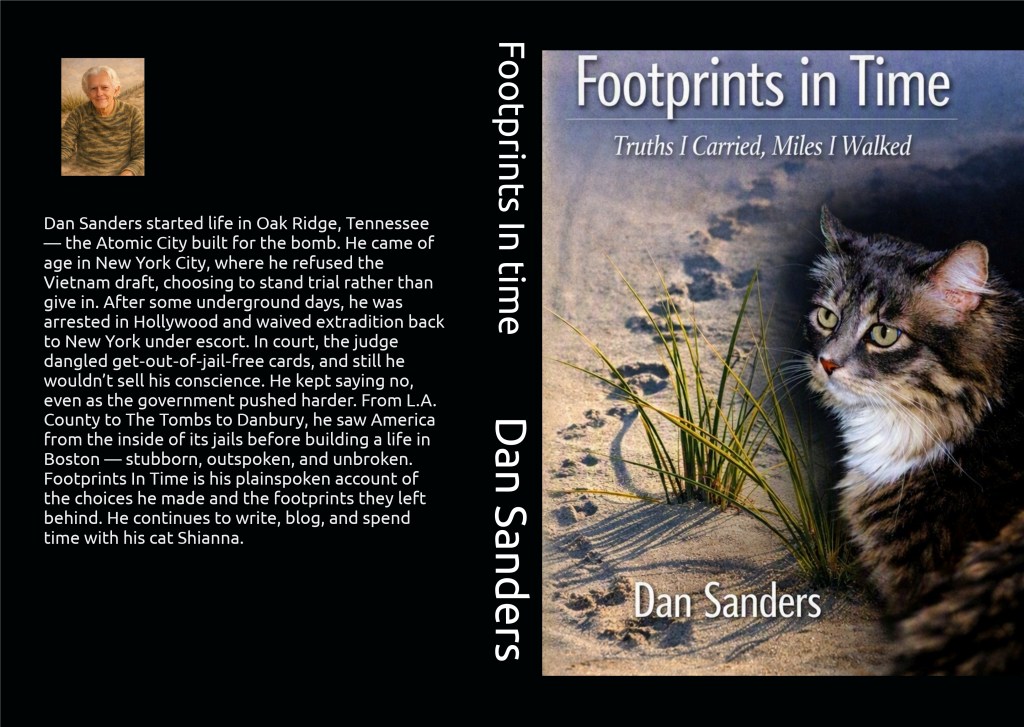
Dan Sanders grew up on Staten Island and learned early how to navigate the edges of things—family, faith, war, and the long road toward becoming himself. He spent years in radio, activism, and community work before settling in the Boston area, where he writes about the moments that refuse to stay quiet. He lives in what he calls Rambling Harbor with his cat, Shianna, and continues to tell the stories that shaped him, one honest line at a time.

The Road to “I Was There”

It didn’t happen all at once. It wasn’t a straight shot. It was a long road — with detours, breakdowns, and a few stretches where I didn’t touch the wheel at all.

This book took years. Not because I was writing every day, but because I wasn’t. I’d circle back, pick up a thread, lose it again. Life got in the way. So did doubt. So did the internet.

But the story never left. It waited. And every time someone asked — “Are you still working on it?” or “When’s the book coming out?” — it reminded me that I was still on the road.

So thank you. To everyone who kept asking. To those who read the early chapters, who saw the fog and the mountains and said, “Keep going.”

The book is out now. It’s called “I Was There”. Because I was. And now, so are you.

And who knows what comes next — maybe that’s the best part. Maybe even another book

follow this link to the Amazon page: https://a.co/d/01jMzMsm

About Me
I’m a dreamer with some rough edges, a word‑slinger, an actor, a picture‑maker, and a guy who hangs onto the stories that don’t always behave. I write from a small harbor shaped by memory, Boston weather, and all the quiet corners where truth sits down and refuses to move.
I Was There is one road I’ve walked. There’ll be others. There always are.

Leave a comment

This site uses Akismet to reduce spam. Learn how your comment data is processed.

Rating: 1 out of 5.

Rambling Harbor — Evening Edition Ramble AKA WTF Again

Tonight’s tide brought in a story I wish I didn’t recognize.

Evening settles over the Harbor like a worn jacket, the kind you keep by the door because it knows your shape better than you do. The light goes soft, the gulls quiet down, and the world finally stops shouting long enough for you to hear the small truths rattling around in your own chest. That’s when the news found me tonight — not with a bang, but with that familiar sting that comes when history gets pushed around like furniture someone’s tired of looking at.

Another round of funding carved out of Black museums. A Black heritage sign quietly taken down in Boston, as if memory itself were something optional, something you could tuck away when it makes the wrong people uneasy. It didn’t surprise me, but it sure as hell set something off — not a blaze, just that low, steady rumble from a place that’s been paying attention for too many years.

And this isn’t the first time I’ve felt that rumble. A few years back, I resigned from an organization I’d given time and heart to. Not because I heard the man say anything — I never did. This was all online, all at a distance. But then I read he was running for political office in Texas, and one of his proud public stances was opposition to what was then being called “critical race theory.” That was enough. I didn’t need a speech or a meeting or a debate. I just knew I wasn’t going to stay in a place led by someone who wanted to shut down the teaching of systemic racism and the harder truths of American history. If the truth makes you uncomfortable, maybe the problem isn’t the truth. So I walked. Quietly. Cleanly. And I didn’t look back.

And now here we are again, only the stage is bigger, and the stakes are heavier. Grants pulled from the Massachusetts Museum of African American History because the work doesn’t “align with priorities.” Heritage markers taken down like they were never there. Museums and cultural programs frozen out because they dare to tell the story straight. And the language is always the same — “divisive concepts,” “ideological concerns,” “restoring sanity.” Whenever politicians start talking about restoring sanity, you can bet they’re about to erase something.

It’s the same old dance: erase, rename, sanitize, repeat. Pretend it’s about budgets. Pretend it’s about neutrality. Pretend it’s anything except what it is — a slow tightening of the blindfold. And the people doing the tightening always swear they’re the ones protecting us from indoctrination. Meanwhile, the museums they’re defunding are the ones holding the receipts, the records, the stories this country has spent centuries trying to bury.

And what really gets me is the déjà vu of it all. I’ve seen this movie before. I’ve walked out of rooms — and online spaces — over it. And now it’s happening on a national scale, with institutions and memory and public truth on the line. Every time someone says “critical race theory,” what they really mean is “stop telling the parts of the story we don’t like.” Every time a sign comes down, or a grant disappears, they’re hoping the story goes with it.

So here I am, evening deepening over Rambling Harbor, the tide pulling at the edges of the day, and I’m thinking about how fragile memory becomes when people in power decide it’s optional. I’m thinking about how many times we’ve had to fight just to keep the truth in the daylight. And I’m thinking about how history isn’t fragile at all — but apparently some people are.

That’s the ramble tonight. The Harbor’s quiet, but the headlines aren’t. And somewhere out there, the truth is still trying to speak, even if someone keeps reaching for the dimmer switch.

From Rambling Harbor, I ask again: what do we do now?


Leave a comment

This site uses Akismet to reduce spam. Learn how your comment data is processed.

Rating: 1 out of 5.