On the morning of December 16th, 2017, I heard a small, weak, almost inaudible cry — the kind of sound that tells you something is terribly wrong.
A tiny soul was struggling for life.
My little white furry friend, who had been my happiness and my wife’s favorite, was very sick. She had been my emotional support for the six years since my wife passed away.
That day, Chloe Cat had to be put to sleep.
In a fit of grief and panic attacks, I all but wrecked the veterinarian’s exam room. Two friends who were with me explained to the staff what was happening, and the office simply said,
“Let him go. We understand. We’ll take care of it later.”
I have always had a cat — sometimes two — as a friend.
The emptiness of my home in the days after Chloe crossed the Rainbow Bridge was thunderous silence.
So I began searching the internet for a new friend. Not one who could ever take Chloe’s place, but one who might help fill the hole left in my heart.
Page after page.
Cat after cat.
Days and nights that seemed like years of tears.
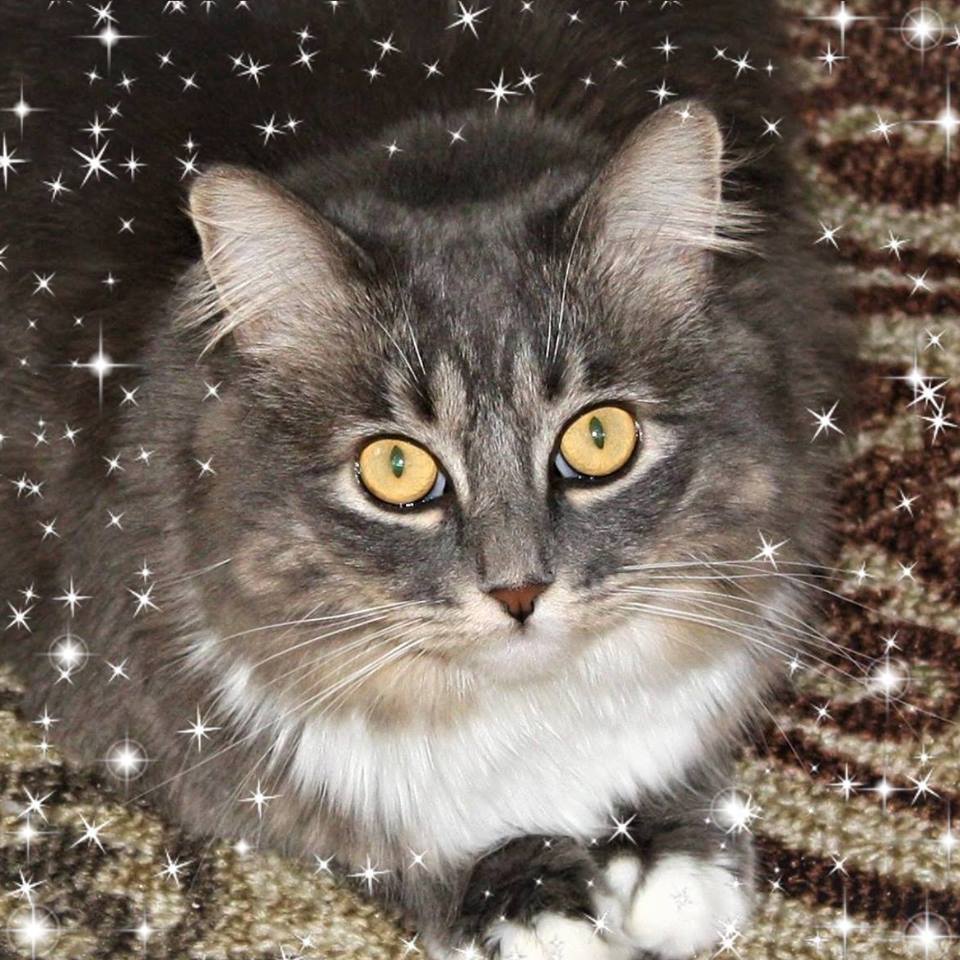
And then one day, looking up from the floor of an adoption center webpage, two great big eyes said,
“Hey, I’m here. Come and get me.”
I called the adoption center, and they agreed to come in the day after Christmas so I could visit this hopefully newfound friend.
A 50‑mile trip in sub‑zero weather in an old car I wasn’t sure would make it to the center, much less back home.
A rural road.
No GPS.
But I felt guided, and I made it there.
I was led into a room filled with cats of all sizes and colors, each one greeting me, purring, and showing off.
But the two big eyes I had seen online were missing.
When I asked, I learned she was hiding deep inside a treehouse, keeping to herself, not part of the crowd.
My first sign that we might be meant for each other.
I slowly reached into the opening of the treehouse, and the staff gave me a chair.
For at least an hour, I sat with my hand through the opening — speaking softly, but mostly not speaking at all.
Letting the unspoken thoughts and feelings that can only exist between humans and animals speak to both of us.
The adoption center people must have thought I was a bit daft, sitting there with just my hand in a cat treehouse.
But they didn’t bother me.
And then I felt it.
I knew this was my animal soul mate, my familiar.
I found the attendant and said, “I’ll take her.”
As I signed the adoption papers, I was told that if there was any problem — any at all — I could bring her back, no questions asked.
A red flag.
And the fact that she was already eight months old — another sign she had been returned.
She had also been hurt; the doctor’s notes read: severe wound, possible nerve damage.
Well, that went along with the shrapnel I’ve carried in my lower back for 50 years.
Two reclusive critters with nerve damage — tell me that’s not two souls looking for each other.
I had left my car warming. I loaded my new friend into her carrier, left the adoption center, and we began the long ride home.
I drove mostly with one hand, the other on her case, telling her the whole way how good things were going to be.
I still wasn’t sure we’d make it back to Boston in my sputtering old car.
But we did.
Once safely home, this little life spent the first part of the night hiding.
I found her behind the stove.
Once coaxed out of there, she spent the night under the bed, and I spent it talking to her through the mattress and trying to think of a name.
Many people don’t understand her name, which is, in some ways, the reason I’m writing this a few days before Christmas — besides the fact that she was adopted the day after Christmas.
If you say her name, you’d think it’s spelled Cheyenne, like the town or the Native American nation.
In fact, one time I overheard a friend tell someone who asked what kind of name it was, and the friend — knowing I am part Native American — said,
“It’s Native American.”
I didn’t bother correcting her.
Her name is a contraction of Shilo.
Shiloh was an ancient Israelite city in the central hill country north of Jerusalem. The meaning of “Shiloh” is debated — possibly related to a root meaning tranquility or peace. Some scholars propose a meaning connected to place of rest.
Either one is fine with me.
And Anna: she was a prophetess, one of the very few women in Scripture clearly given that title.
Anna appears only in three verses in the entire Bible (Luke 2:36–38), yet she stands as one of the most powerful spiritual figures in the New Testament.
And so, having found my new friend the day after Christmas, and somewhere in the middle of the night as I talked to her through the mattress on my bed, her name became Shianna.
Sometimes the gifts that matter most don’t come wrapped in paper or tied with ribbon.
Sometimes they arrive the day after Christmas, with big eyes, a wounded past, and a quiet way of saying,
I’m here.
This is the story of how Shianna found me —
or maybe how we found each other.









 Rambling Harbor
Leave a comment