

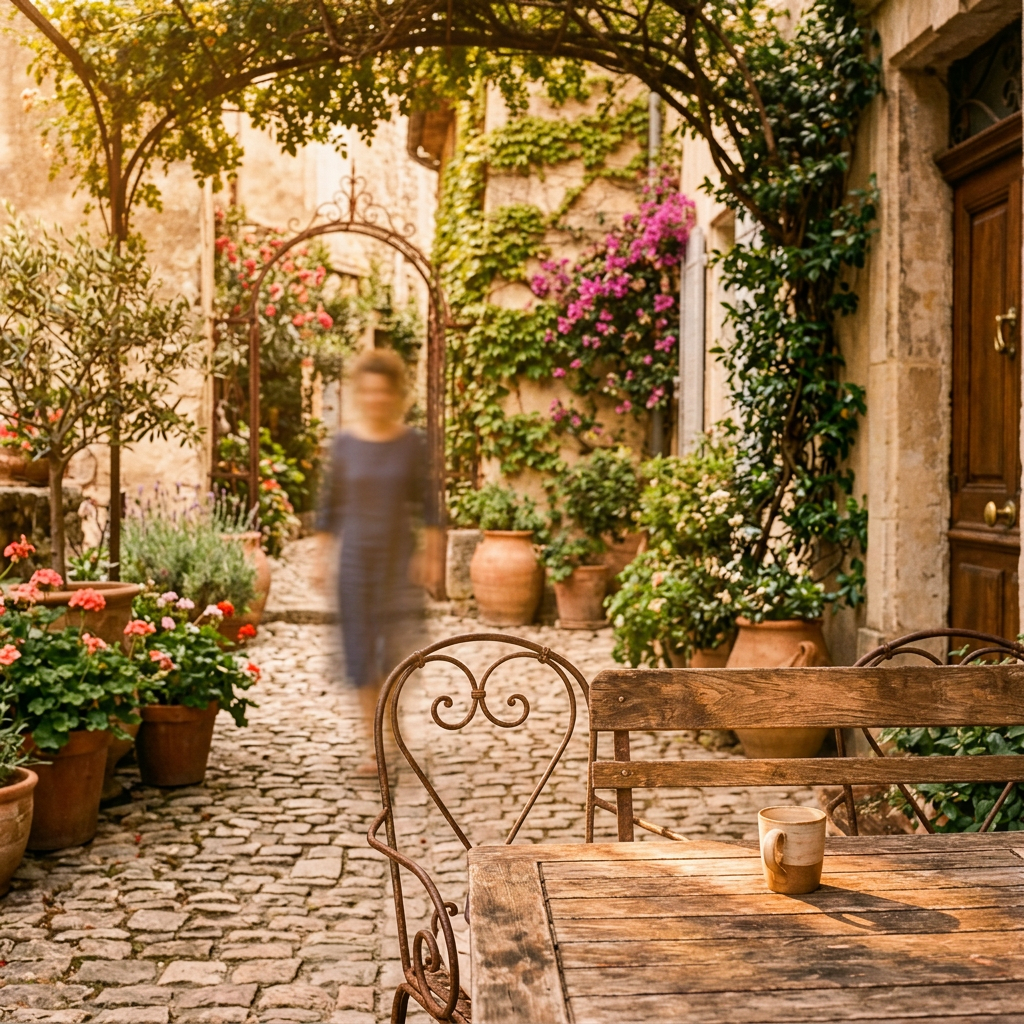
I was just out walking, minding my own business, when two women waved me over for a handful of blueberries. One was my neighbor. The other I’d never seen before. Lazara. And from the first hello, she had that thing — that quiet spell some people carry without trying.
She was beautiful in a way that didn’t announce itself with trumpets, just settled into you. Cuban Spanish beauty with a slow, smoldering warmth under the surface — dark eyes that held both kindness and a little danger. And with me, it’s always the danger that hooks first. Something in her eyes said she’d lived through storms and carried a few of them with her, and instead of warning me off, it pulled me in. That danger wasn’t for the world — it felt aimed right at me, the kind of spark that makes you lean closer even while some old part of your brain whispers you should know better. It’s the lure, the attraction waiting to be uncovered. Like she’d lived through storms and learned to move with them instead of running. Her skin had that sun‑warmed glow that makes you think of late afternoons on a beach you’ve never been to but suddenly ache for. And her hair — loose curls framing her face in a way that made you notice everything: the curve of her mouth, the softness in her cheeks, the quiet fire behind her eyes.
But it wasn’t just how she looked. It was how she moved. There was a natural rhythm to her, a confidence that didn’t need to be loud. She walked like someone who knew exactly who she was — steady, grounded, unhurried — and that alone carried its own kind of heat. The kind that sneaks up on you. The kind that makes the world tilt a little.
The afternoon sun was warm on my shoulders, summer air sweet enough to make you forget the news for five minutes, and suddenly the world slowed down like it remembered how to breathe. The goodness coming off her was unmistakable — quiet, steady, like light through leaves.
I didn’t know then that eight years earlier, in her thirties, she’d been knocked flat by a heart attack. She never told me. I dug that up later, doing my usual nosing around. Maybe staring down death sharpened her sense of life, or maybe she was just born with more goodness than the rest of us get.
We were talking, just easy talk, when I mentioned I’d always wanted to go back to Staten Island where I grew up. I said it like a passing thought, something half buried. She didn’t blink. Didn’t hesitate. She turned toward me — those loose curls shifting, her eyes locking on mine — and said, “I’ll drive you to Staten Island.”
And the way she said it… that’s what knocked me flat. There was movement in her voice, a kind of forward‑leaning energy, like she was already halfway to the car. No drama. No big gesture. Just truth. Real caring. Like she meant every word down to the bone.
But in my heart and mind there was doubt, disbelief — the old reflex that says people don’t really show up like that. Still, she said it. And for a moment, I believed her. For a moment, the world felt possible again.
She also told me she was scared about going back to Cuba to visit family — ICE agents running wild, people getting grabbed or shot, the whole mess. She’s a legal citizen, but that thin veil of uncertainty hangs over people like her anyway. Still, none of it dimmed her. She shone right through it.
That’s where the poem starts: in an ordinary afternoon that suddenly glows. A reminder to myself that life still has moments that break through the noise, if you let them. And that you keep going — heart attack, ICE, politics, whatever — because the alternative is letting the bastards grind you down, and I’m not ready to hand them that victory.
ONE EASY AFTERNOON
She came out of the sunlight
like it owed her something—
Cuban‑Spanish fire wrapped in loose curls,
eyes that could stop a man mid‑sentence
and make him forget what he was saying.
Her beauty wasn’t polite;
it had muscle, it had history,
it carried the salt of the Bronx
and the warmth of Havana in the same breath.
Talking to her felt like standing too close
to a flame you don’t want to walk away from.
I didn’t know much about Lazara then—
just a woman whose presence
could tilt an afternoon on its axis.
Heat rising off her like August pavement,
light catching in her curls
as if the sun had chosen her on purpose.
She moved with that quiet confidence
some people earn the hard way—
storms survived, borders crossed,
a life lived without apology.
Talking to her knocked a few years off me,
made me feel forty again—
lighter, looser, like the world
hadn’t scraped me down to the bone.
But youth doesn’t return;
it just flickers,
a quick spark in the dark,
then steps back.
Still, that spark lit something
I thought had gone cold.
Later I realized it wasn’t just her—
it was the shock of company.
I live quiet in Rambling Harbor,
weeks without seeing a soul,
like some old lighthouse
left running out of habit.
And yeah—
I stay alone for a reason.
You get hurt enough times,
you learn to keep the door shut.
Solitude becomes armor,
and after a while
you forget you’re even wearing it.
But one easy afternoon
reminds me I’m still wired for people,
even if I pretend I’m not.
Solitary teaches you tricks—
how to keep the outside world
out of the inside of your head,
how to convince yourself
you don’t need anyone.
But that’s hunger talking.
You can starve alone, sure—
but you’re not living.
Then two women laugh,
talk soft, talk easy,
don’t ask for anything
except that I show up
and be human for a minute.
And suddenly I’m not the guy
holed up in his home
like the world’s contagious.
I’m just me—
the version I forget exists.
And Lazara—
the way she turned toward me
when I mentioned Staten Island,
those curls shifting,
her eyes locking on mine,
her whole body leaning forward
like she was already halfway to the car—
and she said,
“I’ll drive you to Staten Island.”
Just like that.
No hesitation.
No second‑guessing.
Bronx confidence,
straight shot,
no brakes.
And it knocked me flat.
Because I wanted to believe her—
God, I did—
but disbelief is a habit
that clings like rust
from the old ferry rails
I grew up leaning on.
I don’t need crowds.
I don’t need noise.
I don’t need the pot‑bellied beer sluggers
on the other side of the building
talking about women
like they’re reading off batting averages.
I’ve never belonged there.
Women have always felt
more creative,
more awake,
more worth looking at
than men drowning in their own suds.
But that afternoon—
that simple, accidental afternoon—
brought all my senses back online.
Like muscle memory
I didn’t know I still had.
It was like someone cracked open a window
in a room I’d been sleeping in for years
and let the air rush back in.
And when the day settled,
I saw how long I’ve been living
half asleep.
Solitude turned into armor,
then habit,
then a lie I told myself
because it was easier
than wanting anything.
Easier than risking
one more disappointment.
But the truth is simple:
I’m not built to be completely alone,
no matter how good I’ve gotten at it.
If one small afternoon
can wake me like that,
then maybe I’m still capable
of feeling alive
around the right people.
Maybe I haven’t rusted shut.
Maybe I’m still part of the human race,
even if I only visit it
once in a while.
And at the end,
I’ll never be forty again—
that door’s shut,
the hinges gone,
the whole damn frame pulled out.
But for a few hours
I felt that spark,
the one I thought had slipped
through the cracks years ago.
It rose anyway,
steady and stubborn,
right there in the middle
of an ordinary afternoon.
And it reminded me—
clear as sunlight on the harbor—
that I’m still here,
still warm,
still capable of lighting up
from the inside out
when the right moment
leans in close
and says my name.

 Rambling Harbor
Leave a comment