White Hall Station

Sometimes a chapter needs another walk around the block, and this one did. I went back, rewrote it, and finally gave a little mouse named Archibald MacLeash the explanation he deserved. If you’ve read the book, this fills in the cracks. If you haven’t, well—welcome to the neighborhood.

The night before my induction, I couldn’t sleep. I lay in bed staring at the ceiling, looking for answers. My heart pounded like I’d just run the 40‑yard dash. A drumbeat I wasn’t sure I could march to — too fast, too loud, too soft, and definitely its own rhythm. But I knew exactly where I did not want to march.

I tried everything: counting breaths, replaying old football games, thinking of my girlfriend, even astral projection — maybe I could end up on some tropical island, safe and away. I wanted to be anywhere but, in that room, in that bed, wondering where I might be tomorrow night. But dread snuck in under the door and settled in my brain. I wasn’t afraid of dying. I was afraid of disappearing — of becoming a number, a uniform, a cog in a machine I didn’t believe in.

The draft lottery — America’s twisted game show of fate — wouldn’t begin until 1969. But in 1964, the draft was still run by local boards, deferments reviewed by hand. At eighteen, I burned my college deferment card, thinking I was making a statement. I wrote letters to President Johnson and to my Staten Island draft board, asking to be reclassified 1‑A. You can’t refuse what you haven’t been offered. And I was tired of hiding behind loopholes, even if I hadn’t meant to hide in the first place.

By ’69, they granted my wish. I was 1‑A — fit for service, next in line to toe the line, or not. Five years of business schools and seminaries had led me here. From the gridiron to leg irons.

And then the morning came.

I was up by 6 a.m. — not that I’d slept. I left a note for my mother saying I’d gone to visit friends. I wondered how long I’d really be gone. I took the bus to the Staten Island Ferry, crossed the Hudson, and walked the two longest blocks of my life to Whitehall Station. Even writing about it now, I can feel that god‑awful sickness in my stomach. I can’t do this.

Fight or flight? Mine was freeze and sit. No exit. Just a heart pounding like a drumline on speed. I was about to jump off a cliff and couldn’t see the bottom. Compared to this, the Coney Island Parachute Jump was a kiddie ride.

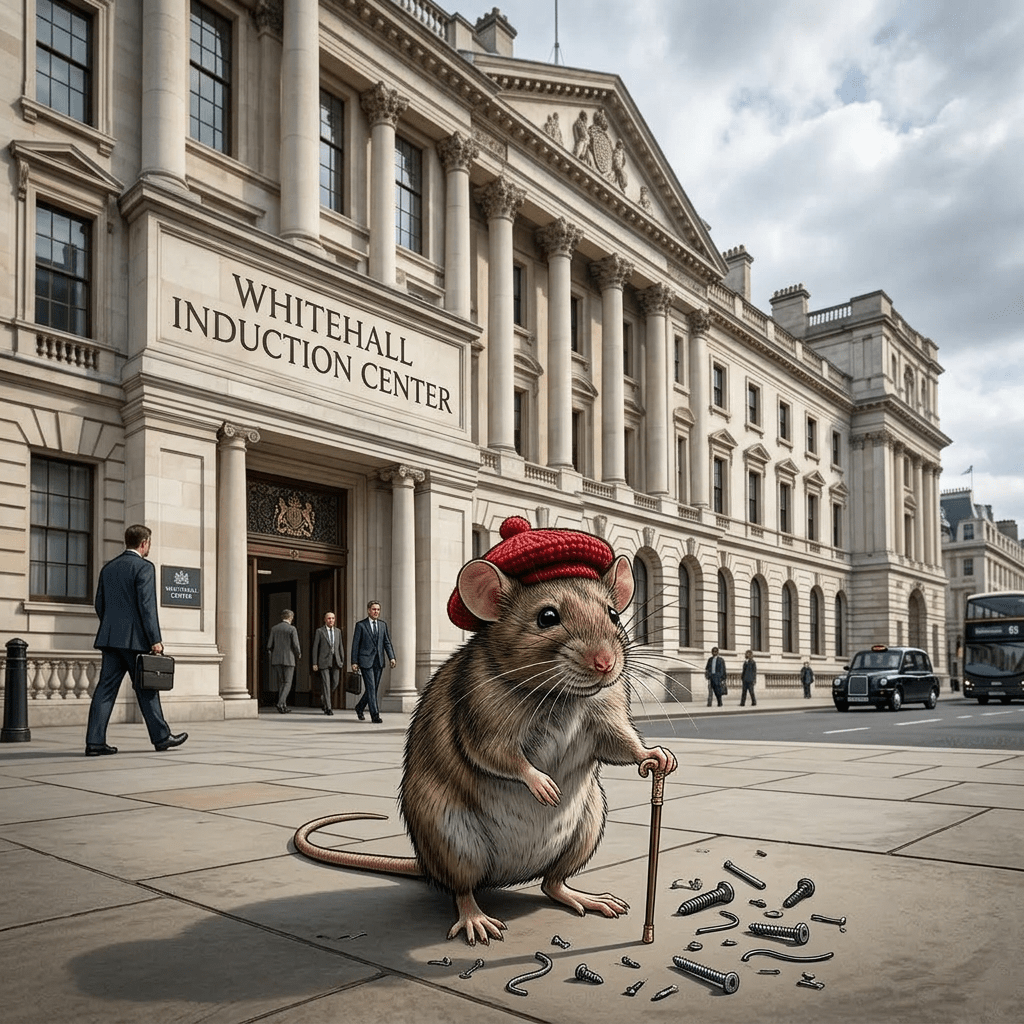
Whitehall Station sat in lower Manhattan like a bureaucratic bunker — the place where boys became soldiers or tried not to. It shut down in 1972, two days before my birthday, while I was in Danbury Federal Correctional Institution. I’d wanted it torn down. I’d done my best to see that happen.

As I climbed the steps, I saw Mr. Harold Jones waiting outside. My eighth‑grade science teacher — but more than that. Over the years, he’d become my confidant, the one adult who understood what I was feeling. He made science feel like storytelling, helped along by a fictional mouse named Archibald MacLeish who lived in his coat closet. I never saw him, but I saw him. Still do.

Mr. Jones said he named the mouse Archibald MacLeish after the poet — “because even a mouse can carry big ideas,” he told me once, tapping his temple like he was winding up a thought. MacLeish wrote about truth, about standing your ground when the world tries to bend you, about the kind of dissent that isn’t loud or showy but stubborn and necessary. He believed democracy wasn’t something you admired from a distance — it was something you practiced, even when it cost you. Jones figured a mouse could teach eighth‑graders more about courage and conscience than any textbook. The beret, the cane, the red bandana — that was all me. That’s how I pictured him: a tiny philosopher with a rebel’s wardrobe, the kind of creature who’d whisper, Don’t let them turn you into something you’re not. Archibald showed up whenever I needed him — not as a hallucination, not as a joke, but as a reminder that dissent can be quiet, steady, and small, and still shake the world.

Mr. Jones didn’t say much that morning. He didn’t have to. He told me to stay who I was. Said it was something to be proud of.

Inside, the induction ceremony began. The room smelled of sweat. The air was thick with the breath of boys pretending not to shake. The recruiter’s voice was flat, rehearsed, like he’d stopped listening years ago.

“Please repeat after me…”

“I do solemnly swear…”

Repeat. Repeat? Hell, I could barely breathe.

“…that I will bear true faith…”

And suddenly I wasn’t in Whitehall anymore. I was back on the football field, hearing my coach yell, “Go in hell‑bent for leather, Little Sandy!” My dad was Big Sandy. The coach used that nickname to rile me up. Hell‑bent for leather — without fear.

My heart picked up the chant until it drowned out everything else.

Then came the words: Step forward.

I sat down.

The recruiter blinked, confused. Thought I was sick. I stood, breathed, sat again.

“I’m not moving,” I said, though I wasn’t sure I could even if I wanted to.

The sergeant’s face turned fire‑engine red. My heart was a jackhammer. I was frozen in defiance — or fear. Maybe both. I prayed he wouldn’t hit me. If he did, I wasn’t sure I could stop myself from hitting back. I may be a peacenik, but I know myself. Anger lives in me too. If I struck him, I wouldn’t be going to jail for trying to end a war, but for starting one.

Two MPs grabbed me like a sack of potatoes and hauled me to a holding cell. I expected that part. I was prepared. No blows were thrown. An Army lawyer came in to make sure I knew what I was doing. I asked if he knew what he was doing — and what he was part of. He accepted my yes and left.

Then came the police car, the ride to Staten Island, and my first night in jail. Five miles from the gridiron. A lifetime away.

As they carried me out of Whitehall, I refused to walk — part of my plan for total non‑cooperation. Mr. Jones stood on the grimy sidewalk. He smiled. Gave me a thumbs‑up. I flashed him a peace sign from between a cop’s holster and his arm.

And behind him — I swear — I saw Archibald MacLeish strutting down the sidewalk, beret tilted, cane tapping a rhythm only I could hear. He paused near the induction center door, tipped his hat, and whispered, “Courage isn’t loud. It’s the quiet refusal.” Then he vanished into the crowd.

Mr. Jones arranged to bail me out, though I was released on my own recognizance. I spent the rest of the day at his home — resting, recovering, trying to make sense of what had just happened. And what would happen next. To my mother, I was simply visiting Mr. Jones. I was old enough to say, “Don’t call my parents,” and the authorities obliged.

A trial date was set for April. The weeks leading up to it blurred into paperwork, legal advice, friends’ advice, and panic. I walked Manhattan like I always had, but now I memorized the cracks in the sidewalk, the rhythm of subway trains, the smell of roasted peanuts from corner carts — anything to anchor me.

Oddly, I’d always found the Financial District peaceful on a Sunday morning. Wall Street’s insanity gave way to silence. I walked it a few times in those last days. And Times Square — the lights of Broadway weren’t going to shine on me, but they still shine inside my memory. So do the beaches of Staten Island.

I didn’t know what I was looking for. Only that it wasn’t in New York anymore.

And so the city’s noise faded behind me. The cracks in the sidewalks, the drumbeat of the subway, even Broadway’s lights became part of a memory I carried but could no longer live inside.

What I needed was silence. Steadiness. A place where the ground didn’t demand allegiance.

Somewhere in the back of my mind, I could still hear Archibald’s cane tapping — that quiet rhythm he kept for me when I couldn’t keep one for myself. He’d been at Whitehall, and he’d be on the mountain too. Courage travels light.

Emily’s mountain was waiting. Quiet, immovable, patient — just like she was — offering refuge without question.


Leave a comment

This site uses Akismet to reduce spam. Learn how your comment data is processed.

Archibald the Mystical Mouse

I’ve been thinking since March 5th of 2026, when I published my book, that I should rewrite it — not because I expect sales to suddenly skyrocket, but because I left out some things, explanations that would have mattered. Like the fact that I have this mystical mouse named Archibald MacLeish who shows up in the beginning. I just assumed everyone would sort of get it, and then it started occurring to me, over and over again, that no, not everyone does get it. What’s the big deal about the mouse?

So let me say it plainly.

In my book, I talk about this make‑believe mouse named Archibald MacLeish. He’s a small, mystical presence who slips in and out of the story, but the name itself comes from something real in my life. Back in school, my science teacher kept a classroom mouse, and he named that little creature Archibald MacLeish. At the time, I didn’t know much about the man behind the name, but my teacher did — and he believed in giving things names that meant something.

Later, I learned who the real Archibald MacLeish was — an American poet who wrote about democracy as something you do, not something you admire from a distance. He believed in dissent, in thinking for yourself, in the dignity of choosing your own path.

So the mouse in my book is that mouse — the one supporting my dissent. Not just the classroom mouse, and not just the poet, but the whole chain of belief behind it: a teacher who saw something in me, a poet who stood for freedom of thought, and a reminder that even the smallest presence can carry a big idea.

That’s the namesake. That’s the reason. That’s why the mouse is Archibald MacLeish. That’s why he shows up at the induction center.

And I should have explained that as an introduction to the little guy — why he’s there and given him the honor and the dues he deserved. I think folks would have felt the depth of his presence.

Leave a comment

This site uses Akismet to reduce spam. Learn how your comment data is processed.

Wavy Gravy Was Born Today

Some people arrive in this world like a whisper. Wavy Gravy showed up like a marching band that took a wrong turn and decided to stay.

Born on this day in 1936, back when the world was still in black‑and‑white, he somehow grew into one of the most colorful human beings to ever wander through the American story. Hugh Romney was the name on the paperwork, but the universe had other plans. It needed a jester. A peacekeeper. A clown with a conscience. A man who could talk down a crowd of 400,000 hungry, muddy, half‑mad festival‑goers at Woodstock with nothing but a microphone and a grin.

He fed people. He calmed people. He made them laugh when they were ready to break. He turned compassion into a kind of performance art, and he never stopped believing that humor could be a tool for survival. The Hog Farm, the Seva Foundation, the endless parade of red noses and tie‑dye — it was all part of the same mission: make the world a little lighter, a little kinder, a little more human.

Wavy Gravy reminds us that you can take the work seriously without taking yourself seriously. That mischief can be mercy. That joy can be a form of resistance. And that sometimes the best way to keep the peace is to show up dressed like a psychedelic Santa Claus and tell everyone it’s going to be okay.

On the day he was born, the universe clearly decided it needed more color. And all these years later, we’re still living in the glow.

From Rambling Harbor, where the tide rolls in with its own kind of cosmic joke, I tip my hat to the man who proved you can change the world with a laugh and a ladle.

Leave a comment

This site uses Akismet to reduce spam. Learn how your comment data is processed.

FREE SUBSCRIBING

I’m Nobody! Who are You?

I published my first book on March 5th. It’s called I Was There. I probably should’ve called it Who Am I, because it’s a memoir, and since I can’t hang a famous name on it, no one really cares. If I were a famous musician, actor, or politician, it wouldn’t matter if my entire memoir was just me sitting by a luxury pool all day sipping fancy drinks made by an impeccable butler — or better yet, a Butlerette in a miniskirt — people would be clamoring to buy it.

On Amazon, where my book is available, I’m competing with the likes of Maya Angelou, Malcolm X, and Trevor Noah’s mother, for God’s sake — all of whom have written memoirs. And that’s just naming the lesser-known ones, except maybe Trevor’s mother, though I suspect everyone but me knows who she is. I’ll add, with sincere condolences, that all are deceased, and underline that I am not willing to die for this book.

I have considered changing the name to something like Outlaw, rewriting it just a bit — not changing the facts, just throwing in more drama and sex. I could confabulate. In writing, confabulation is when you unknowingly fill in gaps with invented details because your mind wants the story to feel complete, smooth, or emotionally coherent. It’s not lying. It’s not embellishment on purpose. It’s the brain saying, “Let me tidy this up for you,” and slipping in something that feels true even if it isn’t. Then I could list my book under Autofiction, which could easily be misunderstood as autoerotica — and that should outsell Trevor’s mother.

A few weeks ago, I was talking to a good friend who’s also writing a book. Hers is about murder, and as I said to her, she has a better chance of gaining buyers because everyone knows what murder is. Along with not dying for this book, I’m also not willing to kill for it. And let me quickly add that my friend is not the murderess in her book either. Though I’ll bet she’s a killer in a miniskirt.

I also need to say my book is not boring. The folks who have read it have all been sincerely enthusiastic in their positive reviews. It deals with ten very turbulent times in my life — ten years when this country was an amalgam of ideas, movements, people, music, war, and yes, even sex. I was involved in some amazing moments with some amazing people, some known to history — people who, if they wrote a memoir today, would give Trevor’s mother a run for her money.

But you see, what I did, I did quietly. Not a lot of fanfare or fangirls or fantastic shenanigans. Maybe what I need to do now is go out and do something to call attention to myself. Maybe run for President on the WTF Party — that’s the What The Fuck Party — or maybe the LWRS Party, the Left Wing Radical Scum Party. You may have heard mention of that breed of human; I think they’re currently under investigation by the residents at 1600 Pennsylvania Avenue.

But the truth is, I never meant to make a splash with my book — not even in a luxury backyard pool with fancy drinks being served by a Butlerette in a miniskirt. I just wanted to tell my story to a few friends and family while there was still time. Part of the problem, I think, is that many of my friends thought I was writing a completely different book — probably about my hazy, crazy days in radio, which I barely mention.

If all of a sudden some major publisher caught on to my book, a major studio made it into a major and successful motion picture, and I suddenly had fame and fortune and miniskirt‑clad Butlerettes running around, I know I’d be looking for the nearest exit to the highest mountain I could find.

In short, I think maybe Emily Dickinson was right, and her idea fits my personality better.

Emily Dickinson wrote:

I’m Nobody! Who are you?
Are you — Nobody — too?
Then there’s a pair of us!
Don’t tell! they’d banish us — you know!

How dreary — to be — Somebody!
How public — like a Frog —
To tell your name — the livelong June —
To an admiring Bog!

Maybe that’s the whole point: I never wanted to be Somebody. I just wanted to leave a trail for the other Nobodies to follow home.

Leave a comment

This site uses Akismet to reduce spam. Learn how your comment data is processed.

Rating: 1 out of 5.

SUBSCRIBING IS FREE

One of the Unrecorded

I was just doing some research on this book, and as I’ve said, I’m horrible with dates. I always have been, as they drift into ancient history, they become a lost, whirling maze of amazement and often befuddled amusement. Just now, I was looking for someone from my CCNV days, and after a multitude of different search sources and avenues, including AI, it came back.

 “You’re trying to find someone who lived in a world that didn’t preserve itself well — CCNV, Catholic Worker, Berrigan circles, early women clergy. Those people didn’t leave digital trails.”

 I laughed aloud and said in my best Robert Deniro Taxi voice, “You talkin’ to me?” I know. I’m one of them, lost to time, memory, but maybe not to history.

About a year ago, I spent several weeks with on-and-off communication with various federal agencies trying to get copies of my arrest and prison records. I started with the bureau of prisons The Bureau of Prisons stated that they do not retain records beyond ten years,  They gave me a link to the FOIA ( Freedom of Information Act) the freedom of information act said that because of my type of cases any records would most likely be held by the National Archives they may have retained documentation related to this type of case. I wrote to the National Archives, but have not heard back. I am willing to bet no one has ever tried so hard to prove they are a criminal. Even though the law I broke needed to be broken, and I still would love to see my whole records including as Arlo Guthrie put it in the song “Alice’s Restaurant”, a black and white 8 by 10 glossy.

So yeah, I did and still do live in a world that doesn’t preserve itself well.

Part of me hopes we’re not all lost to history. And part of me thinks maybe that’s the way it was always meant to go.

Leave a comment

This site uses Akismet to reduce spam. Learn how your comment data is processed.

Rating: 1 out of 5.

A Radio Christmas Remembered

The holidays always make people feel nostalgic. I know I do, even though I don’t really take part in what feels like holiday madness these days, instead of real joy. I get a kick out of the ads that promise big savings if I just spend twice as much as usual.

New Year’s Day has always been a time for me to reflect, feel grateful, and sometimes regretful. Even when I was young, there was always someone or a moment to remember. As we get older, those memories matter even more.

I haven’t done live radio since 2006, and sometimes I miss it. It’s hard not to miss something you dreamed about as a kid and finally got to do. But when I talk to friends, they remind me that radio isn’t what it used to be. Now it’s all programmed and controlled by corporations, with little room for real personalities. I was lucky to work in radio when it meant something, when underground FM was fun and creative.

I wrote the next story a few years back, but it actually happened more than 40 years ago. I’m sharing it again because it’s real and it means a lot to me. People have told me it’s one of their favorite stories, and it’s one of my favorite Christmas memories, too.

A Radio Christmas Remembered

It was a quietly magical December, around 1982. Snow was blowing outside in the middle of the night—well, 3 a.m. is hardly morning. The kind of snow that sneaks up on you, drifting quietly and getting deeper. It moved across the empty parking lot, turning this lonely spot into something like the Montana or Wyoming prairie. It was the perfect scene as Merle Haggard sang about wanting the Big City to let him go. Even though I wasn’t far from Boston, it was easy to feel cut off from the world, watching the snow shape the night. I probably wouldn’t see another person for at least three more hours. I was the only one on duty from midnight to 6 a.m. I could still see most of my car, but I wasn’t sure I’d be able to move it in the morning, even if someone could get to me.

As the keeper of the light, I stayed in touch with others who were awake during the darkest hours—the night people. I’ve always liked night people. There’s a passion in how they move through life—caring, yet often a little lonely, choosing the quiet roads and the small hours. My way of connecting with them was through a country radio station in the basement of a small strip mall in the middle of nowhere. Still, our AM signal reached far and wide, especially at night—traveling over flat land and even across the ocean, carried on the darkness. I was the only show in town, the only one playing music on the AM dial in that forgotten time zone.

About once a week, a cross-country trucker would call me. When he got to Rhode Island and picked up my signal, he’d say, “The California Kid is on the line.” This time, he wished me a Happy Holiday and, as always, asked for a few songs to help him make it to Maine. I was his companion on the road.

I also got calls from Alice. She drove all over the area, servicing ATMs, and would call once or twice a week while she worked. I never met Alice; she was a bit like the coyotes that roamed the parking lot, always staying out of sight. I called her Dallas Alice, after the Little Feat song Willin’, which I played for her every time she called.

On that snowy night, Alice called to wish me a Merry Christmas and told me to wait a few minutes, then look outside. After we hung up, I played Willin’ and walked up the steps to the door. There, already gathering snow, was a small pre-lit Christmas tree and a card that read, “Merry Christmas from Dallas Alice.” I saw her footprints in the snow. She had parked close to the entrance so she could get back to the main road quickly.

I never met Alice, but her kindness lingered long after that night. I never met the California Kid either, yet in the passion of their journeys and the gentle connections forged in the dark, we shared something rare—a caring warmth that glowed quietly in the lonely hours. On that cold, snowy night so many years ago, a woman named Alice—Dallas Alice—and a trucker called the California Kid gave me memories that still make me smile every Christmas.

Every Christmas, I remember the way we reached for each other across the airwaves—passionate, caring, and yes, a little lonely, but never truly alone.


Rating: 1 out of 5.

Leave a comment

This site uses Akismet to reduce spam. Learn how your comment data is processed.

Introduction

I never meant to write a war story. I meant to live a life. Not the kind that ends up in textbooks or on movie screens, but the kind shaped by quiet choices—by sitting down when others stepped forward, by saying no when silence was easier. This book isn’t about the Vietnam War or the peace movement. Those stories already fill libraries. It’s not about my years behind the mic as a radio broadcaster—that came later. Nor is it about the loud ones: the noisemakers, the celebrities, the politicians, or the filmmakers chasing spotlight and legacy.

This book is about quiet defiance. About extraordinary moments tucked inside an otherwise ordinary life. Mine.

During the Vietnam War era, roughly 570,000 young men were labeled draft offenders. Of those, 210,000 were formally charged. Just 8,750 were convicted. And only 3,250 were jailed. Less than one percent. This book is about that final group—the ones history rarely names, Hollywood never casts, and textbooks barely mention. It’s about my friend Kevin, who said, when we reconnected after Daniel Berrigan’s passing in 2016, “Dan, we didn’t go after the government; they came after us. We just wanted to live our lives.” Kevin was right. We wanted to live, and we wanted the boys sent to fight in a war we didn’t choose to live also.

I’m proud to say I was one of the 3,250 who said no. We said it quietly, but loud enough to keep our souls intact while they locked up our bodies. I tell only my part of the story, but I know I’m not so different from the other 3,249. Maybe I can make a little noise for all of us.

I once asked my father what happens when we die. We were walking a dirt road in the Deep South, the heat thick as molasses. I was nine. My dad, a scientist in spirit and mind, told me energy can’t be created or destroyed—it only changes form. Since the human body is mostly energy, it too must become something else. That left me with the unsettling idea that I might not become a mighty oak, but a daffodil on the side of a hill. Maybe my life has been a long attempt to be the oak, not the daffodil. But the jury’s still out.

I never planned to oppose a war, and I certainly never intended to write a book. If I had, maybe I would’ve kept a diary—or at least some decent notes. What few I scribbled on barroom napkins or in stray notebooks are long gone, buried in some landfill. Hopefully, raising a mighty oak. But I do remember a few things.

I’ll tell you about growing up on Staten Island—football, beaches, music, and radio. A middle-class kid with few worldly cares and a head full of books. My first dream was to be a radio star. That dream shifted when friends started coming home in body bags—boys who could run, jump, and catch with the best of us, now still forever.

I’ll try to explain how a painfully shy kid found the courage to sit down instead of stepping forward at Whitehall Station—the military induction center in New York City where young men were processed for the draft. The routine was simple: They underwent a written aptitude test and a physical examination to determine fitness for service.

Based on these evaluations, they were classified (e.g., 1-A for fit, 4-F for unfit). When your name was called, you stepped forward to begin your journey into military service. But I didn’t. I sat down. I don’t know if fear buckled my knees or if I’d read somewhere that sitting was the perfect nonviolent act. Maybe it was both. Either way, that quiet refusal marked the beginning of my resistance.

I’ll take you from New York to the mountains of West Virginia, to a woman named Emily who taught me how to live off the land. Then, to a woman older than I was, with three children, about her, and the court fight for custody of her kids and one of mine. I’ll tell you about my arrest in Hollywood and the cross-country ride back to New York, escorted by U.S. marshals. And the old judge who nearly begged me to take one of his get-out-of-jail-free cards.

I’ll talk about meeting Daniel and Phillip Berrigan in prison. And how resistance didn’t end behind bars, as shown by my trips to solitary confinement for refusing to walk the prison lines. I’ll tell you about fellow inmates like Howard Hunt, G. Gordon Liddy, and Clifford Irving—and the handful of other draft and war resisters. I’ll finish with life after prison.

3,249 other stories may or may not be told. This one is mine.

Dan Sanders

July 2025

Leave a comment

This site uses Akismet to reduce spam. Learn how your comment data is processed.

Rating: 1 out of 5.

CHAPTER TWO: MEETING EMILY

I met Emily in the fall of 1967, during the anti-war march on the Pentagon. That protest—tens of thousands strong—was a rupture. D.C. felt electric and volatile, like the air before a lightning strike. The war was surging, and so was the resistance. Students, clergy, veterans, poets, and provocateurs collided, not always in harmony. The movement was splintering: some preached peace, others demanded revolution. Everyone wanted change, but no one agreed on its shape.

Several years before this, I started writing letters to my draft board. Lyndon B. Johnson was still president, Nixon waiting in the wings. The letters weren’t meant for Johnson, but I imagined him reading them anyway—grimacing, maybe, before tossing them aside. The draft board replied a few times, reminding me I was deferred under 3-A college status. Eventually, they recalculated me as 1-A. Combat-ready. And I welcomed it. You can’t refuse what hasn’t been offered. I was done hiding behind loopholes.

I’ve never had patience for those who ran to Canada, claimed bone spurs, or found clever ways to dodge the draft. If others were saying yes by dying, I could damn well risk my freedom to say no—with my body, not just my words. That was the point. Resistance isn’t clean. It’s not comfortable. It’s not supposed to be.

I first met a friend of Emily’s who invited me to speak at George Washington University about my involvement. Emily was there. Back of the room. Silent. Motionless. She claimed a corner as if it were a refuge. Twenty, maybe twenty-five people in a vast lecture hall. Most clustered together, ready to pounce. She stood apart. Her small frame held a quiet strength.

As I spoke, the questions came hard—verbal rotten tomatoes, launched like missiles. Who was I to think I could end a war? Why did I care? I was safe. I was free. But I kept looking toward her. She hadn’t said a word, yet
I felt held by her silence.

And then she spoke. Softly. Simply. Powerfully.

“Wouldn’t you want them to do the same for you,” she said, “if it were your children being napalmed?”

That sentence still echoes. In 1967, napalm wasn’t theoretical—it was the image on the evening news, the smell in the back of our throats. Her words cut through the noise like truth often does. Amid the shouting, she was the still point.

We met again later that year at another protest in New York City. Reverend Martin Luther King Jr. was speaking at Riverside Church. That speech—his first significant break with the Johnson administration—was a thunderclap. He called the U.S. “the greatest purveyor of violence in the world.” It cost him allies, but it galvanized many of us. Emily and I never saw him speak. Instead, we ended up at Coney Island—my first and only time there.

She convinced me to ride the Parachute Jump, a steel skeleton of a tower that looked like it had been designed by someone with a grudge against gravity. Two-person canvas seat. Lifted 250 feet into the sky. Dropped like a stone. Caught, eventually, by a parachute that felt more like a suggestion than a guarantee.

She said it would be fun. I said yes, mostly to impress her. It was not fun. It was terrifying. But she laughed, hugged me, and called me brave. Said it was one of the best experiences of her life. I didn’t understand how she could enjoy it. But I was falling for her faster than that drop from the tower. Before we parted, she told me: if I ever needed a safe place, she had land in West Virginia.

The Pentagon was thunder. Riverside was lightning. But Emily—Emily was shelter. In the roar of fractured movements and rising resistance, she offered stillness. Her words didn’t shout; they landed like balm. Even that wild ride at Coney Island, terrifying as it was, became a metaphor: the world drops you, but sometimes you’re caught—not by canvas or steel, but by someone who sees you.

Before we parted, she offered land in West Virginia—a place untouched by sirens or slogans. A sanctuary. And I began to wonder: maybe the revolution wasn’t just in the streets. Perhaps it was also in the quiet spaces we build with each other.

After more than fifty years, I’ve learned that quiet doesn’t always live in geography. Sometimes it’s tucked into memory, into rituals that outlast the hands that once performed them. And sometimes, it’s the comfort and warmth of remembering the people who held me when the world did not.

Maybe that’s the revolution too—not just in the streets, but in the stillness we carry forward.

And the real question is this: when the world lets you down, who catches you?

A mountain. A mouse. A friend on a grimy sidewalk. Sometimes, that’s enough.