
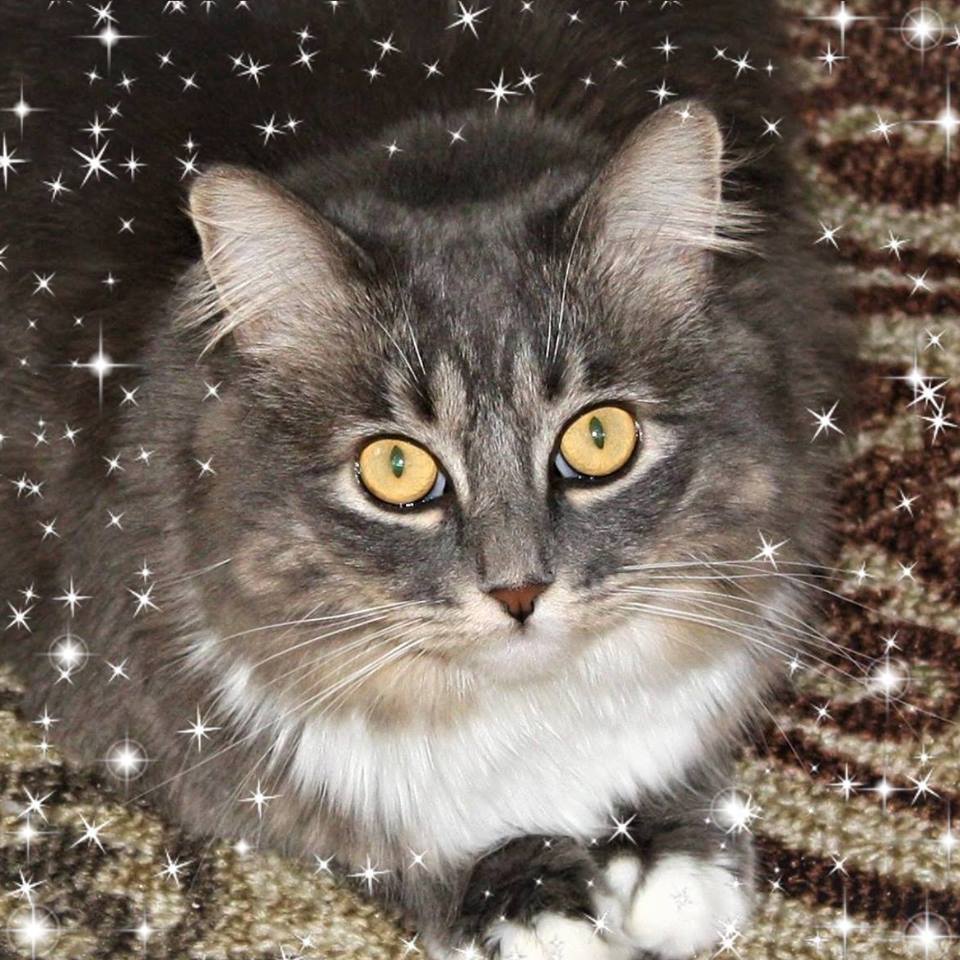
Shianna: A Christmas Story

On the morning of December 16th, 2017, I heard a small, weak, almost inaudible cry — the kind of sound that tells you something is terribly wrong.
A tiny soul was struggling for life.

My little white furry friend, who had been my happiness and my wife’s favorite, was very sick. She had been my emotional support for the six years since my wife passed away.
That day, Chloe Cat had to be put to sleep.

In a fit of grief and panic attacks, I all but wrecked the veterinarian’s exam room. Two friends who were with me explained to the staff what was happening, and the office simply said,
“Let him go. We understand. We’ll take care of it later.”

I have always had a cat — sometimes two — as a friend.
The emptiness of my home in the days after Chloe crossed the Rainbow Bridge was thunderous silence.

So I began searching the internet for a new friend. Not one who could ever take Chloe’s place, but one who might help fill the hole left in my heart.
Page after page.
Cat after cat.
Days and nights that seemed like years of tears.

And then one day, looking up from the floor of an adoption center webpage, two great big eyes said,
“Hey, I’m here. Come and get me.”

I called the adoption center, and they agreed to come in the day after Christmas so I could visit this hopefully newfound friend.
A 50‑mile trip in sub‑zero weather in an old car I wasn’t sure would make it to the center, much less back home.
A rural road.
No GPS.
But I felt guided, and I made it there.

I was led into a room filled with cats of all sizes and colors, each one greeting me, purring, and showing off.
But the two big eyes I had seen online were missing.

When I asked, I learned she was hiding deep inside a treehouse, keeping to herself, not part of the crowd.
My first sign that we might be meant for each other.

I slowly reached into the opening of the treehouse, and the staff gave me a chair.
For at least an hour, I sat with my hand through the opening — speaking softly, but mostly not speaking at all.
Letting the unspoken thoughts and feelings that can only exist between humans and animals speak to both of us.

The adoption center people must have thought I was a bit daft, sitting there with just my hand in a cat treehouse.
But they didn’t bother me.

And then I felt it.
I knew this was my animal soul mate, my familiar.

I found the attendant and said, “I’ll take her.”

As I signed the adoption papers, I was told that if there was any problem — any at all — I could bring her back, no questions asked.
A red flag.
And the fact that she was already eight months old — another sign she had been returned.

She had also been hurt; the doctor’s notes read: severe wound, possible nerve damage.
Well, that went along with the shrapnel I’ve carried in my lower back for 50 years.
Two reclusive critters with nerve damage — tell me that’s not two souls looking for each other.

I had left my car warming. I loaded my new friend into her carrier, left the adoption center, and we began the long ride home.
I drove mostly with one hand, the other on her case, telling her the whole way how good things were going to be.

I still wasn’t sure we’d make it back to Boston in my sputtering old car.
But we did.

Once safely home, this little life spent the first part of the night hiding.
I found her behind the stove.
Once coaxed out of there, she spent the night under the bed, and I spent it talking to her through the mattress and trying to think of a name.

Many people don’t understand her name, which is, in some ways, the reason I’m writing this a few days before Christmas — besides the fact that she was adopted the day after Christmas.

If you say her name, you’d think it’s spelled Cheyenne, like the town or the Native American nation.
In fact, one time I overheard a friend tell someone who asked what kind of name it was, and the friend — knowing I am part Native American — said,
“It’s Native American.”
I didn’t bother correcting her.

Her name is a contraction of Shilo.

Shiloh was an ancient Israelite city in the central hill country north of Jerusalem. The meaning of “Shiloh” is debated — possibly related to a root meaning tranquility or peace. Some scholars propose a meaning connected to place of rest.
Either one is fine with me.

And Anna: she was a prophetess, one of the very few women in Scripture clearly given that title.
Anna appears only in three verses in the entire Bible (Luke 2:36–38), yet she stands as one of the most powerful spiritual figures in the New Testament.

And so, having found my new friend the day after Christmas, and somewhere in the middle of the night as I talked to her through the mattress on my bed, her name became Shianna.

Sometimes the gifts that matter most don’t come wrapped in paper or tied with ribbon.
Sometimes they arrive the day after Christmas, with big eyes, a wounded past, and a quiet way of saying,
I’m here.

This is the story of how Shianna found me —
or maybe how we found each other.


Leave a comment

This site uses Akismet to reduce spam. Learn how your comment data is processed.

Go back

Your message has been sent

Rating(required)
Warning

A Radio Christmas Remembered

The holidays always make people feel nostalgic. I know I do, even though I don’t really take part in what feels like holiday madness these days, instead of real joy. I get a kick out of the ads that promise big savings if I just spend twice as much as usual.

New Year’s Day has always been a time for me to reflect, feel grateful, and sometimes regretful. Even when I was young, there was always someone or a moment to remember. As we get older, those memories matter even more.

I haven’t done live radio since 2006, and sometimes I miss it. It’s hard not to miss something you dreamed about as a kid and finally got to do. But when I talk to friends, they remind me that radio isn’t what it used to be. Now it’s all programmed and controlled by corporations, with little room for real personalities. I was lucky to work in radio when it meant something, when underground FM was fun and creative.

I wrote the next story a few years back, but it actually happened more than 40 years ago. I’m sharing it again because it’s real and it means a lot to me. People have told me it’s one of their favorite stories, and it’s one of my favorite Christmas memories, too.

A Radio Christmas Remembered

It was a quietly magical December, around 1982. Snow was blowing outside in the middle of the night—well, 3 a.m. is hardly morning. The kind of snow that sneaks up on you, drifting quietly and getting deeper. It moved across the empty parking lot, turning this lonely spot into something like the Montana or Wyoming prairie. It was the perfect scene as Merle Haggard sang about wanting the Big City to let him go. Even though I wasn’t far from Boston, it was easy to feel cut off from the world, watching the snow shape the night. I probably wouldn’t see another person for at least three more hours. I was the only one on duty from midnight to 6 a.m. I could still see most of my car, but I wasn’t sure I’d be able to move it in the morning, even if someone could get to me.

As the keeper of the light, I stayed in touch with others who were awake during the darkest hours—the night people. I’ve always liked night people. There’s a passion in how they move through life—caring, yet often a little lonely, choosing the quiet roads and the small hours. My way of connecting with them was through a country radio station in the basement of a small strip mall in the middle of nowhere. Still, our AM signal reached far and wide, especially at night—traveling over flat land and even across the ocean, carried on the darkness. I was the only show in town, the only one playing music on the AM dial in that forgotten time zone.

About once a week, a cross-country trucker would call me. When he got to Rhode Island and picked up my signal, he’d say, “The California Kid is on the line.” This time, he wished me a Happy Holiday and, as always, asked for a few songs to help him make it to Maine. I was his companion on the road.

I also got calls from Alice. She drove all over the area, servicing ATMs, and would call once or twice a week while she worked. I never met Alice; she was a bit like the coyotes that roamed the parking lot, always staying out of sight. I called her Dallas Alice, after the Little Feat song Willin’, which I played for her every time she called.

On that snowy night, Alice called to wish me a Merry Christmas and told me to wait a few minutes, then look outside. After we hung up, I played Willin’ and walked up the steps to the door. There, already gathering snow, was a small pre-lit Christmas tree and a card that read, “Merry Christmas from Dallas Alice.” I saw her footprints in the snow. She had parked close to the entrance so she could get back to the main road quickly.

I never met Alice, but her kindness lingered long after that night. I never met the California Kid either, yet in the passion of their journeys and the gentle connections forged in the dark, we shared something rare—a caring warmth that glowed quietly in the lonely hours. On that cold, snowy night so many years ago, a woman named Alice—Dallas Alice—and a trucker called the California Kid gave me memories that still make me smile every Christmas.

Every Christmas, I remember the way we reached for each other across the airwaves—passionate, caring, and yes, a little lonely, but never truly alone.


Rating: 1 out of 5.

Leave a comment

This site uses Akismet to reduce spam. Learn how your comment data is processed.

“Between Manger and Cave”

A couple of nights ago, I watched a rarity on television, an excellent show, Kevin Costner Presents: The First Christmas. As I listened to Costner’s narration, I couldn’t help but think back to my seminary days and wish someone had taught this version then. What struck me, beyond Costner’s presentation and delivery, was how different it was from what the Bible teaches or what churches traditionally teach. Instead of repeating familiar pageantry, it offered a retelling grounded in historical imagination and modern scholarship, a version that, to my mind, feels closer to the reality of what may have happened.

The Gospels of Matthew and Luke give us the only biblical accounts of Jesus’ birth, and they are spare, theological narratives. Luke tells us of Mary and Joseph traveling to Bethlehem because of the census, of the child lying in a manger because “there was no room in the inn,” and of the shepherds who were the first witnesses. Matthew, by contrast, emphasizes prophecy fulfilled: the Magi following a star, Herod’s paranoia, and the slaughter of the innocents. Both accounts are symbolic, designed to show Jesus as Messiah and Savior, but they leave many historical details unspoken.

Costner’s special, however, fills in those gaps with realism. It places the birth not in a wooden stable but in a cave—a detail supported by early Christian writers like Justin Martyr and by archaeological evidence from Bethlehem. Caves were common shelters for animals, far more plausible than the tidy manger scene we’ve inherited from centuries of pageantry. That single shift changes everything: from rustic charm to raw survival. Mary and Joseph are portrayed as vulnerable teenagers under Roman oppression. Herod’s cruelty is dramatized with unflinching detail, and the shepherds and Magi are woven together in a single narrative, reflecting how oral traditions often collapse timelines. The effect is a story that feels raw and human, less about prophecy and more about survival in a dangerous world. And in many ways, that realism rings truer than the theological gloss of the Gospel accounts.

Step by step, the differences become clear. The journey to Bethlehem in Luke is framed as obedience to a Roman decree; in the show, it is hardship and fear. The birth in Luke is humble, marked by a manger; in the show, it is stark, set in a cave carved into rock, damp and shadowed, where animals were kept. The witnesses in Luke and Matthew are divided: shepherds first, Magi later, but the show collapses them into a single dramatic moment, reflecting how memory and oral tradition often blend.

Herod’s violence in Matthew is theological, a warning about worldly power; in the show, it is visceral, a reminder of the brutality of history.

In the end, the Gospels give us a theological testimony, while Costner’s special offers a reconstruction that feels historically plausible. One stresses prophecy and divine purpose; the other stresses realism and human struggle. And if accuracy is the measure, Costner’s version may come closer to the facts of the Nativity than the Gospel accounts themselves.

Watching Costner’s retelling reminded me that stories never sit still; they shift with the teller, the time, and the need. The Gospels gave us prophecy and promise, the churches gave us ritual and pageant, and Costner gave us grit and survival. Somewhere between manger and cave, shepherd and Magi, theology and history, the truth of the Nativity flickers. And maybe that’s the point: every generation must find its own way to cradle the child, whether in scripture, in spectacle, or in memory. For me, Costner’s version felt less like myth and more like history, a ritual of faith, doubt, and wonder that refuses to fade, even under the harsh light of television.

And isn’t it something when Hollywood, of all places, edges closer to the facts than the pulpit? The Gospels gave us prophecy, the churches gave us pageantry, and Costner gave us caves, grit, and teenage parents. Two thousand years later, it takes a cowboy narrator to remind us that the Nativity was not a pageant in a stable but a birth in a cave, messy, human, and all the more believable.

CODA: If you’d like to see the full special for yourself, here are the official streaming options:

  • Watch on Disney+
  • Watch on ABC.com

Runtime: 1h 24m | Rating: TV-PG

Leave a comment

This site uses Akismet to reduce spam. Learn how your comment data is processed.

Rating: 1 out of 5.