

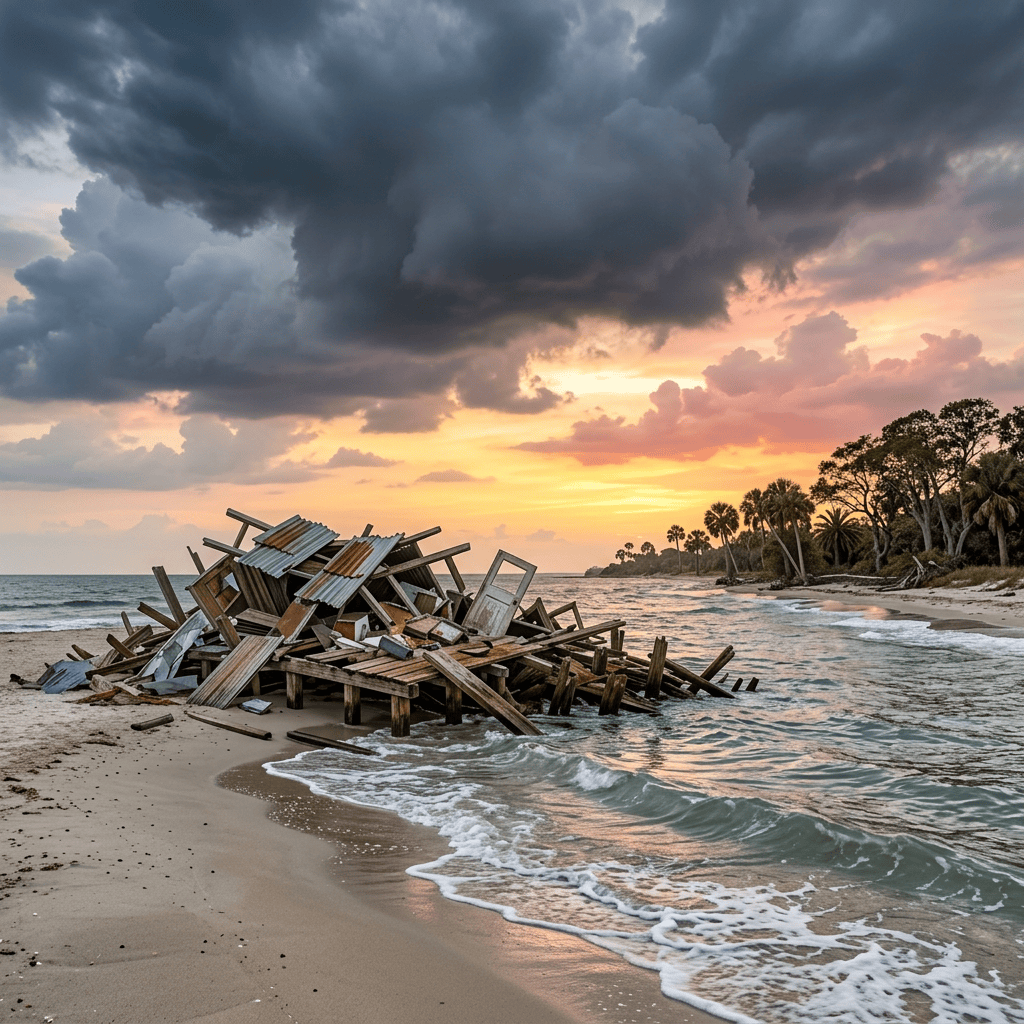
Hurricane season’s back on the weather reports again — all those swirling graphics and tight‑lipped meteorologists pointing at the Gulf — and every time I watch them I get pulled straight back to one night in Biloxi. The night Camille came for us, and I realized some storms don’t just hit, they remember you.
When Camille Came Calling — And Found Us in Biloxi
Every coastal town has that storm — the one people still talk about like it happened last night. For Biloxi, Mississippi, that storm was Hurricane Camille, August 1969. A Category 5 buzz‑saw that didn’t just hit the coast — it carved its name into it.
And we were there.
Joanie — yes, that Joanie, the one I zig‑zagged across America with, three kids in the back seat, living on forged prescriptions, stolen returns, and whatever luck we could scrape together — she and I were holed up in a motel in Biloxi when Camille decided to make her entrance.
It wasn’t a fancy place. Just one of those Gulf Coast motels with a flickering neon sign and an air conditioner that rattled like it was trying to escape the window frame. We were just passing through, same as always. A night or two, then back on the road. But storms don’t care about your itinerary.
Camille came in fast — too fast. No slow buildup, no polite warning. Just a sudden shift in the air, a pressure drop you could feel in your teeth, and then the wind started talking in that voice storms use when they mean business.
The kids were restless, Joanie was pacing, and I kept looking out the motel window like I expected the Gulf itself to come walking up the street. The rain hit sideways. The walls shook. You could hear things outside breaking — metal, wood, whatever wasn’t nailed down well enough. Camille didn’t knock. She kicked the damn door in.
People talk about the storm surge — 24, 25 feet of water rolling in like a moving wall — but what I remember most is the sound. A freight train mixed with a scream. A kind of roaring that makes you understand, deep down, that nature doesn’t give a damn about you or your motel room or your borrowed life.
And here’s the part that matters:
We survived because that motel sat on a hill — just enough elevation, just far enough inland, to keep the surge from swallowing us whole.
If we’d been a quarter‑mile closer to the water, or down on flat ground, this story might’ve ended differently. But luck — or fate, or whatever you want to call it — put us in a place that stayed above the worst of Camille’s rage.
When the sun finally crawled up, Biloxi looked scraped clean. Boats in places boats shouldn’t be. Houses shifted off foundations. Debris everywhere. Camille had come through like she owned the place.
Later storms would come — Katrina being the big one — but for a long time, Camille was the yardstick. The one everyone measured fear against.
And for us, it was another chapter in that wild, dangerous, beautiful stretch of life with Joanie and the kids — the years when we lived on nerve, instinct, and whatever the universe handed us. Camille didn’t stop us. She just became part of the story.
Subscriptions are free


Leave a comment