
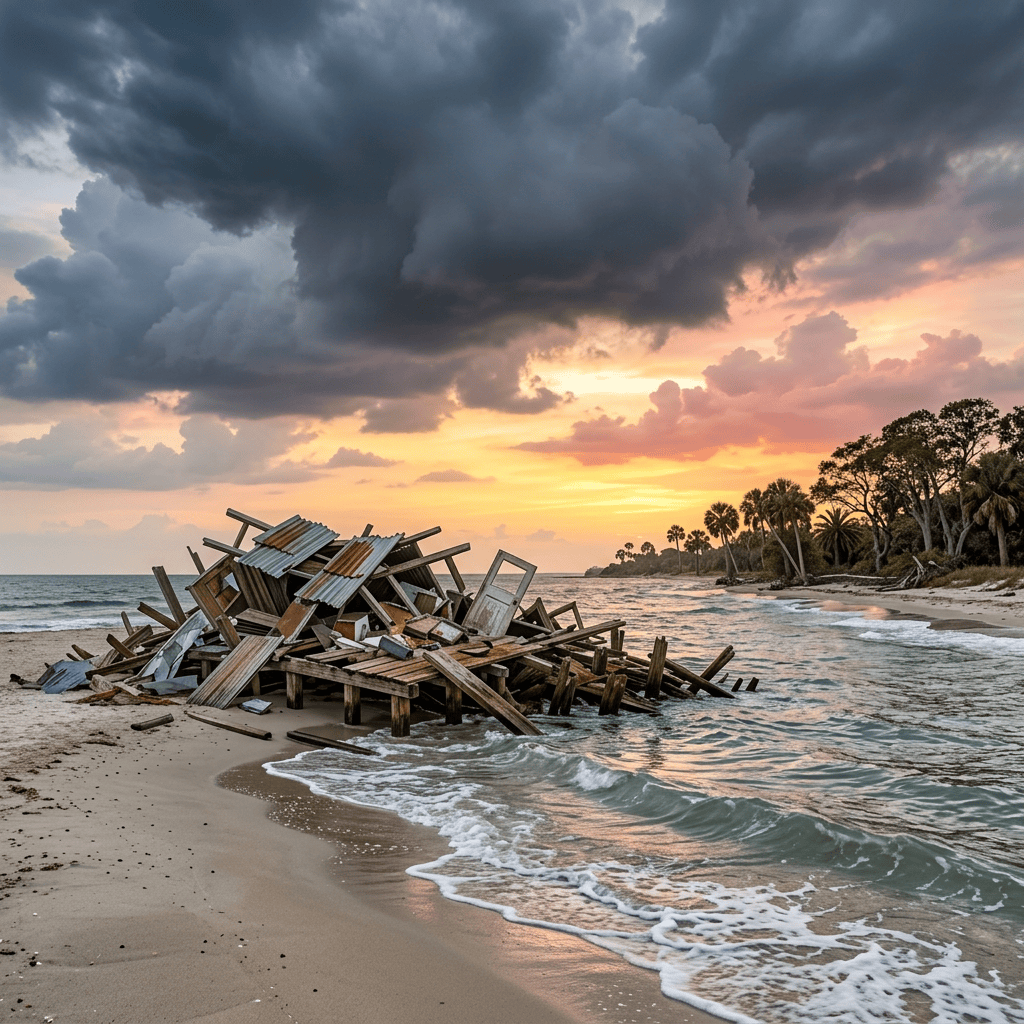
Camille, Biloxi and the Big Blow

Hurricane season’s back on the weather reports again — all those swirling graphics and tight‑lipped meteorologists pointing at the Gulf — and every time I watch them I get pulled straight back to one night in Biloxi. The night Camille came for us, and I realized some storms don’t just hit, they remember you.
When Camille Came Calling — And Found Us in Biloxi
Every coastal town has that storm — the one people still talk about like it happened last night. For Biloxi, Mississippi, that storm was Hurricane Camille, August 1969. A Category 5 buzz‑saw that didn’t just hit the coast — it carved its name into it.

And we were there.

Joanie — yes, that Joanie, the one I zig‑zagged across America with, three kids in the back seat, living on forged prescriptions, stolen returns, and whatever luck we could scrape together — she and I were holed up in a motel in Biloxi when Camille decided to make her entrance.

It wasn’t a fancy place. Just one of those Gulf Coast motels with a flickering neon sign and an air conditioner that rattled like it was trying to escape the window frame. We were just passing through, same as always. A night or two, then back on the road. But storms don’t care about your itinerary.

Camille came in fast — too fast. No slow buildup, no polite warning. Just a sudden shift in the air, a pressure drop you could feel in your teeth, and then the wind started talking in that voice storms use when they mean business.

The kids were restless, Joanie was pacing, and I kept looking out the motel window like I expected the Gulf itself to come walking up the street. The rain hit sideways. The walls shook. You could hear things outside breaking — metal, wood, whatever wasn’t nailed down well enough. Camille didn’t knock. She kicked the damn door in.

People talk about the storm surge — 24, 25 feet of water rolling in like a moving wall — but what I remember most is the sound. A freight train mixed with a scream. A kind of roaring that makes you understand, deep down, that nature doesn’t give a damn about you or your motel room or your borrowed life.

And here’s the part that matters:
We survived because that motel sat on a hill — just enough elevation, just far enough inland, to keep the surge from swallowing us whole.
If we’d been a quarter‑mile closer to the water, or down on flat ground, this story might’ve ended differently. But luck — or fate, or whatever you want to call it — put us in a place that stayed above the worst of Camille’s rage.

When the sun finally crawled up, Biloxi looked scraped clean. Boats in places boats shouldn’t be. Houses shifted off foundations. Debris everywhere. Camille had come through like she owned the place.

Later storms would come — Katrina being the big one — but for a long time, Camille was the yardstick. The one everyone measured fear against.

And for us, it was another chapter in that wild, dangerous, beautiful stretch of life with Joanie and the kids — the years when we lived on nerve, instinct, and whatever the universe handed us. Camille didn’t stop us. She just became part of the story.

Subscriptions are free

Leave a Reply

This site uses Akismet to reduce spam. Learn how your comment data is processed.

May Day.

May Day shows up every year like an old friend who never knocks, just walks in and expects you to know why they’re there. It’s a day with more identities than most of us manage in a lifetime — workers’ marches, ancient bonfires, maypoles, the whole spring‑is‑coming‑whether-you’re-ready-or-not business. A strange mix of protest and petals.

Long before it was a date on a union calendar, it was the halfway mark between the equinox and the solstice, a reminder that the world keeps tilting toward the light even when we’re not paying attention. People lit fires to chase off whatever darkness they believed in. Maybe they weren’t wrong. We still carry our own shadows around, and sometimes a little symbolic fire wouldn’t hurt.

In the labor world, May Day is the day people stood up and said enough — enough hours, enough bosses squeezing the last drop out of the last worker. It’s a day built on the idea that ordinary people deserve a life, not just a living. That message hasn’t aged a bit.

And here we are, another May 1st. No bonfires on the beach, no marching bands down the street, just the quiet truth that the year is moving whether we move with it or not. Spring is trying its best. The light hangs around a little longer each night. Even the air feels like it’s leaning forward.

Maybe that’s the real heart of May Day: the nudge. The reminder. The gentle shove from the universe saying, Get on with it. Dan would’ve liked that part.

So here’s to May Day — the ancient, the political, the personal. A day that asks nothing more than that we notice the world turning and decide, in whatever small way we can, to turn with it.

Leave a Reply

This site uses Akismet to reduce spam. Learn how your comment data is processed.

NO CHARGE TO SUBSCRIBE

Matches and Money: A Sanctuary Strategy for Resistance

Tomorrow, Saturday, October 18th, is the nationwide “No Kings March”. And I’ve been beating myself silly because this time I’ve decided that I can’t go—not that I don’t want to, but that I can’t. The primary reason is that my back has been so bad this week, I’ve spent most of my time in what’s called the non-violent prone position. In this case, that means flat on my bed.

And while I was lying there, writing the great American resistance novel on my ceiling, I kept thinking about an article I’d just read by Brian Huba published in”The Hill” today, October 17th. He was talking about another form of resistance—one I’ve always believed in. The kind that hits them where it hurts: the pocketbook.

Now, I’m not pretending that my low participation in the general ebb and flow of the almighty buying power of the dollar will make much difference. And I’m not saying it can replace the power of demonstration—of people gathering to make our voices heard and to send a signal, both to each other and to the Gestapo in DC: ‘We are not alone.’

But I’ve been thinking about pressure. Not the kind that crushes, but the kind that carves. The type that reshapes stone into sanctuary. And lately, I’ve come to believe that the most potent pressure we can apply—politically, spiritually, economically—is a two-part ritual: matches and money.

Let me explain.

We’ve been taught to march. To chant. To gather in the streets with cardboard signs and aching knees. And yes, there’s power in that, and there’s power in the crowd. But maybe the real revolution isn’t in the march, but in the match? Not the kind that burns buildings. The kind that lights candles. That ignites awareness. That says: ‘I see what you’re doing, and I will not fund it.’

Because the truth is: the system doesn’t fear our voices. It loves our wallets, our money, and it fears losing them. It fears our cancellations, our divestments, our refusal to play along. When we cancel a subscription, we’re not just saving $14.99—we’re pulling a thread from the tapestry of complicity. When we stop feeding the beast, the beast gets hungry.

Brian Huba said it plainly: maybe the most radical thing we can do right now isn’t to protest in the streets, but to unsubscribe, to stop paying for platforms that profit from our pain. To match our outrage with economic consequences.

So, I’m lighting matches. Quiet ones. Symbolic ones. I’m canceling, redirecting, reimagining. I’m spending like a poet—every dollar a stanza, every boycott a verse. I’m building a sanctuary where resistance isn’t just loud, it’s strategic.

Because when matches meet money, we don’t just protest. We pressure. We don’t just speak. We shift.

And yes—I will march again.

But first, I get the MRI.

First, I listen to the good doctors—the ones I trust to tell me how to walk without pain, how to stand without flinching.

Because resistance isn’t just about showing up. It’s about showing up whole.

And when I do march again, and I will return, I’ll be carrying my flag and my banners, not just as protest, but as testimony.

Proof that healing is part of the revolution, too.

—Dan

Rambling Harbor, where even the receipts are revolutionary

Leave a Reply

This site uses Akismet to reduce spam. Learn how your comment data is processed.