

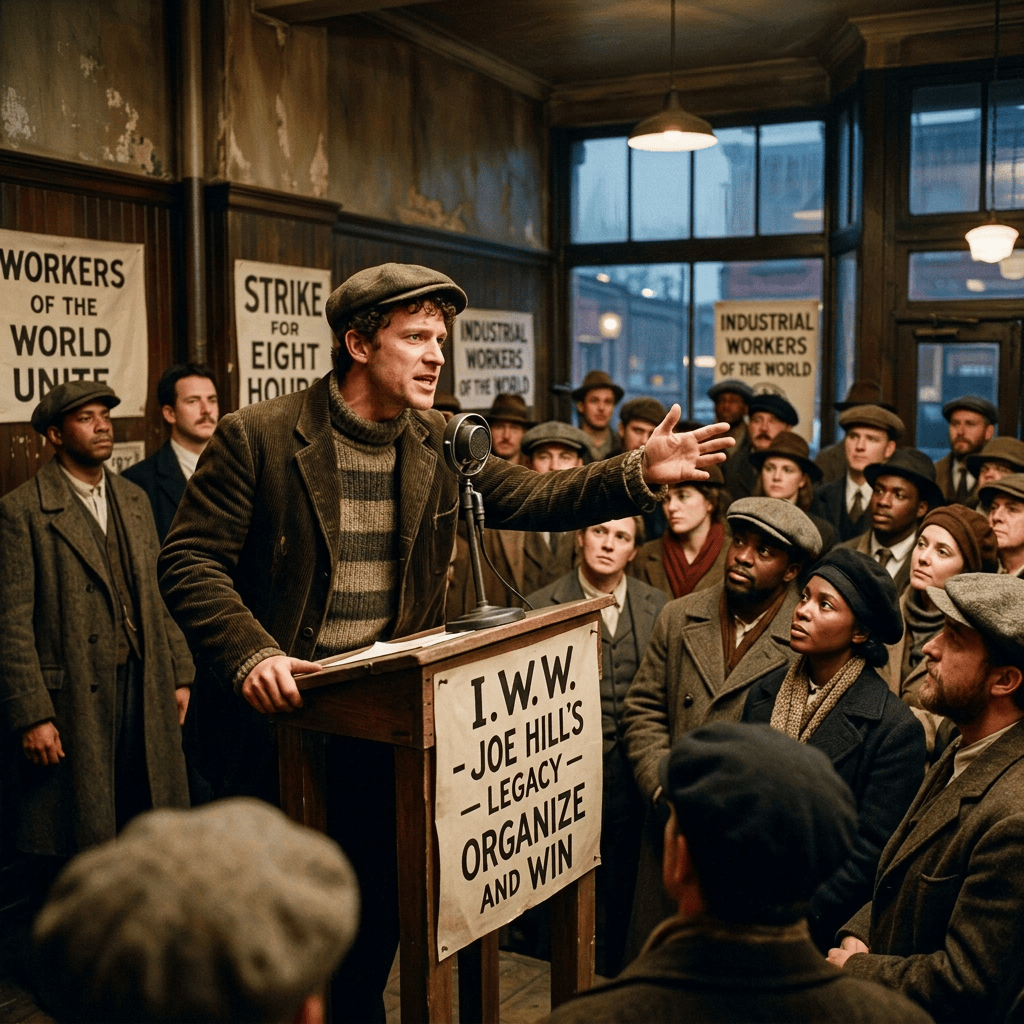
Joe Hill wasn’t just a labor organizer — he was the kind of guy who could walk into a room full of scared, exhausted workers and make them believe they mattered. A Swedish immigrant, a wandering worker, a songwriter with a knife‑sharp tongue, he wrote the songs that turned picket lines into something like church: The Preacher and the Slave, Casey Jones, There Is Power in a Union. Songs you could shout over factory noise or sing under your breath when the boss walked by.
Hill joined the Industrial Workers of the World, the Wobblies — the union that didn’t care about your race, your job, your skill level, or whether you had two nickels to rub together. If you worked, you belonged. That alone made him dangerous to the people who liked their workers quiet and scared.
In 1914, Hill was arrested in Utah for a murder he almost certainly didn’t commit. The trial was a mess — no motive, no real evidence, just a man the state wanted gone. And they got their wish: Hill was executed by firing squad in 1915. But here’s the thing — the man refused to die properly. His last words were basically, “Don’t mourn. Organize.” And that line became a fuse.
His ashes were scattered in every state except Utah, because the Wobblies figured he’d already spent enough time there. And every time workers stood up — miners, factory hands, farm laborers, nurses, teachers — Joe Hill was the ghost in the room, the voice saying, You’re worth more than they tell you.
That’s why Joan Baez could stand on the Woodstock stage in 1969, pregnant, rain coming down, and sing Joe Hill like she was calling him out of the ground. And the crowd — half stoned, half soaked, all alive — felt it. Because Joe Hill isn’t a man anymore. He’s a reminder.
You can kill a person.
You can’t kill an idea.
And Joe Hill was the idea that working people deserve a life.


Leave a comment