Some Thoughts and a Poem

I was just remembering the old Trump slogan “Drill, Baby, Drill,” and while I know a lot of folks are hurting because of the price of oil, I still think this: if there’s no earth left to drive on, the price of gas doesn’t matter.

Oil drilling harms the Earth in multiple, well‑documented ways, affecting land, water, air, wildlife, and the climate. The damage begins long before the first drop of oil is pumped and continues through extraction, transport, and burning.

Oil drilling isn’t just a technical process or an economic talking point. It tears open land that never asked to be touched, poisons water that once ran clear and leaves behind a kind of silence that feels heavier than sound. Every spill, every leak, every plume of smoke is another reminder that the earth absorbs more than we ever admit — and it remembers longer than we ever will.

That’s the ground my poem “The Scorched Land” stands on. It came from the moment I realized the planet isn’t just a stage for our mistakes — it’s a witness. A witness to the forests scraped away for access roads, the oceans slicked with oil, the air thickened by what we pull from below. These aren’t abstract harms. They’re wounds. And the earth carries them the way a body carries scars.

The poem lives in that uneasy space where anger and grief meet the stubborn belief that we can still do better. It’s not political. It’s personal. It’s the voice you hear when the world goes quiet enough for you to notice what’s been lost and what’s still worth saving.

If you’ve ever felt that shift under your feet — that sense that the ground itself is keeping score — then “The Scorched Land” is the part of this post meant for you.

And if you want the part of this story that doesn’t fit neatly into facts or headlines, it’s in the poem that grew out of all this.

The Scorched Land

When the last of us remain on this scorched land,
We will watch the ancient footage of our folly—
How we spurned the cries of nature and her hand,
How we slowly drained the lifeblood of this planet.

We will see the glaciers melt, and oceans rise,
We will see the forests burn, and deserts spread,
We will see storms, floods, droughts, and fires,
We will see the mass extinction of the living dead.

We will wonder how we could have been so blind—
How could we have let our greed destroy our home?
How could we have ignored the signs of our decline?
How could we have sealed our fate with a catacomb?

Leave a comment

This site uses Akismet to reduce spam. Learn how your comment data is processed.

Subscriptions don’t bite and they are free

Fashion or Conspicuous Consumption on Display

Maybe it’s just me—many times in cases like this it is at least mostly me—and before I go any further, I want to say I did not watch it. Instead, I watched the New York Knicks get some Boston Celtics revenge against the Philadelphia 76ers. But this morning the news is all over the event like bugs on a bumper, and the event I’m referring to is the Met Gala. An evening where individual costumes commonly range from $50,000 to $200,000, the Met Gala is officially known as the Costume Institute Benefit. It exists to financially support the Costume Institute of the Metropolitan Museum of Art. Unlike other Met departments, the Costume Institute is self‑funded. According to reporting summarized by The New Republic, the Met Gala has raised approximately $166.5 million over the past decade—an average of about $16–17 million per year. What makes this arrangement striking is not simply the sum raised, but the structure behind it: the museum collects the revenue while the immense aesthetic costs are absorbed by designers and luxury brands. The result is an event framed as philanthropy but sustained by a logic that more closely resembles high‑end advertising.

In the end, watching the Met Gala felt less like witnessing fashion and more like staring straight into the neon heart of conspicuous consumption. All that glitter, all that theater, all that money draped over people who can barely walk in it — it hits me like a scream I can’t quite swallow. Maybe it’s just the guy in clean jeans and a sweatshirt talking, but there’s something grounding about clothes meant to be lived in, not displayed like trophies. And standing in the shadow of all that gaudiness, I’m reminded how far spectacle can drift from anything that feels real.

Leave a comment

This site uses Akismet to reduce spam. Learn how your comment data is processed.

SUBSCRIBING IS ALWAYS FREE

Pete Seeger

Pete Seeger was born on May 3, 1919, in New York City. He became a legendary American folk musician, songwriter, and activist whose long career made a significant impact on music and social movements. Seeger wasn’t just part of the folk revival — he was one of the engines driving it. In the 1940s and ’50s, most of America listened to crooners and big bands. Seeger was dragging a long-neck banjo across union halls, college campuses, and picket lines. He taught people that folk music wasn’t a museum piece. It was a living language of protest, hope, and ordinary people trying to make the world a little fairer.rer.

When he joined The Weavers in 1948, the group became a kind of Trojan horse for social change. They took traditional songs — work songs, spirituals, Appalachian ballads — and smuggled them into the mainstream. Their version of “Goodnight, Irene” hit No. 1 in 1950, and suddenly millions of Americans were humming a tune from the Black folk tradition. That was Seeger’s quiet genius: he made the radical feel familiar.

But success painted a target on their backs. The early 1950s were the height of the McCarthy era, when suspicion was a national pastime, and anyone with left‑leaning politics was treated like a threat. Seeger had been outspoken about labor rights, racial justice, and peace — long before it was fashionable — and that made him an easy mark. The Weavers were dragged into the anti‑communist hysteria, labeled subversive, and effectively erased from radio and television. Concerts were canceled. Record contracts evaporated. Their career didn’t just stall; it was deliberately strangled. Seeger was subpoenaed by the House Un-American Activities Committee in 1955. He refused to name names or apologize for his beliefs. He did not hide behind the Fifth Amendment. Instead, he told Congress he had a right to sing for anyone he pleased. It was a bold act of conscience, and it cost him dearly. He was indicted for contempt and blacklisted for years.

Even after these setbacks, Seeger stayed active in music. He wrote and made famous songs like “Where Have All the Flowers Gone?,” “If I Had a Hammer,” and “Turn! Turn! Turn!” These songs became important for civil rights, labor, and anti‑war movements. His version of “We Shall Overcome” helped make it a key song in the civil rights movement.

Seeger was also a committed activist beyond music. He worked for environmental causes, especially the cleanup of the Hudson River, and remained involved as he aged. He inspired artists like Bob Dylan and Bruce Springsteen to continue his tradition of songs about social issues.

Seeger died January 27, 2014, at 94, but his songs and beliefs continue to inspire. He believed music could unite people.

Leave a comment

This site uses Akismet to reduce spam. Learn how your comment data is processed.

SUBSCRIPTION ARE FREE

Earth Day at the Harbor

Today is Earth Day, and every year it rolls around, I think about how it didn’t begin with a parade or a proclamation, but with a book — Rachel Carson’s Silent Spring back in 1962. One woman sitting at a desk, writing about pesticides and poisoned water, managed to shake the country awake, at least for a moment.

And then there was Gaylord Nelson, a senator from Wisconsin who must’ve felt like he was shouting into the wind. He went on speaking tours, trying to get pollution onto the national radar. The people heard him. The politicians mostly shrugged and went back to whatever they were doing.

So the people did what people sometimes have to do: they organized themselves. They made enough noise that the country couldn’t ignore it anymore. That noise became the first Earth Day in 1970.

Standing here in Rambling Harbor, watching the tide drag the morning light across the water, it’s hard not to think about how long we’ve been warned, and how slow we’ve been to listen. The planet keeps sending messages. The question is whether we’re finally ready to answer.

Leave a comment

This site uses Akismet to reduce spam. Learn how your comment data is processed.

Rating: 1 out of 5.

NO CHARGE FOR SUBSCRIBING

Nixon lies + Trump parallel Morning Ramble,

Every time I look back at Nixon’s Vietnam “we’re winning” routine, I hear an echo.

Here’s the Nixon highlight reel: • “Vietnamization is working.” (It wasn’t.) • “Peace is at hand.” (It wasn’t.) • “The enemy is weakening.” (They weren’t.) • “I have a secret plan.” (He didn’t.) • “We’re withdrawing because we’re winning.” (We weren’t.) • “The bombing is working.” (It didn’t change the terms.)

And now we’ve got a whole new era of leaders who pull the same trick — declare victory, deny reality, and hope nobody notices the smoke pouring out of the engine room.

Boston folks can smell that a mile away, and I hope the United States still can.

History doesn’t repeat, but the sales pitch sure does.

Leave a comment

This site uses Akismet to reduce spam. Learn how your comment data is processed.

Rating: 1 out of 5.

My Easter Ramble.

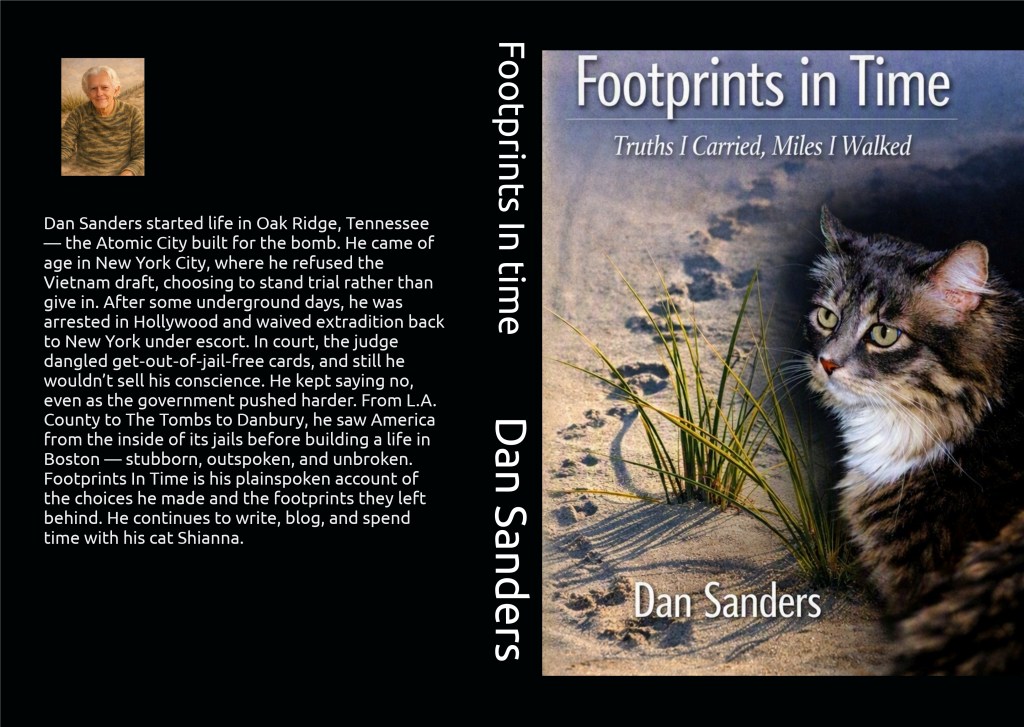
This moment comes from a stretch of my life when I was being moved across the country by U.S. Marshals—an experience that was tense, surreal, and, somehow, funny. I learned early on that if I could get the Marshals to crack a smile, the miles went by a little easier. This particular memory landed on Easter Sunday, somewhere in the endless wheat fields of Kansas, when the only thing to do was look out the window and try to keep the mood human.

“The one day I am sure of on this trip was Easter Sunday, and I remember that because as we traveled through the wheat fields of Kansas—miles and miles of nothing but wheat—I said to the Marshals, ‘You guys know it’s Easter?’ and one replied sarcastically, ‘Yeah, ya’ want to go to church?’ I replied, ‘No, I’m not much on churchgoing, but I thought we might have an Easter egg hunt, and I’ll be glad to play the part of the egg.’ This was the second time I made them laugh.”

For the whole story, the complete book follows the bouncing link at the bottom. But to help avoid Amazon’s paranoid algorithm, I’ll borrow a line from the Grateful Dead:

“Just one thing I ask of you, just one thing for me

Please forget you know my name, my darling Sugaree…”

Shake it, shake it, Sugaree — just don’t tell them that you know me.

Here’s the link to the full book: Here’s the link to the full book: https://a.co/d/016MrqUQ

Leave a comment

This site uses Akismet to reduce spam. Learn how your comment data is processed.

Rating: 1 out of 5.

Rambling Harbor — Evening Edition Ramble AKA WTF Again

Tonight’s tide brought in a story I wish I didn’t recognize.

Evening settles over the Harbor like a worn jacket, the kind you keep by the door because it knows your shape better than you do. The light goes soft, the gulls quiet down, and the world finally stops shouting long enough for you to hear the small truths rattling around in your own chest. That’s when the news found me tonight — not with a bang, but with that familiar sting that comes when history gets pushed around like furniture someone’s tired of looking at.

Another round of funding carved out of Black museums. A Black heritage sign quietly taken down in Boston, as if memory itself were something optional, something you could tuck away when it makes the wrong people uneasy. It didn’t surprise me, but it sure as hell set something off — not a blaze, just that low, steady rumble from a place that’s been paying attention for too many years.

And this isn’t the first time I’ve felt that rumble. A few years back, I resigned from an organization I’d given time and heart to. Not because I heard the man say anything — I never did. This was all online, all at a distance. But then I read he was running for political office in Texas, and one of his proud public stances was opposition to what was then being called “critical race theory.” That was enough. I didn’t need a speech or a meeting or a debate. I just knew I wasn’t going to stay in a place led by someone who wanted to shut down the teaching of systemic racism and the harder truths of American history. If the truth makes you uncomfortable, maybe the problem isn’t the truth. So I walked. Quietly. Cleanly. And I didn’t look back.

And now here we are again, only the stage is bigger, and the stakes are heavier. Grants pulled from the Massachusetts Museum of African American History because the work doesn’t “align with priorities.” Heritage markers taken down like they were never there. Museums and cultural programs frozen out because they dare to tell the story straight. And the language is always the same — “divisive concepts,” “ideological concerns,” “restoring sanity.” Whenever politicians start talking about restoring sanity, you can bet they’re about to erase something.

It’s the same old dance: erase, rename, sanitize, repeat. Pretend it’s about budgets. Pretend it’s about neutrality. Pretend it’s anything except what it is — a slow tightening of the blindfold. And the people doing the tightening always swear they’re the ones protecting us from indoctrination. Meanwhile, the museums they’re defunding are the ones holding the receipts, the records, the stories this country has spent centuries trying to bury.

And what really gets me is the déjà vu of it all. I’ve seen this movie before. I’ve walked out of rooms — and online spaces — over it. And now it’s happening on a national scale, with institutions and memory and public truth on the line. Every time someone says “critical race theory,” what they really mean is “stop telling the parts of the story we don’t like.” Every time a sign comes down, or a grant disappears, they’re hoping the story goes with it.

So here I am, evening deepening over Rambling Harbor, the tide pulling at the edges of the day, and I’m thinking about how fragile memory becomes when people in power decide it’s optional. I’m thinking about how many times we’ve had to fight just to keep the truth in the daylight. And I’m thinking about how history isn’t fragile at all — but apparently some people are.

That’s the ramble tonight. The Harbor’s quiet, but the headlines aren’t. And somewhere out there, the truth is still trying to speak, even if someone keeps reaching for the dimmer switch.

From Rambling Harbor, I ask again: what do we do now?


Leave a comment

This site uses Akismet to reduce spam. Learn how your comment data is processed.

Rating: 1 out of 5.

One of the Unrecorded

I was just doing some research on this book, and as I’ve said, I’m horrible with dates. I always have been, as they drift into ancient history, they become a lost, whirling maze of amazement and often befuddled amusement. Just now, I was looking for someone from my CCNV days, and after a multitude of different search sources and avenues, including AI, it came back.

 “You’re trying to find someone who lived in a world that didn’t preserve itself well — CCNV, Catholic Worker, Berrigan circles, early women clergy. Those people didn’t leave digital trails.”

 I laughed aloud and said in my best Robert Deniro Taxi voice, “You talkin’ to me?” I know. I’m one of them, lost to time, memory, but maybe not to history.

About a year ago, I spent several weeks with on-and-off communication with various federal agencies trying to get copies of my arrest and prison records. I started with the bureau of prisons The Bureau of Prisons stated that they do not retain records beyond ten years,  They gave me a link to the FOIA ( Freedom of Information Act) the freedom of information act said that because of my type of cases any records would most likely be held by the National Archives they may have retained documentation related to this type of case. I wrote to the National Archives, but have not heard back. I am willing to bet no one has ever tried so hard to prove they are a criminal. Even though the law I broke needed to be broken, and I still would love to see my whole records including as Arlo Guthrie put it in the song “Alice’s Restaurant”, a black and white 8 by 10 glossy.

So yeah, I did and still do live in a world that doesn’t preserve itself well.

Part of me hopes we’re not all lost to history. And part of me thinks maybe that’s the way it was always meant to go.

Leave a comment

This site uses Akismet to reduce spam. Learn how your comment data is processed.

Rating: 1 out of 5.

Morning Ramble: Bad Bunny, Kid Rock, and the Strange Weather of Culture

Morning Ramble: Bad Bunny, Kid Rock, and the Strange Weather of Culture

Some days, the cultural weather rolls in sideways, and you find yourself watching people online argue about whether Bad Bunny or Kid Rock is the “real” entertainer. This debate misses the core point: what matters isn’t which entertainer is more legitimate, but the type of culture each represents. Comparing them is like comparing a lighthouse to a lawnmower — both make noise, but only one helps you find your way home.

Bad Bunny — Benito — is out there bending sound like light through a prism, turning reggaetón, trap, pop, and whatever else he feels like into something that feels alive. He’s got Grammys, stadiums, and a global fanbase that sings in Spanish with their whole chest, even if they only understand every third word. He’s fluid, political when he wants to be, joyful when he chooses to be, and unbothered by the borders other people try to draw around him.

Kid Rock, meanwhile, is still trying to convince the world he’s the same guy from the “Cowboy” era, even though the world has rotated a few dozen times since then. The swagger hardened into shouting, the rebellion calcified into grievance, and the lyrics… well, let’s just say they don’t exactly age like wine. More like something you’d find in a forgotten cooler behind a shed.

And that’s why—let me be crystal clear—I would choose the Super Bowl halftime show over Kid Rock and TPUSA. Not out of spite or politics, but because the moment feels like a reflection on what culture can grow into, not what it leaves behind. It comes down to the music, the message, the energy—the difference between expanding the world or holding it still.

Bad Bunny writes about identity, heartbreak, joy, pride, and the messy business of being human. Kid Rock writes about… well, sometimes things you wouldn’t want on your search history. One artist is building bridges; the other is burning daylight.

But the funny thing about music is that it’s weather. It shifts. It tells you what season the culture is in. Bad Bunny is a warm front rolling in from the Caribbean, reshaping the atmosphere. Kid Rock is a cold gust from a bar that closed at 1 a.m. and forgot to turn off the neon sign.

Maybe that’s the whole point: choosing between them isn’t really about music — it’s about the kind of world we want to live in. Are we supporting a culture that grows and remixes itself, or one that clings to the past and resists change? This is the real choice at the heart of the argument.

Anyway, that’s what washed up on the harbor today. The tide brings what it brings.

Have a good morning. As the Super Bowl approaches—a time that should be about sports, not politics—I’ll keep exploring the truth about why Bad Bunny, Kid Rock, and the halftime show matter in this cultural conversation.

Leave a comment

This site uses Akismet to reduce spam. Learn how your comment data is processed.

Mentors

Mentors can come from the docks, the back roads and back alleys, or, surprisingly, a monastery in Kentucky. Thomas Merton was one of mine. He wasn’t my only mentor, but he was a steady voice that helped me find clarity.

He was born in 1915 in Prades, France—a place distant from here, and even further removed from the Trappist life he ultimately embraced. Throughout his life, he authored 50 books, wrote 2,000 poems, and kept journals that revealed a relentless pursuit of personal growth.

What I admired wasn’t just that he was a monk. It was the strength underneath. He questioned everything, including himself. He spent time in silence, listening to things most of us drown out with noise, drinking, TV, or anything else we use to avoid facing ourselves.

He wasn’t afraid to say he didn’t have all the answers. Sometimes, he wasn’t even sure he was asking the right questions. That kind of honesty can surprise you and help you see things more clearly.

He taught me that solitude isn’t about escaping. It’s about taking care of yourself, like cleaning a boat so it keeps moving. He showed me that silence isn’t empty; it’s where change happens. He also taught me that being human is slow, difficult work, often done without recognition and against challenges.

I’ve had other mentors—some loud, some quiet, some unexpected. But Merton taught me how to be still without losing myself, how to listen, and how to stay honest even when the truth is hard to accept.

Every year on his birthday, I remember him. Though he was born in France in 1915 and eventually became a Kentucky monk, he somehow found his way into my journey. Even from behind monastery walls, he found ways to help others see new possibilities.

We don’t choose all our mentors. Some arrive unexpectedly, shaped by life, and turn out to be just what we need to keep going.

Now, fifty years later, after running up and down many roads, I find myself once again sitting in silence. Being alone is sometimes the hardest part—quiet, remembering who I have been, and, most importantly, who I am. I sometimes drift with the tide, or swim against it when necessary, here on the shores of Rambling Harbor.

Leave a comment

This site uses Akismet to reduce spam. Learn how your comment data is processed.

A Message of Hope — A story about friendship, courage, and the small ways hope still finds us.

I have a friend I’ve known since 1980, someone who used to listen to my overnight radio show when she was only sixteen. She would call me in the middle of the night, and we’d talk. I remember wishing her a happy eighteenth birthday at midnight. We met many years later in a grocery store when she was in her thirties, just before Halloween, at a time when my personal life was going through struggles as my wife battled cancer. I hadn’t seen her standing there, but I guess she remembered my voice, and I heard her say with a question mark in her voice, Sanders? And I then remember the voice that had kept me company through a phone so long ago. I like to tell her it was over the Candy Corn aisle, but she denies that memory. Still, I’ve always liked the idea that hope can show up in the corniest places. We’ve remained friends ever since. And before you get the wrong idea and think you know where this is going, here’s where it takes a sharp left.

My friend has been married and has a daughter and a granddaughter. I met her daughter once, when I think she was around eight years old—a beautiful young child. That daughter is now older than her mother was when she used to call that lonely late-night DJ. My friend comes from a religious upbringing, and her daughter, through her own choices, has been pursuing a life in the ministry as a student at a local school.

Here comes that left turn again. A few days ago, I got a message from my friend saying her daughter was preparing to go to Minneapolis, Minnesota, and that she was both proud and petrified. I told her I could understand both. Of course, we all know the horror unfolding in the city.

My friend is well aware of my resistance to the Vietnam War, my time in prison for refusing induction, my involvement with Phil and Dan Berrigan, as well as my own stay in seminary and a basic life of resistance to oppression in all its ugly forms. And I know that’s one reason she chose to tell me about her daughter’s upcoming adventure.

So why am I telling you this story? Because it’s a story of hope. In this world where ugliness is all around us—where women can be shot as their last words still echo in our minds, “I’m not mad at you, dude”; where our president tries to conquer the world and tear down democracy one White House brick at a time; where someone I’ve known and worked with can try to justify what ICE is doing and justify that shooting—when I’m at my darkest and it feels like everyone has lost all sense of morality and right or wrong… out of nowhere, I got a message of hope.

This beautiful young child I met so many years ago is heading into the belly of the beast to try to influence and bear witness to the truth. And I’m sharing this with you because I have friends who feel as scared and disappointed as I have—friends who, in their own ways, have tried to bring truth and hope into the world, who want things to change and get better, and who have felt disappointed, hopeless, and lost as things just keep getting worse.

And maybe part of why this hit me so hard is because this isn’t just anyone’s daughter. This is the daughter of a woman who has been woven through almost half my life—a friend who once called a lonely late-night DJ at sixteen, who somehow stayed woven through the fabric of my life through decades of change, disappointment, and small miracles. I care what happens to her. I care what happens to her daughter. And knowing that this young woman is stepping into the world with courage, conviction, and a sense of calling… well, that felt like a comforting hand on my shoulder in a dark room.

Hope doesn’t always arrive with trumpets. Sometimes it shows up as a message from an old friend, telling you her daughter is heading into the storm because she believes in something better. She leaves on Wednesday. And for a moment—just long enough—you remember that belief is still possible, and you feel yourself steady a bit. I hope this story offers the same small steadiness to anyone who’s felt their strength wavering.

Leave a comment

This site uses Akismet to reduce spam. Learn how your comment data is processed.

Subscribing to my website is free.

The Face in the Window

From a cross he cried, “Forgive them.”
“I’m not mad at you,” she smiled.
Three times he fell,
Three shots rang out.
From the wood, his blood hit the ground.
From the car, the road turned red.

They say he walked again.
I asked if that is so.
Is this where her story ends?
Or did he know he’d need to be seen again
in this world of doubt and sin —
a world where mercy comes, if it comes at all,
from a car and a smiling face within?

Forgive them.
I’m not mad at you, dude.

And while her heart and name were Good
There is no forgiveness for what the ICE man stood.

← Back

Thank you for your response. ✨

Rating(required)

Leave a comment

This site uses Akismet to reduce spam. Learn how your comment data is processed.