
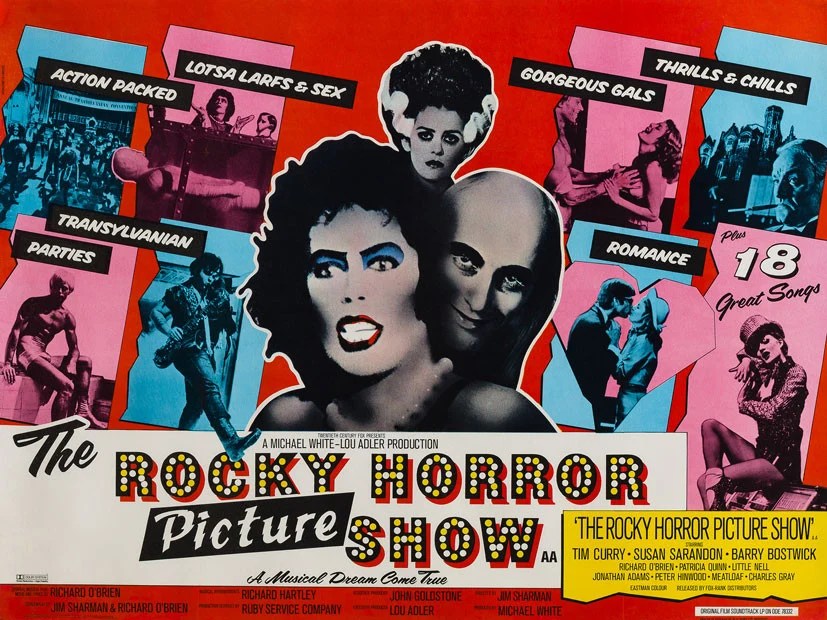
Rocky Horror at the Orson Welles Cinema and Tim Curry

The Orson Welles Cinema in Cambridge was one of those places that didn’t just show movies — it created events. By the late seventies, the midnight screening of The Rocky Horror Picture Show had turned into something closer to a weekly pilgrimage. You didn’t just go to see a film. You went to be part of something strange, loud, funny, and absolutely alive.

The theater itself had a kind of scrappy charm. It wasn’t a palace like the big Boston houses. It was smaller, more intimate, a little rough around the edges — the perfect place for a movie that didn’t fit anywhere else. When the lights went down and the opening lips filled the screen, the whole room shifted. People shouted lines, threw props, danced in the aisles. It was chaos, but it was joyful chaos, the kind that makes you feel like you’re part of a tribe.

And of course, Tim Curry was part of that magic. Not in person — he never performed live at the Orson Welles — but his presence filled the room every time Frank‑N‑Furter strutted down that staircase in heels and pearls. His performance in the 1975 film was the heartbeat of the whole thing. Every midnight showing was built around him, around that wild mix of danger, humor, seduction, and pure theatrical electricity he brought to the role. You could feel the crowd lean forward when he appeared, like they were greeting an old friend.

The Orson Welles screenings helped turn Rocky Horror from a movie into a ritual. People came week after week. Some dressed as Columbia or Magenta, some as Riff Raff, and some just came to watch the madness unfold. The shadow cast acted out the film in front of the screen, timing every gesture to Curry’s voice. It didn’t matter that he wasn’t there in the flesh — his performance was the anchor, the spark, the reason the whole thing worked.

By the time the Orson Welles Cinema closed in 1986, Rocky Horror had already become a legend. But for a lot of people in Cambridge and Boston, the real memories weren’t just of the movie — they were of those midnight gatherings, the laughter, the shouting, the feeling that for a couple of hours you were part of something bigger, stranger, and more fun than anything else in town.

And now they’re both gone. The Orson Welles is dust, the midnight crowds long scattered, but Tim Curry’s Frank‑N‑Furter still shines like a spark from a world that will never come again.
Leave a comment

This site uses Akismet to reduce spam. Learn how your comment data is processed.

Howard Phillips Lovecraft-H.P. Lovecraft,

Born August 20th, 1890, Howard Phillips Lovecraft-H.P. Lovecraft,

It’s the birthday of H.P. Lovecraft, born Howard Phillips Lovecraft in Providence, Rhode Island, back in 1890 — a man who somehow turned the quiet corners of New England into a map of cosmic dread. Funny how a place like Providence, with its brick houses and sleepy streets, could produce someone who spent his life staring into the abyss and then reporting back on what stared right back at him.

Lovecraft wasn’t writing about monsters, not really. He was writing about that feeling you get at three in the morning when the world tilts just a little, and you realize you’re smaller than you ever imagined. He gave that feeling names — Cthulhu, Yog‑Sothoth, the whole tentacled family reunion — but the real terror was always the same: the universe doesn’t care. And he wrote that truth with the intensity of a man who felt it in his bones.

He lived most of his life broke, anxious, and tucked away in rented rooms, scribbling stories that wouldn’t become famous until long after he was gone. There’s something almost New England about that — the stubbornness, the quiet grind, the belief that the work matters even if nobody’s listening yet. Providence shaped him, and in return he reshaped Providence into a place where shadows have weight and old houses whisper at night.

On his birthday, I think about how strange it is that a man who rarely traveled farther than the Northeast managed to chart entire galaxies of fear. And how his stories, written in the margins of his own troubled life, still echo through books, movies, games, and the imaginations of anyone who’s ever felt the cold breath of the unknown on the back of their neck.

Lovecraft didn’t give us hope. He gave us honesty — the kind that crawls under your skin and stays there. And maybe that’s why he endures. Because sometimes the world really does feel bigger, darker, and stranger than we can handle. And he was the one who said, “Yes. It is. And here’s what that looks like.”

And when you look at the end of his life, it fits the man: a quiet death in 1937, only 46, worn down by illness and poverty, leaving behind stories that outlived him by decades. Today his grave in Swan Point Cemetery has become its own kind of pilgrimage site. The headstone now famously reads “I AM PROVIDENCE.” Visitors leave coins, stones, shells, little figurines, handwritten notes — small offerings to a man who spent his life writing about the vast, uncaring universe.

And lately, there’s this odd little tradition that’s grown legs: bottles of vodka left at the grave. Lovecraft hated alcohol, wouldn’t touch the stuff, so maybe it’s a joke, maybe it’s a dare, maybe it’s just fans being weird in the way fans get weird. But the strange part is how the offerings sometimes move. A bottle set neatly at the base of the stone ends up a few feet away the next morning. Stones rearrange themselves. Notes shift. Cemetery staff say it’s wind or animals or teenagers, and maybe it is. But standing there, looking at that grave with its quiet declaration — I AM PROVIDENCE — you can’t help feeling that the man who wrote about the thin places in the world might still have one around him. A little ripple. A little nudge. A little reminder that mystery doesn’t always need monsters.

Just a grave, a name, a bottle of vodka that won’t stay put, and the sense that even now, something old and curious is paying attention.

See less

Leave a comment

This site uses Akismet to reduce spam. Learn how your comment data is processed.