

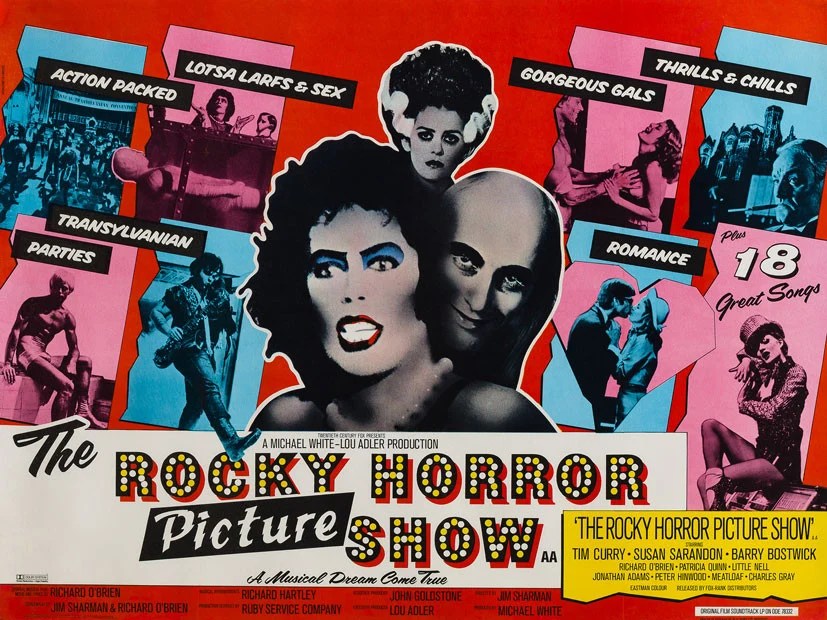
The Orson Welles Cinema in Cambridge was one of those places that didn’t just show movies — it created events. By the late seventies, the midnight screening of The Rocky Horror Picture Show had turned into something closer to a weekly pilgrimage. You didn’t just go to see a film. You went to be part of something strange, loud, funny, and absolutely alive.
The theater itself had a kind of scrappy charm. It wasn’t a palace like the big Boston houses. It was smaller, more intimate, a little rough around the edges — the perfect place for a movie that didn’t fit anywhere else. When the lights went down and the opening lips filled the screen, the whole room shifted. People shouted lines, threw props, danced in the aisles. It was chaos, but it was joyful chaos, the kind that makes you feel like you’re part of a tribe.
And of course, Tim Curry was part of that magic. Not in person — he never performed live at the Orson Welles — but his presence filled the room every time Frank‑N‑Furter strutted down that staircase in heels and pearls. His performance in the 1975 film was the heartbeat of the whole thing. Every midnight showing was built around him, around that wild mix of danger, humor, seduction, and pure theatrical electricity he brought to the role. You could feel the crowd lean forward when he appeared, like they were greeting an old friend.
The Orson Welles screenings helped turn Rocky Horror from a movie into a ritual. People came week after week. Some dressed as Columbia or Magenta, some as Riff Raff, and some just came to watch the madness unfold. The shadow cast acted out the film in front of the screen, timing every gesture to Curry’s voice. It didn’t matter that he wasn’t there in the flesh — his performance was the anchor, the spark, the reason the whole thing worked.
By the time the Orson Welles Cinema closed in 1986, Rocky Horror had already become a legend. But for a lot of people in Cambridge and Boston, the real memories weren’t just of the movie — they were of those midnight gatherings, the laughter, the shouting, the feeling that for a couple of hours you were part of something bigger, stranger, and more fun than anything else in town.
And now they’re both gone. The Orson Welles is dust, the midnight crowds long scattered, but Tim Curry’s Frank‑N‑Furter still shines like a spark from a world that will never come again.


Leave a Reply