

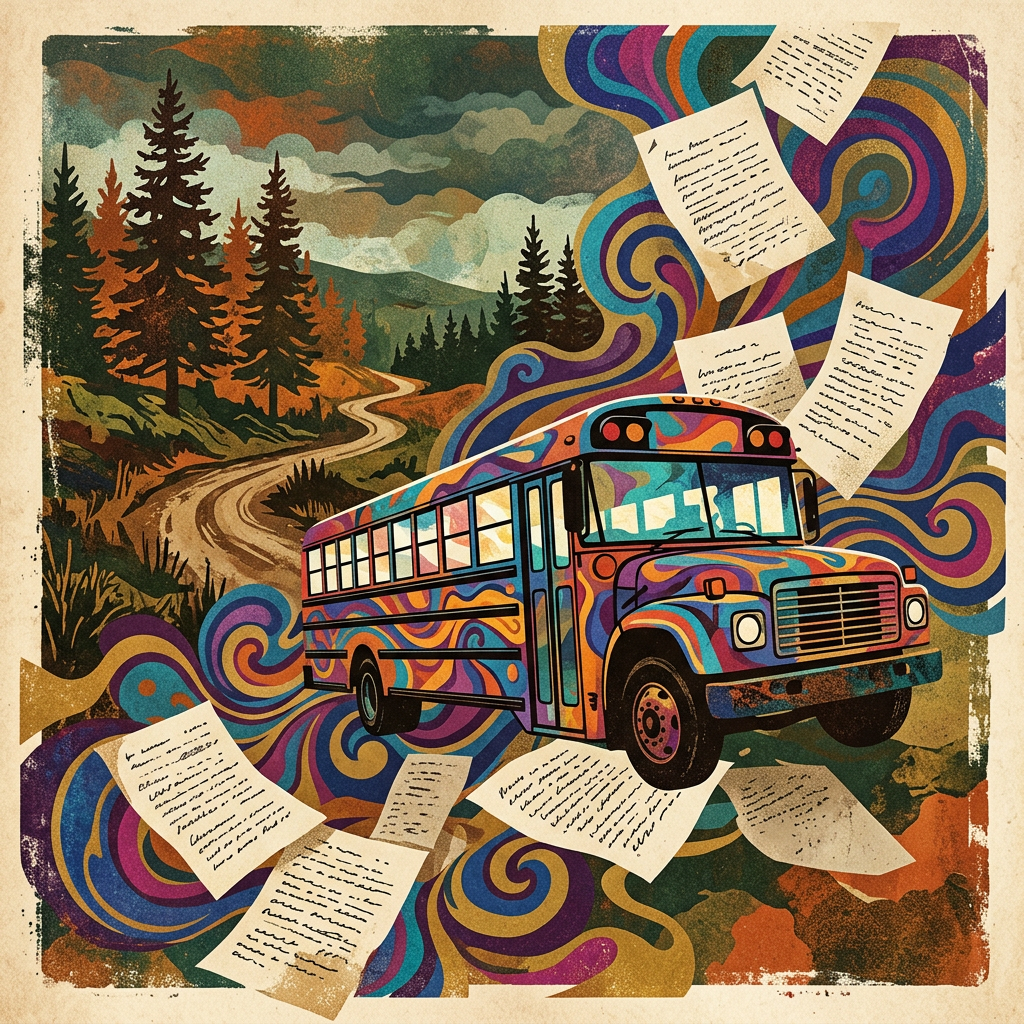
Ken Kesey’s birthday rolls around today — kid came squalling into the world out in La Junta, Colorado back in ’35, but he really grew up wild in Oregon, the real Oregon, not the brochure. Him and his brother Chuck tearing down the Willamette River like they were trying to outrun the sun. Swimming, fishing, wrestling the rapids, wrestling each other, wrestling life itself. The guy was built like somebody who didn’t mind getting punched in the face if it meant a good story later.
In high school they tagged him “most likely to succeed,” which is funny, because Kesey’s idea of success was never the one the guidance counselor had taped to the wall. He goes off to Stanford to study creative writing — sure, fine — but then he ends up at the VA hospital in Menlo Park making seventy‑five bucks a day letting doctors pump him full of LSD and whatever other alphabet‑soup chemicals they were cooking up. Seventy‑five bucks in the early ’60s! That’s rent, groceries, and a couple nights of trouble.
He stuck around afterward as a night attendant in the psych ward, wandering those fluorescent hallways while the world slept. That’s where One Flew Over the Cuckoo’s Nest came from — not theory, not academia, but the real deal: human beings cracked open, stitched together, trying to make sense of the noise in their heads. The title came from an old kids’ rhyme: “One flew east, one flew west, one flew over the cuckoo’s nest.” Simple, spooky, perfect.
Pauline Kael said the book had the whole damn era packed inside it — Vietnam, campus revolts, drugs, the counterculture — all before the country even realized it was about to blow its gasket. Kesey wasn’t predicting the future; he was already living in it.
And somewhere in the middle of all that chaos, he fell in with a little San Francisco band called the Grateful Dead. They weren’t legends yet — just a bunch of long‑haired kids with amps that hummed like beehives and a drummer who looked like he’d been born in a thunderstorm. Kesey and the Merry Pranksters pulled the Dead into the Acid Tests, those wild, neon‑soaked nights where music wasn’t just played, it was summoned. The Dead became the house band for the psychedelic revolution, and Kesey was the ringmaster, the guy stirring the punch bowl and the consciousness of everyone in the room. Garcia once said Kesey didn’t just open doors — he kicked them off the hinges. And Kesey loved the Dead because they weren’t trying to be stars; they were trying to be free. It was a friendship built on noise, color, and the belief that life could be bigger than the box it came in.
Then Hollywood got its hands on Cuckoo’s Nest in ’75, and boom — six Oscars. Jack Nicholson grinning like the devil in a denim jacket. Kesey didn’t love the movie, but that’s another story for another windy day. He wrote Sometimes a Great Notion — big, wet, logging‑town epic — and later Sailor Song, which reads like Alaska got drunk and decided to tell you its secrets.
Kesey was one of those American originals — the kind you don’t get anymore. Half cowboy, half mystic, half troublemaker. Yeah, that’s three halves, but Kesey never fit in the math anyway.
And then there’s the interview — the one I watched again this morning. Not Merv Griffin. Not some slick 1960s talk‑show host with a shiny desk and a band in the corner. No — this was Charlie Rose, 1992. Rose in his suit, leaning forward like he’s about to ask the meaning of life. Kesey sitting across from him, older now, beard gone,hair gray at the edges, wearing a simple dark shirt, no blazer, no tie‑dye, just Kesey as he was — a man who’d lived through the noise and come out the other side with a grin that said he still knew a few secrets the rest of us hadn’t caught up to yet.
It’s a collision of worlds — Rose’s studio polish against Kesey’s Oregon mud. Rose wants to talk literature; Kesey wants to talk life. LSD, rivers, kids, stories, the whole messy American experiment. You can see Rose trying to keep it tidy, but Kesey keeps slipping out of the frame, like a fish that refuses to be caught.
That’s the beauty of it — two men, one chasing understanding, the other chasing freedom. Kesey’s grin says he’s still riding the rapids, still hearing the music under the noise. And somewhere in that studio, between the questions and the laughter, you can feel the ghost of the Willamette River rolling through the lights.
The link to that interview https://youtu.be/BJjNIoODO2k




Leave a Reply