White Hall Station

Sometimes a chapter needs another walk around the block, and this one did. I went back, rewrote it, and finally gave a little mouse named Archibald MacLeash the explanation he deserved. If you’ve read the book, this fills in the cracks. If you haven’t, well—welcome to the neighborhood.

The night before my induction, I couldn’t sleep. I lay in bed staring at the ceiling, looking for answers. My heart pounded like I’d just run the 40‑yard dash. A drumbeat I wasn’t sure I could march to — too fast, too loud, too soft, and definitely its own rhythm. But I knew exactly where I did not want to march.

I tried everything: counting breaths, replaying old football games, thinking of my girlfriend, even astral projection — maybe I could end up on some tropical island, safe and away. I wanted to be anywhere but, in that room, in that bed, wondering where I might be tomorrow night. But dread snuck in under the door and settled in my brain. I wasn’t afraid of dying. I was afraid of disappearing — of becoming a number, a uniform, a cog in a machine I didn’t believe in.

The draft lottery — America’s twisted game show of fate — wouldn’t begin until 1969. But in 1964, the draft was still run by local boards, deferments reviewed by hand. At eighteen, I burned my college deferment card, thinking I was making a statement. I wrote letters to President Johnson and to my Staten Island draft board, asking to be reclassified 1‑A. You can’t refuse what you haven’t been offered. And I was tired of hiding behind loopholes, even if I hadn’t meant to hide in the first place.

By ’69, they granted my wish. I was 1‑A — fit for service, next in line to toe the line, or not. Five years of business schools and seminaries had led me here. From the gridiron to leg irons.

And then the morning came.

I was up by 6 a.m. — not that I’d slept. I left a note for my mother saying I’d gone to visit friends. I wondered how long I’d really be gone. I took the bus to the Staten Island Ferry, crossed the Hudson, and walked the two longest blocks of my life to Whitehall Station. Even writing about it now, I can feel that god‑awful sickness in my stomach. I can’t do this.

Fight or flight? Mine was freeze and sit. No exit. Just a heart pounding like a drumline on speed. I was about to jump off a cliff and couldn’t see the bottom. Compared to this, the Coney Island Parachute Jump was a kiddie ride.

Whitehall Station sat in lower Manhattan like a bureaucratic bunker — the place where boys became soldiers or tried not to. It shut down in 1972, two days before my birthday, while I was in Danbury Federal Correctional Institution. I’d wanted it torn down. I’d done my best to see that happen.

As I climbed the steps, I saw Mr. Harold Jones waiting outside. My eighth‑grade science teacher — but more than that. Over the years, he’d become my confidant, the one adult who understood what I was feeling. He made science feel like storytelling, helped along by a fictional mouse named Archibald MacLeish who lived in his coat closet. I never saw him, but I saw him. Still do.

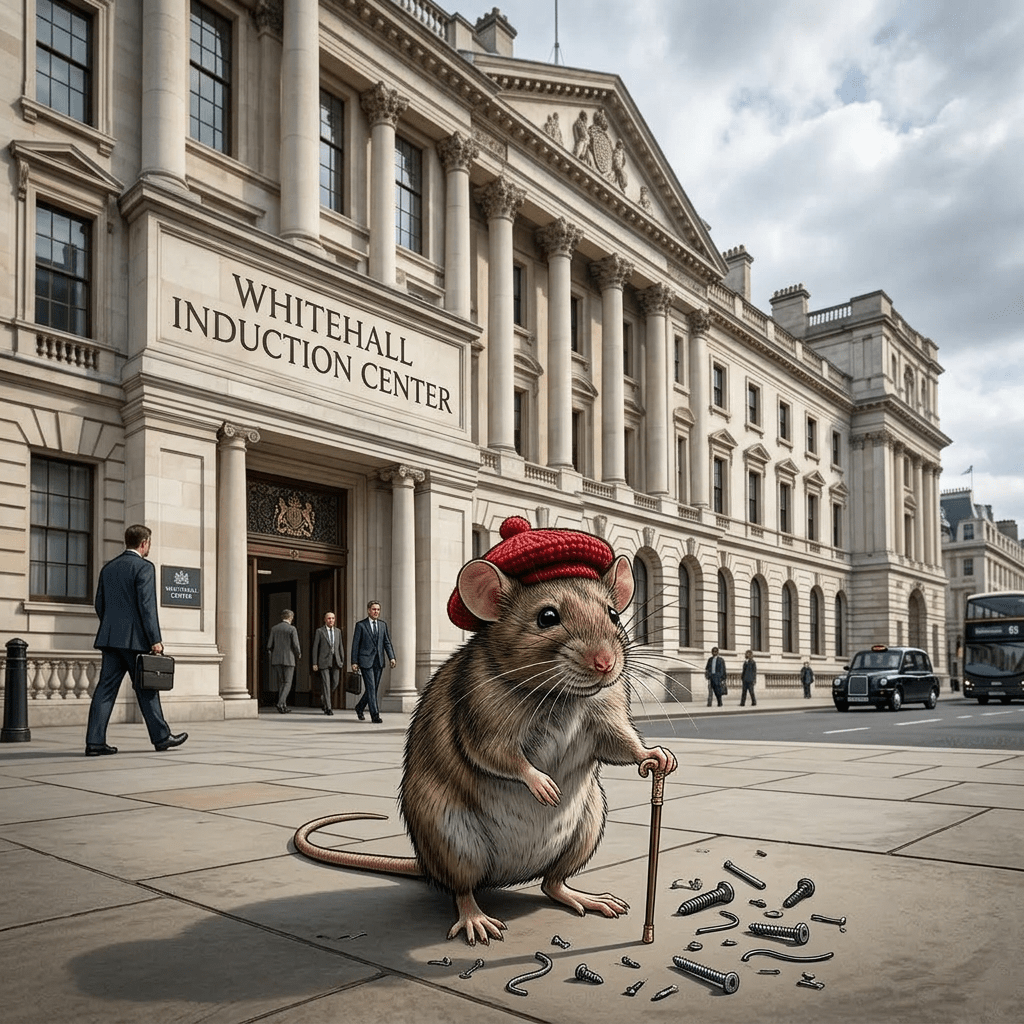
Mr. Jones said he named the mouse Archibald MacLeish after the poet — “because even a mouse can carry big ideas,” he told me once, tapping his temple like he was winding up a thought. MacLeish wrote about truth, about standing your ground when the world tries to bend you, about the kind of dissent that isn’t loud or showy but stubborn and necessary. He believed democracy wasn’t something you admired from a distance — it was something you practiced, even when it cost you. Jones figured a mouse could teach eighth‑graders more about courage and conscience than any textbook. The beret, the cane, the red bandana — that was all me. That’s how I pictured him: a tiny philosopher with a rebel’s wardrobe, the kind of creature who’d whisper, Don’t let them turn you into something you’re not. Archibald showed up whenever I needed him — not as a hallucination, not as a joke, but as a reminder that dissent can be quiet, steady, and small, and still shake the world.

Mr. Jones didn’t say much that morning. He didn’t have to. He told me to stay who I was. Said it was something to be proud of.

Inside, the induction ceremony began. The room smelled of sweat. The air was thick with the breath of boys pretending not to shake. The recruiter’s voice was flat, rehearsed, like he’d stopped listening years ago.

“Please repeat after me…”

“I do solemnly swear…”

Repeat. Repeat? Hell, I could barely breathe.

“…that I will bear true faith…”

And suddenly I wasn’t in Whitehall anymore. I was back on the football field, hearing my coach yell, “Go in hell‑bent for leather, Little Sandy!” My dad was Big Sandy. The coach used that nickname to rile me up. Hell‑bent for leather — without fear.

My heart picked up the chant until it drowned out everything else.

Then came the words: Step forward.

I sat down.

The recruiter blinked, confused. Thought I was sick. I stood, breathed, sat again.

“I’m not moving,” I said, though I wasn’t sure I could even if I wanted to.

The sergeant’s face turned fire‑engine red. My heart was a jackhammer. I was frozen in defiance — or fear. Maybe both. I prayed he wouldn’t hit me. If he did, I wasn’t sure I could stop myself from hitting back. I may be a peacenik, but I know myself. Anger lives in me too. If I struck him, I wouldn’t be going to jail for trying to end a war, but for starting one.

Two MPs grabbed me like a sack of potatoes and hauled me to a holding cell. I expected that part. I was prepared. No blows were thrown. An Army lawyer came in to make sure I knew what I was doing. I asked if he knew what he was doing — and what he was part of. He accepted my yes and left.

Then came the police car, the ride to Staten Island, and my first night in jail. Five miles from the gridiron. A lifetime away.

As they carried me out of Whitehall, I refused to walk — part of my plan for total non‑cooperation. Mr. Jones stood on the grimy sidewalk. He smiled. Gave me a thumbs‑up. I flashed him a peace sign from between a cop’s holster and his arm.

And behind him — I swear — I saw Archibald MacLeish strutting down the sidewalk, beret tilted, cane tapping a rhythm only I could hear. He paused near the induction center door, tipped his hat, and whispered, “Courage isn’t loud. It’s the quiet refusal.” Then he vanished into the crowd.

Mr. Jones arranged to bail me out, though I was released on my own recognizance. I spent the rest of the day at his home — resting, recovering, trying to make sense of what had just happened. And what would happen next. To my mother, I was simply visiting Mr. Jones. I was old enough to say, “Don’t call my parents,” and the authorities obliged.

A trial date was set for April. The weeks leading up to it blurred into paperwork, legal advice, friends’ advice, and panic. I walked Manhattan like I always had, but now I memorized the cracks in the sidewalk, the rhythm of subway trains, the smell of roasted peanuts from corner carts — anything to anchor me.

Oddly, I’d always found the Financial District peaceful on a Sunday morning. Wall Street’s insanity gave way to silence. I walked it a few times in those last days. And Times Square — the lights of Broadway weren’t going to shine on me, but they still shine inside my memory. So do the beaches of Staten Island.

I didn’t know what I was looking for. Only that it wasn’t in New York anymore.

And so the city’s noise faded behind me. The cracks in the sidewalks, the drumbeat of the subway, even Broadway’s lights became part of a memory I carried but could no longer live inside.

What I needed was silence. Steadiness. A place where the ground didn’t demand allegiance.

Somewhere in the back of my mind, I could still hear Archibald’s cane tapping — that quiet rhythm he kept for me when I couldn’t keep one for myself. He’d been at Whitehall, and he’d be on the mountain too. Courage travels light.

Emily’s mountain was waiting. Quiet, immovable, patient — just like she was — offering refuge without question.

Leave a comment

This site uses Akismet to reduce spam. Learn how your comment data is processed.

Archibald the Mystical Mouse

I’ve been thinking since March 5th of 2026, when I published my book, that I should rewrite it — not because I expect sales to suddenly skyrocket, but because I left out some things, explanations that would have mattered. Like the fact that I have this mystical mouse named Archibald MacLeish who shows up in the beginning. I just assumed everyone would sort of get it, and then it started occurring to me, over and over again, that no, not everyone does get it. What’s the big deal about the mouse?

So let me say it plainly.

In my book, I talk about this make‑believe mouse named Archibald MacLeish. He’s a small, mystical presence who slips in and out of the story, but the name itself comes from something real in my life. Back in school, my science teacher kept a classroom mouse, and he named that little creature Archibald MacLeish. At the time, I didn’t know much about the man behind the name, but my teacher did — and he believed in giving things names that meant something.

Later, I learned who the real Archibald MacLeish was — an American poet who wrote about democracy as something you do, not something you admire from a distance. He believed in dissent, in thinking for yourself, in the dignity of choosing your own path.

So the mouse in my book is that mouse — the one supporting my dissent. Not just the classroom mouse, and not just the poet, but the whole chain of belief behind it: a teacher who saw something in me, a poet who stood for freedom of thought, and a reminder that even the smallest presence can carry a big idea.

That’s the namesake. That’s the reason. That’s why the mouse is Archibald MacLeish. That’s why he shows up at the induction center.

And I should have explained that as an introduction to the little guy — why he’s there and given him the honor and the dues he deserved. I think folks would have felt the depth of his presence.

Leave a comment

This site uses Akismet to reduce spam. Learn how your comment data is processed.

Self-Promotion

Fifty‑five of you have hit that “subscribe” button, and I’m grateful for every one of you. Maybe you’re here for the stories, maybe for the memories, maybe because something I wrote once made you stop and think. Whatever brought you here, I’m glad you’re still with me.

Lately I’ve been thinking about how strange it is to promote yourself. It feels like standing on a street corner with a cardboard sign that says, “I wrote a thing, would you mind reading it?” And yet here I am again, doing exactly that.

I’ve spent a lifetime telling stories — on the air, on the page, in the quiet corners of my mind — and somehow they keep spilling out. Some of them turn into poems. Some turn into books. Some just sit with me until they decide what they want to be. But every time I share one, I feel a little less alone in the world, and maybe you do too.

So this is me, waving from the dock, saying thank you for sticking around. Thank you for reading, for listening, for letting me ramble. If something I write makes you think, or laugh, or remember something you thought you’d forgotten, then this whole strange exercise in self‑promotion is worth it.

And just so there’s no confusion: the link below goes to my memoir — ten years of my life, the most dramatic ones — gathered into a book I’m proud of.

I’ll keep walking through my mind. You keep stopping by when you can. Seems like a fair deal.

Leave a comment

This site uses Akismet to reduce spam. Learn how your comment data is processed.

I’m Nobody! Who are You?

I published my first book on March 5th. It’s called I Was There. I probably should’ve called it Who Am I, because it’s a memoir, and since I can’t hang a famous name on it, no one really cares. If I were a famous musician, actor, or politician, it wouldn’t matter if my entire memoir was just me sitting by a luxury pool all day sipping fancy drinks made by an impeccable butler — or better yet, a Butlerette in a miniskirt — people would be clamoring to buy it.

On Amazon, where my book is available, I’m competing with the likes of Maya Angelou, Malcolm X, and Trevor Noah’s mother, for God’s sake — all of whom have written memoirs. And that’s just naming the lesser-known ones, except maybe Trevor’s mother, though I suspect everyone but me knows who she is. I’ll add, with sincere condolences, that all are deceased, and underline that I am not willing to die for this book.

I have considered changing the name to something like Outlaw, rewriting it just a bit — not changing the facts, just throwing in more drama and sex. I could confabulate. In writing, confabulation is when you unknowingly fill in gaps with invented details because your mind wants the story to feel complete, smooth, or emotionally coherent. It’s not lying. It’s not embellishment on purpose. It’s the brain saying, “Let me tidy this up for you,” and slipping in something that feels true even if it isn’t. Then I could list my book under Autofiction, which could easily be misunderstood as autoerotica — and that should outsell Trevor’s mother.

A few weeks ago, I was talking to a good friend who’s also writing a book. Hers is about murder, and as I said to her, she has a better chance of gaining buyers because everyone knows what murder is. Along with not dying for this book, I’m also not willing to kill for it. And let me quickly add that my friend is not the murderess in her book either. Though I’ll bet she’s a killer in a miniskirt.

I also need to say my book is not boring. The folks who have read it have all been sincerely enthusiastic in their positive reviews. It deals with ten very turbulent times in my life — ten years when this country was an amalgam of ideas, movements, people, music, war, and yes, even sex. I was involved in some amazing moments with some amazing people, some known to history — people who, if they wrote a memoir today, would give Trevor’s mother a run for her money.

But you see, what I did, I did quietly. Not a lot of fanfare or fangirls or fantastic shenanigans. Maybe what I need to do now is go out and do something to call attention to myself. Maybe run for President on the WTF Party — that’s the What The Fuck Party — or maybe the LWRS Party, the Left Wing Radical Scum Party. You may have heard mention of that breed of human; I think they’re currently under investigation by the residents at 1600 Pennsylvania Avenue.

But the truth is, I never meant to make a splash with my book — not even in a luxury backyard pool with fancy drinks being served by a Butlerette in a miniskirt. I just wanted to tell my story to a few friends and family while there was still time. Part of the problem, I think, is that many of my friends thought I was writing a completely different book — probably about my hazy, crazy days in radio, which I barely mention.

If all of a sudden some major publisher caught on to my book, a major studio made it into a major and successful motion picture, and I suddenly had fame and fortune and miniskirt‑clad Butlerettes running around, I know I’d be looking for the nearest exit to the highest mountain I could find.

In short, I think maybe Emily Dickinson was right, and her idea fits my personality better.

Emily Dickinson wrote:

I’m Nobody! Who are you?
Are you — Nobody — too?
Then there’s a pair of us!
Don’t tell! they’d banish us — you know!

How dreary — to be — Somebody!
How public — like a Frog —
To tell your name — the livelong June —
To an admiring Bog!

Maybe that’s the whole point: I never wanted to be Somebody. I just wanted to leave a trail for the other Nobodies to follow home.

Leave a comment

This site uses Akismet to reduce spam. Learn how your comment data is processed.

Rating: 1 out of 5.

SUBSCRIBING IS FREE

I Was There

There’s a moment, when you finish a book that came out of your own bones, where the world goes strangely quiet. Not peaceful quiet — more like the hush that settles over the harbor right before the fog rolls in. You stand there thinking, Well, I guess I really did this.

“I Was There” didn’t start as a book. It started as scraps — memories, radio nights, the odd corners of life that stick to you like sea salt. I wasn’t trying to write anything grand. I was just trying to make sense of the noise in my head before it drifted off like a gull that couldn’t be bothered to land.

But stories have their own stubborn tide. They kept washing back up at my feet. And eventually I realized I wasn’t collecting them — they were collecting me.

Now the thing is out there in the world, floating around on Goodreads and Amazon like a bottle tossed into the Atlantic. People can pick it up, shake it, hold it to the light, decide if they want to walk a few miles with me. Some already have. Some will. Some won’t. The tide doesn’t ask permission.

What matters is this: the stories aren’t trapped anymore. They’re free to wander, to be misunderstood, to be loved, to be argued with, to be read at 2 a.m. by someone who can’t sleep and needs to know they’re not the only one who’s lived through a few storms.

If you want to take a look, here’s the Goodreads page — no passwords, no secret handshake, just the book sitting there waiting: Click the little arrow on the left side of the Goodreads page under the word read and a drop-down will appear with the link on it.

https://www.goodreads.com/book/show/249304682-i-was-there

I’ve walked a long road to get here. Some of it was smooth, most of it wasn’t, and all of it ended up in these pages. If you decide to read it, I hope you find something in there that feels like truth — or at least something that feels like company.

The tide keeps moving. The stories keep coming. And I’m still here, walking the shoreline.

Leave a comment

This site uses Akismet to reduce spam. Learn how your comment data is processed.

NO CHARGE FOR SUBSCRIPTIONS