Rambling Harbor Dispatch: The Bill Comes Due

In the late 1960s, while napalm lit the skies over Vietnam, a quieter rebellion flickered across American kitchens. It wasn’t shouted in the streets—it was whispered through unpaid phone bills. The government had slapped a 10% excise tax on telephone service to help fund the war. And hundreds of thousands of citizens said, “No thanks.” They refused to pay, not out of stinginess, but out of conscience. I was one of those. They called it war tax resistance. I call it dialing into dignity.

By 1972, as many as half a million Americans were hanging up on war—literally—by withholding the tax. The IRS attempted to pursue them, once even seizing a man’s car over $2.44. That’s not enforcement. That’s bureaucratic burlesque.

Fast forward to 2025, and the bill has come due again. Only this time, it’s not for war—it’s for one man’s legal battle against the government. President Trump, facing a thicket of lawsuits, wants taxpayers to help cover the costs of his defense. The irony? It’s thicker than a Nixon tape.
In the Vietnam era, we resisted paying for bombs. Today, we’re being asked to pay for briefs. Legal briefs. Filed by a man who once promised to drain the swamp but now wants us to subsidize his wade through it.
Where’s the opt-out box on that invoice?

This isn’t just about money. It’s about memory. About whether public funds should be used to defend personal grievances. About whether the American people are shareholders in someone else’s vendetta. And about whether resistance still has a place in the age of auto-pay and algorithmic distraction.

It may be time to revive the spirit of the phone tax rebels, not with rotary dials and mimeographed pamphlets, but with satire, sanctuary, and a refusal to subsidize secrecy. Maybe it’s time to hang up again—this time on legal tab transfers disguised as patriotism.

Whether it’s $2.44 or $2.4 million, the principle remains: we should not be forced to pay for what violates our conscience.

And here’s my thought: what if you decided to withhold even $ 5 from any tax you might owe, along with a long explanation about why you are doing this? And sure, that would really make no difference, but sometimes it’s the symbolism, the meaning behind the action.

Donald Trump is reportedly seeking reimbursement of approximately $4.2 million. So, along with our $5, what if we lean on major companies? Corporate Tax Revenue: In 2024, the federal government collected roughly $425 billion in corporate income taxes.

Imagine if Apple, Amazon, and Google said: “We’re withholding 3% until Congress passes climate legislation.” Or until war funding is redirected to healthcare. And not one cent to Donald Trump’s defense. It would be the modern equivalent of hanging up on war—only this time, with billions instead of phone bills.

3% Withheld: That’s about $12.75 billion withheld.
Sure, I’m Dan Don Quixote, still maybe swinging at windmills, but this is my first thought tonight. If you have a better one, don’t hesitate to share it.

Rambling Harbor remembers. And resists.

Subscribing is FREE

Leave a comment

This site uses Akismet to reduce spam. Learn how your comment data is processed.

Introduction

I never meant to write a war story. I meant to live a life. Not the kind that ends up in textbooks or on movie screens, but the kind shaped by quiet choices—by sitting down when others stepped forward, by saying no when silence was easier. This book isn’t about the Vietnam War or the peace movement. Those stories already fill libraries. It’s not about my years behind the mic as a radio broadcaster—that came later. Nor is it about the loud ones: the noisemakers, the celebrities, the politicians, or the filmmakers chasing spotlight and legacy.

This book is about quiet defiance. About extraordinary moments tucked inside an otherwise ordinary life. Mine.

During the Vietnam War era, roughly 570,000 young men were labeled draft offenders. Of those, 210,000 were formally charged. Just 8,750 were convicted. And only 3,250 were jailed. Less than one percent. This book is about that final group—the ones history rarely names, Hollywood never casts, and textbooks barely mention. It’s about my friend Kevin, who said, when we reconnected after Daniel Berrigan’s passing in 2016, “Dan, we didn’t go after the government; they came after us. We just wanted to live our lives.” Kevin was right. We wanted to live, and we wanted the boys sent to fight in a war we didn’t choose to live also.

I’m proud to say I was one of the 3,250 who said no. We said it quietly, but loud enough to keep our souls intact while they locked up our bodies. I tell only my part of the story, but I know I’m not so different from the other 3,249. Maybe I can make a little noise for all of us.

I once asked my father what happens when we die. We were walking a dirt road in the Deep South, the heat thick as molasses. I was nine. My dad, a scientist in spirit and mind, told me energy can’t be created or destroyed—it only changes form. Since the human body is mostly energy, it too must become something else. That left me with the unsettling idea that I might not become a mighty oak, but a daffodil on the side of a hill. Maybe my life has been a long attempt to be the oak, not the daffodil. But the jury’s still out.

I never planned to oppose a war, and I certainly never intended to write a book. If I had, maybe I would’ve kept a diary—or at least some decent notes. What few I scribbled on barroom napkins or in stray notebooks are long gone, buried in some landfill. Hopefully, raising a mighty oak. But I do remember a few things.

I’ll tell you about growing up on Staten Island—football, beaches, music, and radio. A middle-class kid with few worldly cares and a head full of books. My first dream was to be a radio star. That dream shifted when friends started coming home in body bags—boys who could run, jump, and catch with the best of us, now still forever.

I’ll try to explain how a painfully shy kid found the courage to sit down instead of stepping forward at Whitehall Station—the military induction center in New York City where young men were processed for the draft. The routine was simple: They underwent a written aptitude test and a physical examination to determine fitness for service.

Based on these evaluations, they were classified (e.g., 1-A for fit, 4-F for unfit). When your name was called, you stepped forward to begin your journey into military service. But I didn’t. I sat down. I don’t know if fear buckled my knees or if I’d read somewhere that sitting was the perfect nonviolent act. Maybe it was both. Either way, that quiet refusal marked the beginning of my resistance.

I’ll take you from New York to the mountains of West Virginia, to a woman named Emily who taught me how to live off the land. Then, to a woman older than I was, with three children, about her, and the court fight for custody of her kids and one of mine. I’ll tell you about my arrest in Hollywood and the cross-country ride back to New York, escorted by U.S. marshals. And the old judge who nearly begged me to take one of his get-out-of-jail-free cards.

I’ll talk about meeting Daniel and Phillip Berrigan in prison. And how resistance didn’t end behind bars, as shown by my trips to solitary confinement for refusing to walk the prison lines. I’ll tell you about fellow inmates like Howard Hunt, G. Gordon Liddy, and Clifford Irving—and the handful of other draft and war resisters. I’ll finish with life after prison.

3,249 other stories may or may not be told. This one is mine.

Dan Sanders

July 2025

Leave a comment

This site uses Akismet to reduce spam. Learn how your comment data is processed.

Rating: 1 out of 5.

CHAPTER TWO: MEETING EMILY

I met Emily in the fall of 1967, during the anti-war march on the Pentagon. That protest—tens of thousands strong—was a rupture. D.C. felt electric and volatile, like the air before a lightning strike. The war was surging, and so was the resistance. Students, clergy, veterans, poets, and provocateurs collided, not always in harmony. The movement was splintering: some preached peace, others demanded revolution. Everyone wanted change, but no one agreed on its shape.

Several years before this, I started writing letters to my draft board. Lyndon B. Johnson was still president, Nixon waiting in the wings. The letters weren’t meant for Johnson, but I imagined him reading them anyway—grimacing, maybe, before tossing them aside. The draft board replied a few times, reminding me I was deferred under 3-A college status. Eventually, they recalculated me as 1-A. Combat-ready. And I welcomed it. You can’t refuse what hasn’t been offered. I was done hiding behind loopholes.

I’ve never had patience for those who ran to Canada, claimed bone spurs, or found clever ways to dodge the draft. If others were saying yes by dying, I could damn well risk my freedom to say no—with my body, not just my words. That was the point. Resistance isn’t clean. It’s not comfortable. It’s not supposed to be.

I first met a friend of Emily’s who invited me to speak at George Washington University about my involvement. Emily was there. Back of the room. Silent. Motionless. She claimed a corner as if it were a refuge. Twenty, maybe twenty-five people in a vast lecture hall. Most clustered together, ready to pounce. She stood apart. Her small frame held a quiet strength.

As I spoke, the questions came hard—verbal rotten tomatoes, launched like missiles. Who was I to think I could end a war? Why did I care? I was safe. I was free. But I kept looking toward her. She hadn’t said a word, yet
I felt held by her silence.

And then she spoke. Softly. Simply. Powerfully.

“Wouldn’t you want them to do the same for you,” she said, “if it were your children being napalmed?”

That sentence still echoes. In 1967, napalm wasn’t theoretical—it was the image on the evening news, the smell in the back of our throats. Her words cut through the noise like truth often does. Amid the shouting, she was the still point.

We met again later that year at another protest in New York City. Reverend Martin Luther King Jr. was speaking at Riverside Church. That speech—his first significant break with the Johnson administration—was a thunderclap. He called the U.S. “the greatest purveyor of violence in the world.” It cost him allies, but it galvanized many of us. Emily and I never saw him speak. Instead, we ended up at Coney Island—my first and only time there.

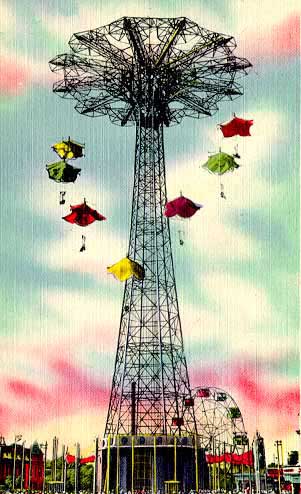
She convinced me to ride the Parachute Jump, a steel skeleton of a tower that looked like it had been designed by someone with a grudge against gravity. Two-person canvas seat. Lifted 250 feet into the sky. Dropped like a stone. Caught, eventually, by a parachute that felt more like a suggestion than a guarantee.

She said it would be fun. I said yes, mostly to impress her. It was not fun. It was terrifying. But she laughed, hugged me, and called me brave. Said it was one of the best experiences of her life. I didn’t understand how she could enjoy it. But I was falling for her faster than that drop from the tower. Before we parted, she told me: if I ever needed a safe place, she had land in West Virginia.

The Pentagon was thunder. Riverside was lightning. But Emily—Emily was shelter. In the roar of fractured movements and rising resistance, she offered stillness. Her words didn’t shout; they landed like balm. Even that wild ride at Coney Island, terrifying as it was, became a metaphor: the world drops you, but sometimes you’re caught—not by canvas or steel, but by someone who sees you.

Before we parted, she offered land in West Virginia—a place untouched by sirens or slogans. A sanctuary. And I began to wonder: maybe the revolution wasn’t just in the streets. Perhaps it was also in the quiet spaces we build with each other.

After more than fifty years, I’ve learned that quiet doesn’t always live in geography. Sometimes it’s tucked into memory, into rituals that outlast the hands that once performed them. And sometimes, it’s the comfort and warmth of remembering the people who held me when the world did not.

Maybe that’s the revolution too—not just in the streets, but in the stillness we carry forward.

And the real question is this: when the world lets you down, who catches you?

A mountain. A mouse. A friend on a grimy sidewalk. Sometimes, that’s enough.