A Message of Hope — A story about friendship, courage, and the small ways hope still finds us.

I have a friend I’ve known since 1980, someone who used to listen to my overnight radio show when she was only sixteen. She would call me in the middle of the night, and we’d talk. I remember wishing her a happy eighteenth birthday at midnight. We met many years later in a grocery store when she was in her thirties, just before Halloween, at a time when my personal life was going through struggles as my wife battled cancer. I hadn’t seen her standing there, but I guess she remembered my voice, and I heard her say with a question mark in her voice, Sanders? And I then remember the voice that had kept me company through a phone so long ago. I like to tell her it was over the Candy Corn aisle, but she denies that memory. Still, I’ve always liked the idea that hope can show up in the corniest places. We’ve remained friends ever since. And before you get the wrong idea and think you know where this is going, here’s where it takes a sharp left.

My friend has been married and has a daughter and a granddaughter. I met her daughter once, when I think she was around eight years old—a beautiful young child. That daughter is now older than her mother was when she used to call that lonely late-night DJ. My friend comes from a religious upbringing, and her daughter, through her own choices, has been pursuing a life in the ministry as a student at a local school.

Here comes that left turn again. A few days ago, I got a message from my friend saying her daughter was preparing to go to Minneapolis, Minnesota, and that she was both proud and petrified. I told her I could understand both. Of course, we all know the horror unfolding in the city.

My friend is well aware of my resistance to the Vietnam War, my time in prison for refusing induction, my involvement with Phil and Dan Berrigan, as well as my own stay in seminary and a basic life of resistance to oppression in all its ugly forms. And I know that’s one reason she chose to tell me about her daughter’s upcoming adventure.

So why am I telling you this story? Because it’s a story of hope. In this world where ugliness is all around us—where women can be shot as their last words still echo in our minds, “I’m not mad at you, dude”; where our president tries to conquer the world and tear down democracy one White House brick at a time; where someone I’ve known and worked with can try to justify what ICE is doing and justify that shooting—when I’m at my darkest and it feels like everyone has lost all sense of morality and right or wrong… out of nowhere, I got a message of hope.

This beautiful young child I met so many years ago is heading into the belly of the beast to try to influence and bear witness to the truth. And I’m sharing this with you because I have friends who feel as scared and disappointed as I have—friends who, in their own ways, have tried to bring truth and hope into the world, who want things to change and get better, and who have felt disappointed, hopeless, and lost as things just keep getting worse.

And maybe part of why this hit me so hard is because this isn’t just anyone’s daughter. This is the daughter of a woman who has been woven through almost half my life—a friend who once called a lonely late-night DJ at sixteen, who somehow stayed woven through the fabric of my life through decades of change, disappointment, and small miracles. I care what happens to her. I care what happens to her daughter. And knowing that this young woman is stepping into the world with courage, conviction, and a sense of calling… well, that felt like a comforting hand on my shoulder in a dark room.

Hope doesn’t always arrive with trumpets. Sometimes it shows up as a message from an old friend, telling you her daughter is heading into the storm because she believes in something better. She leaves on Wednesday. And for a moment—just long enough—you remember that belief is still possible, and you feel yourself steady a bit. I hope this story offers the same small steadiness to anyone who’s felt their strength wavering.

Leave a comment

This site uses Akismet to reduce spam. Learn how your comment data is processed.

Subscribing to my website is free.

A Radio Christmas Remembered

The holidays always make people feel nostalgic. I know I do, even though I don’t really take part in what feels like holiday madness these days, instead of real joy. I get a kick out of the ads that promise big savings if I just spend twice as much as usual.

New Year’s Day has always been a time for me to reflect, feel grateful, and sometimes regretful. Even when I was young, there was always someone or a moment to remember. As we get older, those memories matter even more.

I haven’t done live radio since 2006, and sometimes I miss it. It’s hard not to miss something you dreamed about as a kid and finally got to do. But when I talk to friends, they remind me that radio isn’t what it used to be. Now it’s all programmed and controlled by corporations, with little room for real personalities. I was lucky to work in radio when it meant something, when underground FM was fun and creative.

I wrote the next story a few years back, but it actually happened more than 40 years ago. I’m sharing it again because it’s real and it means a lot to me. People have told me it’s one of their favorite stories, and it’s one of my favorite Christmas memories, too.

A Radio Christmas Remembered

It was a quietly magical December, around 1982. Snow was blowing outside in the middle of the night—well, 3 a.m. is hardly morning. The kind of snow that sneaks up on you, drifting quietly and getting deeper. It moved across the empty parking lot, turning this lonely spot into something like the Montana or Wyoming prairie. It was the perfect scene as Merle Haggard sang about wanting the Big City to let him go. Even though I wasn’t far from Boston, it was easy to feel cut off from the world, watching the snow shape the night. I probably wouldn’t see another person for at least three more hours. I was the only one on duty from midnight to 6 a.m. I could still see most of my car, but I wasn’t sure I’d be able to move it in the morning, even if someone could get to me.

As the keeper of the light, I stayed in touch with others who were awake during the darkest hours—the night people. I’ve always liked night people. There’s a passion in how they move through life—caring, yet often a little lonely, choosing the quiet roads and the small hours. My way of connecting with them was through a country radio station in the basement of a small strip mall in the middle of nowhere. Still, our AM signal reached far and wide, especially at night—traveling over flat land and even across the ocean, carried on the darkness. I was the only show in town, the only one playing music on the AM dial in that forgotten time zone.

About once a week, a cross-country trucker would call me. When he got to Rhode Island and picked up my signal, he’d say, “The California Kid is on the line.” This time, he wished me a Happy Holiday and, as always, asked for a few songs to help him make it to Maine. I was his companion on the road.

I also got calls from Alice. She drove all over the area, servicing ATMs, and would call once or twice a week while she worked. I never met Alice; she was a bit like the coyotes that roamed the parking lot, always staying out of sight. I called her Dallas Alice, after the Little Feat song Willin’, which I played for her every time she called.

On that snowy night, Alice called to wish me a Merry Christmas and told me to wait a few minutes, then look outside. After we hung up, I played Willin’ and walked up the steps to the door. There, already gathering snow, was a small pre-lit Christmas tree and a card that read, “Merry Christmas from Dallas Alice.” I saw her footprints in the snow. She had parked close to the entrance so she could get back to the main road quickly.

I never met Alice, but her kindness lingered long after that night. I never met the California Kid either, yet in the passion of their journeys and the gentle connections forged in the dark, we shared something rare—a caring warmth that glowed quietly in the lonely hours. On that cold, snowy night so many years ago, a woman named Alice—Dallas Alice—and a trucker called the California Kid gave me memories that still make me smile every Christmas.

Every Christmas, I remember the way we reached for each other across the airwaves—passionate, caring, and yes, a little lonely, but never truly alone.


Rating: 1 out of 5.

Leave a comment

This site uses Akismet to reduce spam. Learn how your comment data is processed.

Chapter 1: Ties, Offices, and Draft Cards

I need to revisit something I said in the introduction. I called my life ordinary. That was a misfire. Looking back, it’s been anything but. What I should’ve said is that there were ordinary moments scattered through an otherwise extraordinary life. I grew up alongside kids who mapped out their futures with surgical precision—future CEOs, most likely. Me? I had a plan too, though it felt more like a whispered plea to the universe: Please, God, don’t let my life be beige. No cubicle coma. No death by fluorescent light. I’ll tell you soon how close I came to that fate—until I tossed my tie into the Hudson River like a message in a bottle. Still the best decision I ever made.

As I started writing about my life, one emotion kept erupting like a brainquake—volcanic, relentless. It left me slack-jawed, arms limp, staring at the screen like I’d just seen a ghost. If you’ve ever tried writing in that state, you know it’s like trying to type underwater. And that emotion? The gut-punch realization that, holy hell, this is ancient history. Am I really that old? Who was she? Who was he? Did I actually do that? A Ulyssean train wreck of memory and feeling, barreling through time.

From the moment we’re born, we’re shaped by sound, sight, touch, and experience.

I was sixteen in 1962 when the Cuban Missile Crisis hit—a high-stakes staring contest between the U.S. and the Soviet Union, triggered by Soviet missiles in Cuba. It was the closest we ever came to turning the Cold War into a full-blown nuclear nightmare. But in my corner of Staten Island, the “wonder years” of the 1950s still lingered like the scent of summer on a football jersey. My friends and I spent our days at the beach, dreaming of October and kickoff season. But that October was different. For thirteen days, the whole country held its breath. I did too, hoping the football field would still be there when morning came.

My dad had worked on the Manhattan Project. He didn’t talk much about it, but I knew he carried the weight. He once said the first bomb should’ve been dropped on Mt. Fuji as a warning, not on Hiroshima. That act, he believed, was revenge—rage disguised as strategy. And now, just seventeen years later, we were back on the brink, flirting with annihilation.

Three books helped shape me in those early years. First was Elie Wiesel’s Night—a raw, haunting account of surviving Auschwitz and Buchenwald. Years later, I’d sit at the dinner table with a Tufts professor who’d lived through it. His stories etched themselves into my memory like carvings in stone. The second was Black Like Me, where John Howard Griffin darkened his skin and walked through the segregated South to see what it meant to be Black in America. I couldn’t have known then that I’d one day I’d call Phil Berrigan—a white priest who rode with the Freedom Riders—a friend. The third was Fail-Safe, serialized during the Cuban Missile Crisis itself. It imagined a nuclear war sparked by a glitch. Fiction, yes—but terrifyingly plausible.

Heavy reading for a sixteen-year-old. I don’t know what other kids were reading, but those books rewired my brain. The wonder years ended in 1962. I graduated from high school in ’64, skipped the ceremony, and refused the yearbook photo. Some of my teammates had gone off to war. Some came back in boxes. I didn’t want the pomp. I wanted silence. My mom was quietly heartbroken. My dad understood, though he never said so.

In ’63 and ’64, I had a summer gig at WSLT Radio in Ocean City, New Jersey. Two hours each way from Staten Island, but I had a license and a dream. Sunday mornings were mine—I was king of the airwaves. The worst part was driving through Newark, where the air tasted like burnt rubber and my gum absorbed the pollution. I think of that now, as climate change becomes the new crisis.

I was supposed to start at Pace University in September ’64. Tuition paid. The catch? A lifetime at Cunard Steamship Company. I lasted six weeks. One hot day, I walked into Battery Park and threw my tie into the Hudson. That was my declaration of independence. My boss called. My mom worried. My dad? Not surprised.

I kept the Sunday radio gig.

Meanwhile, the world was shifting. In December ’63, Eugene Keyes burned his draft card on Christmas Day. In May ’64, I got mine—and joined a protest in Union Square. Fifty of us. My mom thought I was with my girlfriend. My dad probably knew better. Burning that card was symbolic. I had a deferment, and I wasn’t headed to Vietnam. But I broke two laws: failing to carry the card and destroying government property. I kept the ashes in my pocket.

I haven’t been back to New York since 1968. But one day, I’ll return to Battery Park. And remember.


________________________________________

Leave a comment

This site uses Akismet to reduce spam. Learn how your comment data is processed.

Rating: 1 out of 5.

CHAPTER TWO: MEETING EMILY

I met Emily in the fall of 1967, during the anti-war march on the Pentagon. That protest—tens of thousands strong—was a rupture. D.C. felt electric and volatile, like the air before a lightning strike. The war was surging, and so was the resistance. Students, clergy, veterans, poets, and provocateurs collided, not always in harmony. The movement was splintering: some preached peace, others demanded revolution. Everyone wanted change, but no one agreed on its shape.

Several years before this, I started writing letters to my draft board. Lyndon B. Johnson was still president, Nixon waiting in the wings. The letters weren’t meant for Johnson, but I imagined him reading them anyway—grimacing, maybe, before tossing them aside. The draft board replied a few times, reminding me I was deferred under 3-A college status. Eventually, they recalculated me as 1-A. Combat-ready. And I welcomed it. You can’t refuse what hasn’t been offered. I was done hiding behind loopholes.

I’ve never had patience for those who ran to Canada, claimed bone spurs, or found clever ways to dodge the draft. If others were saying yes by dying, I could damn well risk my freedom to say no—with my body, not just my words. That was the point. Resistance isn’t clean. It’s not comfortable. It’s not supposed to be.

I first met a friend of Emily’s who invited me to speak at George Washington University about my involvement. Emily was there. Back of the room. Silent. Motionless. She claimed a corner as if it were a refuge. Twenty, maybe twenty-five people in a vast lecture hall. Most clustered together, ready to pounce. She stood apart. Her small frame held a quiet strength.

As I spoke, the questions came hard—verbal rotten tomatoes, launched like missiles. Who was I to think I could end a war? Why did I care? I was safe. I was free. But I kept looking toward her. She hadn’t said a word, yet
I felt held by her silence.

And then she spoke. Softly. Simply. Powerfully.

“Wouldn’t you want them to do the same for you,” she said, “if it were your children being napalmed?”

That sentence still echoes. In 1967, napalm wasn’t theoretical—it was the image on the evening news, the smell in the back of our throats. Her words cut through the noise like truth often does. Amid the shouting, she was the still point.

We met again later that year at another protest in New York City. Reverend Martin Luther King Jr. was speaking at Riverside Church. That speech—his first significant break with the Johnson administration—was a thunderclap. He called the U.S. “the greatest purveyor of violence in the world.” It cost him allies, but it galvanized many of us. Emily and I never saw him speak. Instead, we ended up at Coney Island—my first and only time there.

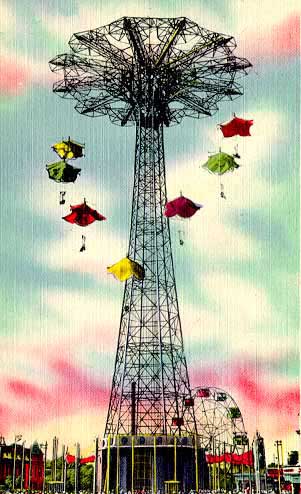
She convinced me to ride the Parachute Jump, a steel skeleton of a tower that looked like it had been designed by someone with a grudge against gravity. Two-person canvas seat. Lifted 250 feet into the sky. Dropped like a stone. Caught, eventually, by a parachute that felt more like a suggestion than a guarantee.

She said it would be fun. I said yes, mostly to impress her. It was not fun. It was terrifying. But she laughed, hugged me, and called me brave. Said it was one of the best experiences of her life. I didn’t understand how she could enjoy it. But I was falling for her faster than that drop from the tower. Before we parted, she told me: if I ever needed a safe place, she had land in West Virginia.

The Pentagon was thunder. Riverside was lightning. But Emily—Emily was shelter. In the roar of fractured movements and rising resistance, she offered stillness. Her words didn’t shout; they landed like balm. Even that wild ride at Coney Island, terrifying as it was, became a metaphor: the world drops you, but sometimes you’re caught—not by canvas or steel, but by someone who sees you.

Before we parted, she offered land in West Virginia—a place untouched by sirens or slogans. A sanctuary. And I began to wonder: maybe the revolution wasn’t just in the streets. Perhaps it was also in the quiet spaces we build with each other.

After more than fifty years, I’ve learned that quiet doesn’t always live in geography. Sometimes it’s tucked into memory, into rituals that outlast the hands that once performed them. And sometimes, it’s the comfort and warmth of remembering the people who held me when the world did not.

Maybe that’s the revolution too—not just in the streets, but in the stillness we carry forward.

And the real question is this: when the world lets you down, who catches you?

A mountain. A mouse. A friend on a grimy sidewalk. Sometimes, that’s enough.