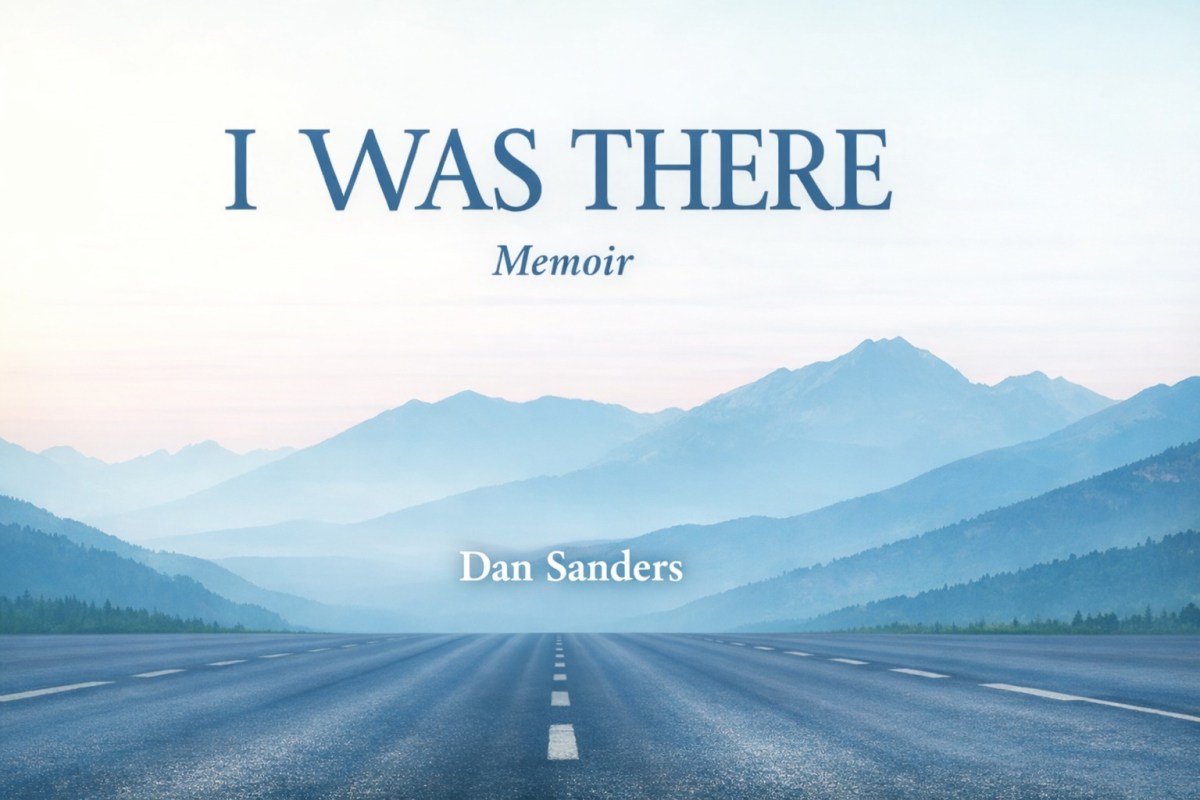
My Book, “I Was There”

This book took years. Not because I was writing every day, but because I wasn’t. I’d circle back, pick up a thread, lose it again. Life got in the way. So did doubt. So did the internet. Heck, sometimes cleaning my kitchen had to take priority. Below are a couple of sections from two of the first chapters. The book is available in both paperback and Kindle formats. You don’t need a Kindle device or a special Kindle account to read my book. Anyone can read it on a computer, phone, or tablet using either the free Kindle app or the Kindle Cloud Reader, which opens right in your web browser with no download needed.

I hope you’ll enjoy the read. Those who have read it so far have told me how much they have enjoyed it.

From Chapter 2

“Several years earlier, I had begun writing letters to my draft board. Lyndon Johnson was still president, Nixon waiting in the wings. The letters weren’t meant for Johnson, but I imagined him reading them anyway—grimacing, maybe, before tossing them aside. The draft board wrote back a few times, reminding me I was deferred under 3‑A college status. Eventually, they recalculated me as 1‑A. Combat‑ready. And I welcomed it. You can’t refuse what hasn’t been offered. I was done hiding behind loopholes.”

From Chapter 3

Inside, the induction ceremony began. The room smelled of sweat. The air was thick with the breath of boys pretending not to shake. The recruiter’s voice was flat, rehearsed, like he’d stopped listening years ago.

“Please repeat after me…”

“I do solemnly swear…”

Repeat. Repeat? Hell, I could barely breathe.

“…that I will bear true faith…”

And suddenly I wasn’t in Whitehall anymore. I was back on the football field, hearing my coach yell, “Go in hell‑bent for leather, Little Sandy!” My dad was Big Sandy. The coach used that nickname to rile me up. Hell‑bent for leather — without fear.

My heart picked up the chant until it drowned out everything else.

Then came the words: Step forward.

I sat down.”

For the whole story, follow this link https://a.co/d/016lhY1F

Rating: 1 out of 5.

My Book Has Been Released

Dan Sanders grew up on Staten Island and learned early how to navigate the edges of things—family, faith, war, and the long road toward becoming himself. He spent years in radio, activism, and community work before settling in the Boston area, where he writes about the moments that refuse to stay quiet. He lives in what he calls Rambling Harbor with his cat, Shianna, and continues to tell the stories that shaped him, one honest line at a time.

The Road to “I Was There”

It didn’t happen all at once. It wasn’t a straight shot. It was a long road — with detours, breakdowns, and a few stretches where I didn’t touch the wheel at all.

This book took years. Not because I was writing every day, but because I wasn’t. I’d circle back, pick up a thread, lose it again. Life got in the way. So did doubt. So did the internet.

But the story never left. It waited. And every time someone asked — “Are you still working on it?” or “When’s the book coming out?” — it reminded me that I was still on the road.

So thank you. To everyone who kept asking. To those who read the early chapters, who saw the fog and the mountains and said, “Keep going.”

The book is out now. It’s called “I Was There”. Because I was. And now, so are you.

And who knows what comes next — maybe that’s the best part. Maybe even another book

follow this link to the Amazon page: https://a.co/d/01jMzMsm

About Me
I’m a dreamer with some rough edges, a word‑slinger, an actor, a picture‑maker, and a guy who hangs onto the stories that don’t always behave. I write from a small harbor shaped by memory, Boston weather, and all the quiet corners where truth sits down and refuses to move.
I Was There is one road I’ve walked. There’ll be others. There always are.

Leave a comment

This site uses Akismet to reduce spam. Learn how your comment data is processed.

Rating: 1 out of 5.

Rambling Harbor — Evening Edition Ramble AKA WTF Again

Tonight’s tide brought in a story I wish I didn’t recognize.

Evening settles over the Harbor like a worn jacket, the kind you keep by the door because it knows your shape better than you do. The light goes soft, the gulls quiet down, and the world finally stops shouting long enough for you to hear the small truths rattling around in your own chest. That’s when the news found me tonight — not with a bang, but with that familiar sting that comes when history gets pushed around like furniture someone’s tired of looking at.

Another round of funding carved out of Black museums. A Black heritage sign quietly taken down in Boston, as if memory itself were something optional, something you could tuck away when it makes the wrong people uneasy. It didn’t surprise me, but it sure as hell set something off — not a blaze, just that low, steady rumble from a place that’s been paying attention for too many years.

And this isn’t the first time I’ve felt that rumble. A few years back, I resigned from an organization I’d given time and heart to. Not because I heard the man say anything — I never did. This was all online, all at a distance. But then I read he was running for political office in Texas, and one of his proud public stances was opposition to what was then being called “critical race theory.” That was enough. I didn’t need a speech or a meeting or a debate. I just knew I wasn’t going to stay in a place led by someone who wanted to shut down the teaching of systemic racism and the harder truths of American history. If the truth makes you uncomfortable, maybe the problem isn’t the truth. So I walked. Quietly. Cleanly. And I didn’t look back.

And now here we are again, only the stage is bigger, and the stakes are heavier. Grants pulled from the Massachusetts Museum of African American History because the work doesn’t “align with priorities.” Heritage markers taken down like they were never there. Museums and cultural programs frozen out because they dare to tell the story straight. And the language is always the same — “divisive concepts,” “ideological concerns,” “restoring sanity.” Whenever politicians start talking about restoring sanity, you can bet they’re about to erase something.

It’s the same old dance: erase, rename, sanitize, repeat. Pretend it’s about budgets. Pretend it’s about neutrality. Pretend it’s anything except what it is — a slow tightening of the blindfold. And the people doing the tightening always swear they’re the ones protecting us from indoctrination. Meanwhile, the museums they’re defunding are the ones holding the receipts, the records, the stories this country has spent centuries trying to bury.

And what really gets me is the déjà vu of it all. I’ve seen this movie before. I’ve walked out of rooms — and online spaces — over it. And now it’s happening on a national scale, with institutions and memory and public truth on the line. Every time someone says “critical race theory,” what they really mean is “stop telling the parts of the story we don’t like.” Every time a sign comes down, or a grant disappears, they’re hoping the story goes with it.

So here I am, evening deepening over Rambling Harbor, the tide pulling at the edges of the day, and I’m thinking about how fragile memory becomes when people in power decide it’s optional. I’m thinking about how many times we’ve had to fight just to keep the truth in the daylight. And I’m thinking about how history isn’t fragile at all — but apparently some people are.

That’s the ramble tonight. The Harbor’s quiet, but the headlines aren’t. And somewhere out there, the truth is still trying to speak, even if someone keeps reaching for the dimmer switch.

From Rambling Harbor, I ask again: what do we do now?


Leave a comment

This site uses Akismet to reduce spam. Learn how your comment data is processed.

Rating: 1 out of 5.

One of the Unrecorded

I was just doing some research on this book, and as I’ve said, I’m horrible with dates. I always have been, as they drift into ancient history, they become a lost, whirling maze of amazement and often befuddled amusement. Just now, I was looking for someone from my CCNV days, and after a multitude of different search sources and avenues, including AI, it came back.

 “You’re trying to find someone who lived in a world that didn’t preserve itself well — CCNV, Catholic Worker, Berrigan circles, early women clergy. Those people didn’t leave digital trails.”

 I laughed aloud and said in my best Robert Deniro Taxi voice, “You talkin’ to me?” I know. I’m one of them, lost to time, memory, but maybe not to history.

About a year ago, I spent several weeks with on-and-off communication with various federal agencies trying to get copies of my arrest and prison records. I started with the bureau of prisons The Bureau of Prisons stated that they do not retain records beyond ten years,  They gave me a link to the FOIA ( Freedom of Information Act) the freedom of information act said that because of my type of cases any records would most likely be held by the National Archives they may have retained documentation related to this type of case. I wrote to the National Archives, but have not heard back. I am willing to bet no one has ever tried so hard to prove they are a criminal. Even though the law I broke needed to be broken, and I still would love to see my whole records including as Arlo Guthrie put it in the song “Alice’s Restaurant”, a black and white 8 by 10 glossy.

So yeah, I did and still do live in a world that doesn’t preserve itself well.

Part of me hopes we’re not all lost to history. And part of me thinks maybe that’s the way it was always meant to go.

Leave a comment

This site uses Akismet to reduce spam. Learn how your comment data is processed.

Rating: 1 out of 5.

Morning Ramble: Bad Bunny, Kid Rock, and the Strange Weather of Culture

Morning Ramble: Bad Bunny, Kid Rock, and the Strange Weather of Culture

Some days, the cultural weather rolls in sideways, and you find yourself watching people online argue about whether Bad Bunny or Kid Rock is the “real” entertainer. This debate misses the core point: what matters isn’t which entertainer is more legitimate, but the type of culture each represents. Comparing them is like comparing a lighthouse to a lawnmower — both make noise, but only one helps you find your way home.

Bad Bunny — Benito — is out there bending sound like light through a prism, turning reggaetón, trap, pop, and whatever else he feels like into something that feels alive. He’s got Grammys, stadiums, and a global fanbase that sings in Spanish with their whole chest, even if they only understand every third word. He’s fluid, political when he wants to be, joyful when he chooses to be, and unbothered by the borders other people try to draw around him.

Kid Rock, meanwhile, is still trying to convince the world he’s the same guy from the “Cowboy” era, even though the world has rotated a few dozen times since then. The swagger hardened into shouting, the rebellion calcified into grievance, and the lyrics… well, let’s just say they don’t exactly age like wine. More like something you’d find in a forgotten cooler behind a shed.

And that’s why—let me be crystal clear—I would choose the Super Bowl halftime show over Kid Rock and TPUSA. Not out of spite or politics, but because the moment feels like a reflection on what culture can grow into, not what it leaves behind. It comes down to the music, the message, the energy—the difference between expanding the world or holding it still.

Bad Bunny writes about identity, heartbreak, joy, pride, and the messy business of being human. Kid Rock writes about… well, sometimes things you wouldn’t want on your search history. One artist is building bridges; the other is burning daylight.

But the funny thing about music is that it’s weather. It shifts. It tells you what season the culture is in. Bad Bunny is a warm front rolling in from the Caribbean, reshaping the atmosphere. Kid Rock is a cold gust from a bar that closed at 1 a.m. and forgot to turn off the neon sign.

Maybe that’s the whole point: choosing between them isn’t really about music — it’s about the kind of world we want to live in. Are we supporting a culture that grows and remixes itself, or one that clings to the past and resists change? This is the real choice at the heart of the argument.

Anyway, that’s what washed up on the harbor today. The tide brings what it brings.

Have a good morning. As the Super Bowl approaches—a time that should be about sports, not politics—I’ll keep exploring the truth about why Bad Bunny, Kid Rock, and the halftime show matter in this cultural conversation.

Leave a comment

This site uses Akismet to reduce spam. Learn how your comment data is processed.

A Message of Hope — A story about friendship, courage, and the small ways hope still finds us.

I have a friend I’ve known since 1980, someone who used to listen to my overnight radio show when she was only sixteen. She would call me in the middle of the night, and we’d talk. I remember wishing her a happy eighteenth birthday at midnight. We met many years later in a grocery store when she was in her thirties, just before Halloween, at a time when my personal life was going through struggles as my wife battled cancer. I hadn’t seen her standing there, but I guess she remembered my voice, and I heard her say with a question mark in her voice, Sanders? And I then remember the voice that had kept me company through a phone so long ago. I like to tell her it was over the Candy Corn aisle, but she denies that memory. Still, I’ve always liked the idea that hope can show up in the corniest places. We’ve remained friends ever since. And before you get the wrong idea and think you know where this is going, here’s where it takes a sharp left.

My friend has been married and has a daughter and a granddaughter. I met her daughter once, when I think she was around eight years old—a beautiful young child. That daughter is now older than her mother was when she used to call that lonely late-night DJ. My friend comes from a religious upbringing, and her daughter, through her own choices, has been pursuing a life in the ministry as a student at a local school.

Here comes that left turn again. A few days ago, I got a message from my friend saying her daughter was preparing to go to Minneapolis, Minnesota, and that she was both proud and petrified. I told her I could understand both. Of course, we all know the horror unfolding in the city.

My friend is well aware of my resistance to the Vietnam War, my time in prison for refusing induction, my involvement with Phil and Dan Berrigan, as well as my own stay in seminary and a basic life of resistance to oppression in all its ugly forms. And I know that’s one reason she chose to tell me about her daughter’s upcoming adventure.

So why am I telling you this story? Because it’s a story of hope. In this world where ugliness is all around us—where women can be shot as their last words still echo in our minds, “I’m not mad at you, dude”; where our president tries to conquer the world and tear down democracy one White House brick at a time; where someone I’ve known and worked with can try to justify what ICE is doing and justify that shooting—when I’m at my darkest and it feels like everyone has lost all sense of morality and right or wrong… out of nowhere, I got a message of hope.

This beautiful young child I met so many years ago is heading into the belly of the beast to try to influence and bear witness to the truth. And I’m sharing this with you because I have friends who feel as scared and disappointed as I have—friends who, in their own ways, have tried to bring truth and hope into the world, who want things to change and get better, and who have felt disappointed, hopeless, and lost as things just keep getting worse.

And maybe part of why this hit me so hard is because this isn’t just anyone’s daughter. This is the daughter of a woman who has been woven through almost half my life—a friend who once called a lonely late-night DJ at sixteen, who somehow stayed woven through the fabric of my life through decades of change, disappointment, and small miracles. I care what happens to her. I care what happens to her daughter. And knowing that this young woman is stepping into the world with courage, conviction, and a sense of calling… well, that felt like a comforting hand on my shoulder in a dark room.

Hope doesn’t always arrive with trumpets. Sometimes it shows up as a message from an old friend, telling you her daughter is heading into the storm because she believes in something better. She leaves on Wednesday. And for a moment—just long enough—you remember that belief is still possible, and you feel yourself steady a bit. I hope this story offers the same small steadiness to anyone who’s felt their strength wavering.

Leave a comment

This site uses Akismet to reduce spam. Learn how your comment data is processed.

Subscribing to my website is free.

Gridiron for Leg Irons

In the winter of
Nineteen hundred and sixty-four
Something was going on,
Called the Vietnam War.

But all we could hear,
At the stadium that night
Was the roar of the crowd,
As we continued our fight.

But older friends
Had joined the fray,
And died in a swamp
Many worlds away.

The play was called.
And I started my run.
As another friend died
Under the gun.

The play I remember
Was Buck-forty-five
As the government kept telling
Us, lie after lie.

Then came the day
They said I must go.
But I stood on the line and shouted
My NO!!

They locked me in chains,
Both hands and
Both feet.
But the mind of the boy
Would not face defeat.

The judge said,
Son, “What will you do?”
I said, “Your honor.
It is all up to you.”

If you think I was wrong, then
To jail, I must go.
If you believe I was right
There’s a great Broadway show.
Perhaps we could go.

And with those words
In the blink of an eye
I traded the gridiron
For leg irons
And two years
At Danbury FCI.

Rating: 1 out of 5.

Leave a comment

This site uses Akismet to reduce spam. Learn how your comment data is processed.


A Radio Christmas Remembered

The holidays always make people feel nostalgic. I know I do, even though I don’t really take part in what feels like holiday madness these days, instead of real joy. I get a kick out of the ads that promise big savings if I just spend twice as much as usual.

New Year’s Day has always been a time for me to reflect, feel grateful, and sometimes regretful. Even when I was young, there was always someone or a moment to remember. As we get older, those memories matter even more.

I haven’t done live radio since 2006, and sometimes I miss it. It’s hard not to miss something you dreamed about as a kid and finally got to do. But when I talk to friends, they remind me that radio isn’t what it used to be. Now it’s all programmed and controlled by corporations, with little room for real personalities. I was lucky to work in radio when it meant something, when underground FM was fun and creative.

I wrote the next story a few years back, but it actually happened more than 40 years ago. I’m sharing it again because it’s real and it means a lot to me. People have told me it’s one of their favorite stories, and it’s one of my favorite Christmas memories, too.

A Radio Christmas Remembered

It was a quietly magical December, around 1982. Snow was blowing outside in the middle of the night—well, 3 a.m. is hardly morning. The kind of snow that sneaks up on you, drifting quietly and getting deeper. It moved across the empty parking lot, turning this lonely spot into something like the Montana or Wyoming prairie. It was the perfect scene as Merle Haggard sang about wanting the Big City to let him go. Even though I wasn’t far from Boston, it was easy to feel cut off from the world, watching the snow shape the night. I probably wouldn’t see another person for at least three more hours. I was the only one on duty from midnight to 6 a.m. I could still see most of my car, but I wasn’t sure I’d be able to move it in the morning, even if someone could get to me.

As the keeper of the light, I stayed in touch with others who were awake during the darkest hours—the night people. I’ve always liked night people. There’s a passion in how they move through life—caring, yet often a little lonely, choosing the quiet roads and the small hours. My way of connecting with them was through a country radio station in the basement of a small strip mall in the middle of nowhere. Still, our AM signal reached far and wide, especially at night—traveling over flat land and even across the ocean, carried on the darkness. I was the only show in town, the only one playing music on the AM dial in that forgotten time zone.

About once a week, a cross-country trucker would call me. When he got to Rhode Island and picked up my signal, he’d say, “The California Kid is on the line.” This time, he wished me a Happy Holiday and, as always, asked for a few songs to help him make it to Maine. I was his companion on the road.

I also got calls from Alice. She drove all over the area, servicing ATMs, and would call once or twice a week while she worked. I never met Alice; she was a bit like the coyotes that roamed the parking lot, always staying out of sight. I called her Dallas Alice, after the Little Feat song Willin’, which I played for her every time she called.

On that snowy night, Alice called to wish me a Merry Christmas and told me to wait a few minutes, then look outside. After we hung up, I played Willin’ and walked up the steps to the door. There, already gathering snow, was a small pre-lit Christmas tree and a card that read, “Merry Christmas from Dallas Alice.” I saw her footprints in the snow. She had parked close to the entrance so she could get back to the main road quickly.

I never met Alice, but her kindness lingered long after that night. I never met the California Kid either, yet in the passion of their journeys and the gentle connections forged in the dark, we shared something rare—a caring warmth that glowed quietly in the lonely hours. On that cold, snowy night so many years ago, a woman named Alice—Dallas Alice—and a trucker called the California Kid gave me memories that still make me smile every Christmas.

Every Christmas, I remember the way we reached for each other across the airwaves—passionate, caring, and yes, a little lonely, but never truly alone.



Rating: 1 out of 5.

Leave a comment

This site uses Akismet to reduce spam. Learn how your comment data is processed.

I Was There When the Soup Was Still steaming, and now I’m steaming

Father J. Edward Guinan didn’t start a charity. He started a rebellion wrapped in mercy.

In 1970, fresh from the Paulist Council and the restless spirit of George Washington University, Guinan and a handful of students opened the Community for Creative Non-Violence (CCNV)—a communal home dedicated to radical service, protest, and poetic resistance. His vision was seismic and straightforward:
“To resist the violent; to gather the gentle; to help free compassion and mercy and truth from the stockades of our empire.”

I joined not long after being released from Danbury Federal Correctional Institution, where I’d served time for refusing induction into the Vietnam War. That refusal wasn’t just political—it was spiritual. I walked out of Danbury with a record and a rhythm, and CCNV gave me a place to put both.

We met at the Newman Center, planned protests like prayers, and fed strangers like family. The Zacchaeus Community Kitchen had just opened near the White House, and Mother Teresa—not yet a household name—came quietly to serve the first bowls of soup. She sat with the guests. That was enough.

In 1973, we launched the Hospitality House, offering medical care to the homeless. It wasn’t a clinic—it was a promise. We fed 200, sometimes 300 people a day. Seven days a week. No grants. Just grit.


By 1974, we opened Euclid House, a communal living space and organizing hub. We fasted for famine relief. We slept on floors. We argued about scripture and soup recipes. We were broke, burning with purpose, and building a sanctuary from scraps.

And now—in 2025—I find myself thinking about those days more than ever. The government is shut down. SNAP benefits are expiring. Families are forced to choose between rent and food. Shelters are full. The hunger we fought in 1973 is still here—just dressed in new bureaucracy.

And I’m mad as hell.
Not just at the politicians who play chicken with people’s lives.
But in the silence. The scrolling. The shrugging.
The way we let hunger become background noise.
Where is the outrage?
Where is the yelling on social media?
Where is the mercy?

CCNV wasn’t perfect. But it was real. It was radiant.
And I was there when the steam rose from the first pot,
when protest became presence,
and when mercy moved in.
You don’t have to go out and get arrested.
You don’t have to directly feed the hungry.
You don’t have to open your home to the homeless.
But for Christ’s sake—YELL.

Yell at the fat-cat politicians who play with poor people’s lives like it’s a game.
Yell like someone’s life depends on it.
Because it does.
Rambling Harbor is where memory meets resistance.
Where soup becomes scripture.
Where sanctuary is stitched from scraps.

I was there.
And I’m still here.
And I’m still yelling.
I’m no longer at CCNV. I’m not peeling potatoes or stirring soup.
But like in the movie Network—the one someone asked about the other day—I’m still yelling.
Through my posts. Through my websites. Through my letters to Congress.
I am yelling that I am mad as hell.
And if you’re not—
You could be.
You should be.

And for Christ’s sake, don’t tell me not to call the fat cats fat
When children are skinny from need.
I’m yelling.
And you could too.

Leave a comment

This site uses Akismet to reduce spam. Learn how your comment data is processed.

Rambling Harbor Dispatch: The Bill Comes Due

In the late 1960s, while napalm lit the skies over Vietnam, a quieter rebellion flickered across American kitchens. It wasn’t shouted in the streets—it was whispered through unpaid phone bills. The government had slapped a 10% excise tax on telephone service to help fund the war. And hundreds of thousands of citizens said, “No thanks.” They refused to pay, not out of stinginess, but out of conscience. I was one of those. They called it war tax resistance. I call it dialing into dignity.

By 1972, as many as half a million Americans were hanging up on war—literally—by withholding the tax. The IRS attempted to pursue them, once even seizing a man’s car over $2.44. That’s not enforcement. That’s bureaucratic burlesque.

Fast forward to 2025, and the bill has come due again. Only this time, it’s not for war—it’s for one man’s legal battle against the government. President Trump, facing a thicket of lawsuits, wants taxpayers to help cover the costs of his defense. The irony? It’s thicker than a Nixon tape.
In the Vietnam era, we resisted paying for bombs. Today, we’re being asked to pay for briefs. Legal briefs. Filed by a man who once promised to drain the swamp but now wants us to subsidize his wade through it.
Where’s the opt-out box on that invoice?

This isn’t just about money. It’s about memory. About whether public funds should be used to defend personal grievances. About whether the American people are shareholders in someone else’s vendetta. And about whether resistance still has a place in the age of auto-pay and algorithmic distraction.

It may be time to revive the spirit of the phone tax rebels, not with rotary dials and mimeographed pamphlets, but with satire, sanctuary, and a refusal to subsidize secrecy. Maybe it’s time to hang up again—this time on legal tab transfers disguised as patriotism.

Whether it’s $2.44 or $2.4 million, the principle remains: we should not be forced to pay for what violates our conscience.

And here’s my thought: what if you decided to withhold even $ 5 from any tax you might owe, along with a long explanation about why you are doing this? And sure, that would really make no difference, but sometimes it’s the symbolism, the meaning behind the action.

Donald Trump is reportedly seeking reimbursement of approximately $4.2 million. So, along with our $5, what if we lean on major companies? Corporate Tax Revenue: In 2024, the federal government collected roughly $425 billion in corporate income taxes.

Imagine if Apple, Amazon, and Google said: “We’re withholding 3% until Congress passes climate legislation.” Or until war funding is redirected to healthcare. And not one cent to Donald Trump’s defense. It would be the modern equivalent of hanging up on war—only this time, with billions instead of phone bills.

3% Withheld: That’s about $12.75 billion withheld.
Sure, I’m Dan Don Quixote, still maybe swinging at windmills, but this is my first thought tonight. If you have a better one, don’t hesitate to share it.

Rambling Harbor remembers. And resists.

Subscribing is FREE

Leave a comment

This site uses Akismet to reduce spam. Learn how your comment data is processed.

Matches and Money: A Sanctuary Strategy for Resistance

Tomorrow, Saturday, October 18th, is the nationwide “No Kings March”. And I’ve been beating myself silly because this time I’ve decided that I can’t go—not that I don’t want to, but that I can’t. The primary reason is that my back has been so bad this week, I’ve spent most of my time in what’s called the non-violent prone position. In this case, that means flat on my bed.

And while I was lying there, writing the great American resistance novel on my ceiling, I kept thinking about an article I’d just read by Brian Huba published in”The Hill” today, October 17th. He was talking about another form of resistance—one I’ve always believed in. The kind that hits them where it hurts: the pocketbook.

Now, I’m not pretending that my low participation in the general ebb and flow of the almighty buying power of the dollar will make much difference. And I’m not saying it can replace the power of demonstration—of people gathering to make our voices heard and to send a signal, both to each other and to the Gestapo in DC: ‘We are not alone.’

But I’ve been thinking about pressure. Not the kind that crushes, but the kind that carves. The type that reshapes stone into sanctuary. And lately, I’ve come to believe that the most potent pressure we can apply—politically, spiritually, economically—is a two-part ritual: matches and money.

Let me explain.

We’ve been taught to march. To chant. To gather in the streets with cardboard signs and aching knees. And yes, there’s power in that, and there’s power in the crowd. But maybe the real revolution isn’t in the march, but in the match? Not the kind that burns buildings. The kind that lights candles. That ignites awareness. That says: ‘I see what you’re doing, and I will not fund it.’

Because the truth is: the system doesn’t fear our voices. It loves our wallets, our money, and it fears losing them. It fears our cancellations, our divestments, our refusal to play along. When we cancel a subscription, we’re not just saving $14.99—we’re pulling a thread from the tapestry of complicity. When we stop feeding the beast, the beast gets hungry.

Brian Huba said it plainly: maybe the most radical thing we can do right now isn’t to protest in the streets, but to unsubscribe, to stop paying for platforms that profit from our pain. To match our outrage with economic consequences.

So, I’m lighting matches. Quiet ones. Symbolic ones. I’m canceling, redirecting, reimagining. I’m spending like a poet—every dollar a stanza, every boycott a verse. I’m building a sanctuary where resistance isn’t just loud, it’s strategic.

Because when matches meet money, we don’t just protest. We pressure. We don’t just speak. We shift.

And yes—I will march again.

But first, I get the MRI.

First, I listen to the good doctors—the ones I trust to tell me how to walk without pain, how to stand without flinching.

Because resistance isn’t just about showing up. It’s about showing up whole.

And when I do march again, and I will return, I’ll be carrying my flag and my banners, not just as protest, but as testimony.

Proof that healing is part of the revolution, too.

—Dan

Rambling Harbor, where even the receipts are revolutionary

Leave a comment

This site uses Akismet to reduce spam. Learn how your comment data is processed.

Introduction

I never meant to write a war story. I meant to live a life. Not the kind that ends up in textbooks or on movie screens, but the kind shaped by quiet choices—by sitting down when others stepped forward, by saying no when silence was easier. This book isn’t about the Vietnam War or the peace movement. Those stories already fill libraries. It’s not about my years behind the mic as a radio broadcaster—that came later. Nor is it about the loud ones: the noisemakers, the celebrities, the politicians, or the filmmakers chasing spotlight and legacy.

This book is about quiet defiance. About extraordinary moments tucked inside an otherwise ordinary life. Mine.

During the Vietnam War era, roughly 570,000 young men were labeled draft offenders. Of those, 210,000 were formally charged. Just 8,750 were convicted. And only 3,250 were jailed. Less than one percent. This book is about that final group—the ones history rarely names, Hollywood never casts, and textbooks barely mention. It’s about my friend Kevin, who said, when we reconnected after Daniel Berrigan’s passing in 2016, “Dan, we didn’t go after the government; they came after us. We just wanted to live our lives.” Kevin was right. We wanted to live, and we wanted the boys sent to fight in a war we didn’t choose to live also.

I’m proud to say I was one of the 3,250 who said no. We said it quietly, but loud enough to keep our souls intact while they locked up our bodies. I tell only my part of the story, but I know I’m not so different from the other 3,249. Maybe I can make a little noise for all of us.

I once asked my father what happens when we die. We were walking a dirt road in the Deep South, the heat thick as molasses. I was nine. My dad, a scientist in spirit and mind, told me energy can’t be created or destroyed—it only changes form. Since the human body is mostly energy, it too must become something else. That left me with the unsettling idea that I might not become a mighty oak, but a daffodil on the side of a hill. Maybe my life has been a long attempt to be the oak, not the daffodil. But the jury’s still out.

I never planned to oppose a war, and I certainly never intended to write a book. If I had, maybe I would’ve kept a diary—or at least some decent notes. What few I scribbled on barroom napkins or in stray notebooks are long gone, buried in some landfill. Hopefully, raising a mighty oak. But I do remember a few things.

I’ll tell you about growing up on Staten Island—football, beaches, music, and radio. A middle-class kid with few worldly cares and a head full of books. My first dream was to be a radio star. That dream shifted when friends started coming home in body bags—boys who could run, jump, and catch with the best of us, now still forever.

I’ll try to explain how a painfully shy kid found the courage to sit down instead of stepping forward at Whitehall Station—the military induction center in New York City where young men were processed for the draft. The routine was simple: They underwent a written aptitude test and a physical examination to determine fitness for service.

Based on these evaluations, they were classified (e.g., 1-A for fit, 4-F for unfit). When your name was called, you stepped forward to begin your journey into military service. But I didn’t. I sat down. I don’t know if fear buckled my knees or if I’d read somewhere that sitting was the perfect nonviolent act. Maybe it was both. Either way, that quiet refusal marked the beginning of my resistance.

I’ll take you from New York to the mountains of West Virginia, to a woman named Emily who taught me how to live off the land. Then, to a woman older than I was, with three children, about her, and the court fight for custody of her kids and one of mine. I’ll tell you about my arrest in Hollywood and the cross-country ride back to New York, escorted by U.S. marshals. And the old judge who nearly begged me to take one of his get-out-of-jail-free cards.

I’ll talk about meeting Daniel and Phillip Berrigan in prison. And how resistance didn’t end behind bars, as shown by my trips to solitary confinement for refusing to walk the prison lines. I’ll tell you about fellow inmates like Howard Hunt, G. Gordon Liddy, and Clifford Irving—and the handful of other draft and war resisters. I’ll finish with life after prison.

3,249 other stories may or may not be told. This one is mine.

Dan Sanders

July 2025

Leave a comment

This site uses Akismet to reduce spam. Learn how your comment data is processed.

Rating: 1 out of 5.